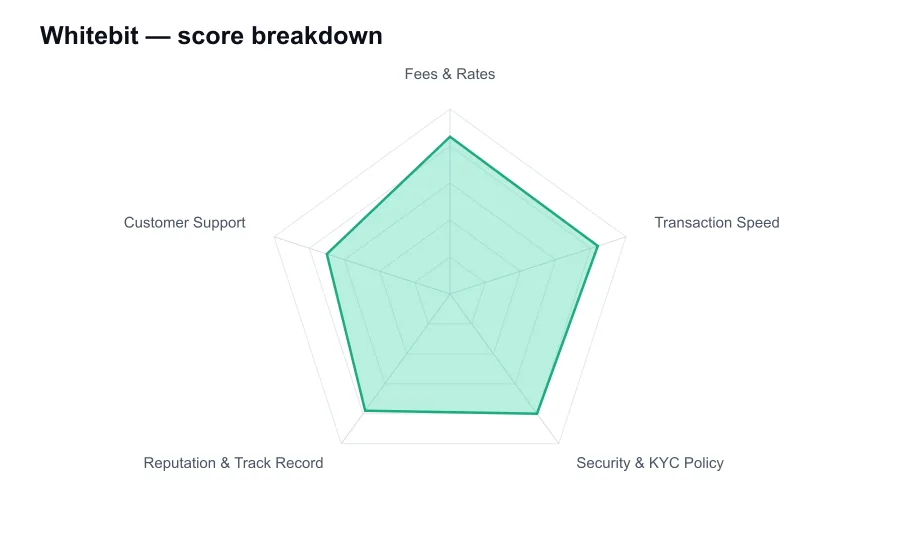
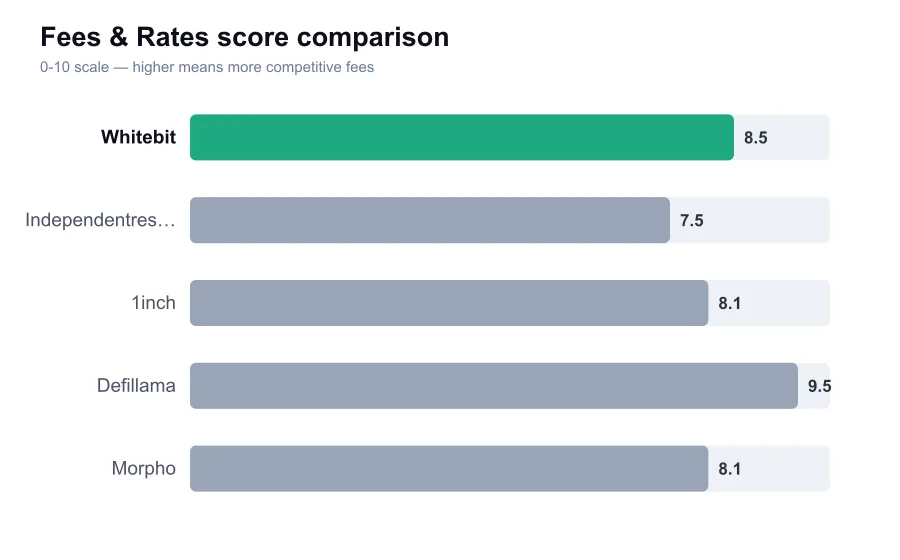
Whitebit scores 8.1/10 overall in our independent review, measured against every other provider we've compared, strongest on Fees & Rates (8.5/10) and weakest on Customer Support (7.0/10).
8.1/10 How we score →Editorial independence: our scores and rankings are produced using the fixed criteria above and are not influenced by advertisers. This is an independent ranking site and is not operated by, or affiliated with, any provider we list.
Affiliate disclosure: some links on this page may earn us a commission at no extra cost to you. This does not affect our rankings.
WhiteBIT is a centralised crypto exchange with far more substance than the typical instant exchanger. Founded in Ukraine and built into a broader European-facing product ecosystem, it offers spot trading, quick conversion tools, staking-style earning products, card and payment integrations in selected markets, and a large menu of listed assets. It is aimed at retail users who want a familiar exchange experience, but it has also pushed toward professional traders through API access, order types, and liquidity programs.
Its real advantage is that it gives users a choice. You can use a simplified conversion screen if you need convenience, or you can use the spot market and see the order book, recent trades, and available liquidity. That alone makes it easier to audit execution than with a quote-only exchanger. For anyone regularly buying or selling crypto, transparent market execution is a better habit than accepting an opaque conversion rate.
The base spot fee is commonly advertised at up to 0.1 percent for both maker and taker trades, with lower rates available through fee-tier arrangements and specific programs. That is competitive. It puts WhiteBIT in the same broad low-fee conversation as Binance's standard spot pricing, though final cost always depends on the pair, account level, and any current promotion. A trader who uses limit orders can often obtain a clean and inexpensive execution.
The fee picture gets less tidy at the edges. Fiat deposits and withdrawals are determined by the chosen payment provider and country, while crypto withdrawal costs depend on the asset and network. Those charges can change with network conditions. The instant exchange function is convenient but should not be assumed to match the best order-book price. For a meaningful trade, I would compare the conversion quote with a limit order before clicking confirm.
WhiteBIT performs well on speed where a centralised exchange should perform well. Internal trading is near immediate, orders execute as soon as they meet available liquidity, and transfers between WhiteBIT users can be very fast. Deposits and withdrawals are constrained by the blockchain and the exchange's confirmation rules, not by the matching engine. A busy Bitcoin network will still be a busy Bitcoin network, whatever platform you use.
The platform's liquidity is usually sufficient for mainstream pairs, especially USDT markets and major assets such as BTC, ETH, SOL, and stablecoins. That does not mean every listed token has deep books. Smaller altcoins can show wider spreads and thinner depth, so market orders deserve caution. This is where WhiteBIT is better than an instant exchanger, because the customer can see the conditions rather than discover them after a quote is locked.
Security is a more serious part of the WhiteBIT package than it is at most small swap sites. The exchange provides standard account protections including two-factor authentication, device and session management, withdrawal-address controls, and anti-phishing features. WhiteBIT has also publicised cold-storage practices and security-oriented partnerships. Those measures are valuable, but users should remember the central fact of exchange custody: the platform holds the keys, not you.
WhiteBIT's compliance policy is also not optional. Identity verification is required for normal access to the full service, and the exchange operates AML controls in line with its regulated-market ambitions. That will frustrate people searching for a no-KYC venue, but it is more predictable than the ambiguous conditional verification common at small exchangers. A legitimate customer should expect to provide accurate identification and potentially answer enhanced due-diligence questions for unusual activity.
The downside of a compliance-first approach is that account restrictions can be stressful and slow to resolve. This is not unique to WhiteBIT. Every large centralised exchange has complaints from users whose withdrawals or accounts were reviewed. The fair test is whether the exchange gives a coherent reason, asks for proportionate evidence, and resolves the matter through a traceable support process. Never deposit funds that you need to move anonymously or immediately if you cannot complete KYC.
WhiteBIT's reputation is meaningfully stronger than that of small exchange-only services. It has operated since 2018, has a visible brand, partnerships, a developed product range, and a sizeable user base. It has also been active during a difficult period for Ukraine, which has given its identity and public profile a degree of visibility that anonymous exchanger brands do not have. That said, visibility is not the same as immunity from operational problems or market risk.
I would not exaggerate the case. WhiteBIT is not in the same category as a publicly listed, heavily scrutinised Western exchange with a long record of public financial reporting. Crypto exchanges remain higher-risk custodians than self-custody, and users should not interpret an exchange's security marketing as deposit insurance. Keep trading capital on-platform if you must, but move long-term holdings to a wallet you control.
Support is available through the platform's help centre and customer-service channels, with a generally more formal knowledge base than a small exchanger can provide. That is a real plus for routine account, deposit, and trading questions. The common weakness, reflected across the exchange industry, is that complex compliance or account-access cases can feel slow because frontline agents cannot simply override a risk decision. Documentation and patience matter.
WhiteBIT is particularly approachable for a user moving from a card purchase app into actual crypto trading. The interface is less intimidating than some professional venues, yet it offers enough tools to learn limit orders, stop orders, and basic portfolio management. The risk is that the wide asset selection can tempt newcomers into illiquid tokens and high-risk products before they understand them. A clean interface doesn't make speculative trading safe.
For an active trader, the exchange is strongest in spot markets, fee competitiveness, and usable execution controls. I would be more selective about derivatives or yield products, where the risks rise sharply and product availability changes by jurisdiction. Read the exact terms, understand liquidation mechanics where applicable, and do not confuse an advertised return with a bank deposit. That is basic discipline, but it matters more in crypto than in almost any other retail market.
WhiteBIT is a credible choice for verified retail users who want a low-cost spot exchange with more functionality than a swap service. It is not ideal for privacy-focused users, those unable to pass identity checks, or anyone seeking a self-custody substitute. The exchange has earned a better reputation than most regional competitors, but its strongest use case remains straightforward: buy, trade, and withdraw carefully. Use two-factor authentication, whitelist withdrawal addresses, and keep only working capital on the platform.
My final take is positive, with limits. WhiteBIT offers competitive spot fees, visible trading conditions, serious account-security tools, and a much more established operating history than the small exchanger brands in this comparison. Its required KYC and centralised custody are not minor caveats, they define the product. For users comfortable with those terms, it is one of the more practical European-oriented exchange options. For long-term asset storage or anonymity, look elsewhere.
| Criterion | Score (0-10) | Notes |
|---|---|---|
| Fees & Rates | 8.5 | Spot trading fees are commonly up to 0.1%. |
| Transaction Speed | 8.4 | Fast matching engine and solid major-pair liquidity. |
| Security & KYC Policy | 8.0 | KYC, 2FA, withdrawal controls, and cold-storage practices. |
| Reputation & Track Record | 7.8 | Operating since 2018 with a visible market presence. |
| Customer Support | 7.0 | Strong help resources, slower on complex compliance cases. |
| Pros | Cons |
|---|
WhiteBIT commonly lists standard spot fees of up to 0.1% for maker and taker trades. Rates can vary by program, account conditions, and product, so check the live fee schedule.
Yes. WhiteBIT uses identity verification and AML controls for access to its services. Users should expect to submit valid identification and, in some cases, further compliance information.
It has meaningful security controls, but it remains a custodial exchange. For long-term holdings, a self-custody wallet where you control the recovery phrase is the safer model.
Processing speed depends on the asset, network, risk checks, and confirmation requirements. Internal trades are immediate, while blockchain withdrawals can take from minutes to longer during congestion.
| Alternative | Score |
|---|---|
| Independentreserve Review | 8.1/10 |
| 1inch Review | 8.2/10 |
| Defillama Review | 8.2/10 |
| Morpho Review | 8.0/10 |
| Kamino Review | 7.8/10 |
| Liquity Review | 7.8/10 |