
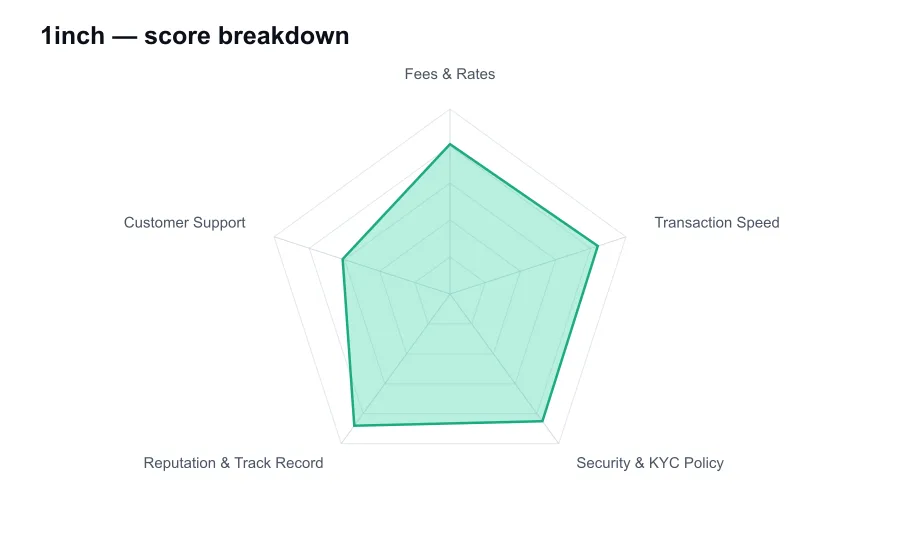
1inch scores 8.2/10 overall in our independent review, measured against every other provider we've compared, strongest on Reputation & Track Record (8.8/10) and weakest on Customer Support (6.1/10).
8.2/10 How we score →Editorial independence: our scores and rankings are produced using the fixed criteria above and are not influenced by advertisers. This is an independent ranking site and is not operated by, or affiliated with, any provider we list.
Affiliate disclosure: some links on this page may earn us a commission at no extra cost to you. This does not affect our rankings.
1inch is not a conventional crypto exchange. It is a decentralized exchange aggregator and liquidity-routing protocol, built for users who want to swap tokens from their own wallet rather than deposit funds with a company. That distinction is central to the review. 1inch does not generally hold a customer balance like Coinbase or Binance. It searches supported decentralized liquidity sources and tries to assemble an efficient route for a swap, often splitting an order across more than one pool.
That architecture puts 1inch near the top of the DeFi routing market. A trader connects a wallet such as MetaMask, Rabby, or a hardware-wallet interface, selects tokens and a network, approves the token if necessary, then signs the transaction. The user keeps custody until the smart contract executes. For experienced DeFi users, that is a major advantage. For a beginner, it means there is no customer-service safety net for a wrong address, bad approval, fake token, or careless signature.
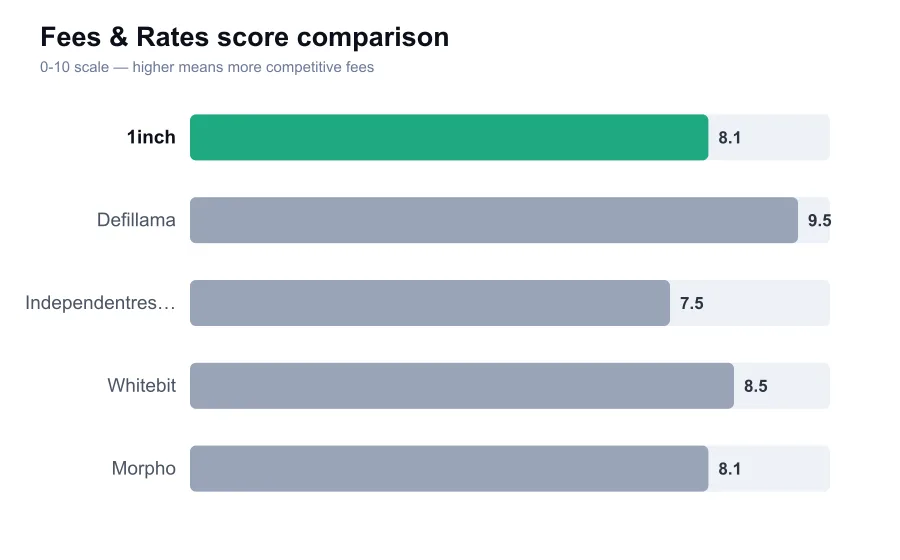
Fees need to be understood in layers. 1inch may show a highly competitive swap quote, but the transaction still incurs network gas, liquidity-provider fees embedded in pool pricing, and price impact. On Ethereum mainnet, gas can dwarf the value of a small trade during congestion. A swap that looks almost free at the protocol interface can become expensive once wallet confirmation appears. This is not unique to 1inch, but it is a reason to judge the actual transaction cost rather than marketing around aggregation.
The routing engine is 1inch's strongest feature. Instead of accepting the price from a single automated market maker, the protocol can compare or combine available liquidity. For a meaningful ERC-20 swap, that can reduce slippage versus trading directly on one pool. The benefit is most visible in fragmented liquidity or larger orders. For a tiny swap of a widely traded token, the difference may be negligible, and gas or an extra approval transaction may erase the advantage.
The interface provides estimated output, price impact, gas information, and route details, though users should still read what they sign. Quotes change before a transaction lands, and slippage tolerance can determine whether a transaction succeeds or fails. Setting it too tight leads to failed transactions that still consume gas. Setting it recklessly wide can produce a poor fill in a volatile or thin market. There is no universally safe percentage. Stable, liquid pairs and illiquid meme tokens are not comparable cases.
Speed is governed more by the selected chain than by 1inch itself. On networks such as Arbitrum, Base, Polygon, or BNB Chain, a swap can settle in seconds or a few minutes depending on the network and wallet fee setting. Ethereum mainnet may take longer under load. Once the transaction is confirmed, settlement is onchain, not dependent on an operations team opening a ticket. That is a real speed advantage over a manual exchanger, but blockchain finality is not the same thing as guaranteed convenience.
1inch has expanded beyond a simple swap screen through products and protocol components such as limit-order functionality, Fusion-style intent-based trading, and cross-chain options where available. These tools can improve execution, especially for users who dislike manually managing gas for every interaction. They also add complexity. A user needs to understand whether an order is an onchain transaction, an offchain signed intent, or a bridge-related process. More sophisticated execution does not remove smart-contract and bridge risk.
Security is strong in one sense and demanding in another. The protocol is a prominent DeFi project with public code, substantial usage, audits, and a long operating history relative to most decentralized applications. Its non-custodial design removes the classic risk of an exchange freezing a deposited account or suffering a direct custodial shortfall. Yet users still depend on smart contracts, wallet security, front-end integrity, token-contract accuracy, and their own transaction review. Self-custody transfers responsibility, it does not eliminate risk.
The most common danger is not an attack on 1inch itself. It is phishing. Fake 1inch pages, malicious wallet prompts, and deceptive token names are persistent threats. Use the official domain, verify the connected network, and inspect approvals. Revoke unnecessary token approvals periodically with a reputable approval-management tool. Hardware wallets are sensible for meaningful balances, although they do not protect someone who confirms a malicious transaction without reading the device screen.
KYC is not normally required for the core decentralized swap experience because a wallet address, rather than an account profile, interacts with the protocol. That should not be confused with immunity from compliance controls elsewhere. A fiat on-ramp, centralized partner, sanctioned-address screening, or regional service restriction can bring different rules. Also, blockchain transactions are public. No-KYC access means less identity collection by the interface, not private money or invisible activity.
1inch's reputation is far stronger than that of a typical anonymous swap site. It has been a recognizable DeFi brand since 2019 and has survived multiple market cycles, protocol changes, and intense competition from Uniswap, CoW Swap, Paraswap, and others. That track record counts. Still, token holders, governance participants, and API users should distinguish the 1INCH token and broader ecosystem from the simple act of using the aggregation interface. A recognizable brand is not a guarantee that every product path is low risk.
Customer support is deliberately limited compared with a centralized exchange. There is documentation, community support, social channels, and developer material, but there is no practical mechanism to reverse a confirmed onchain swap. If a transaction fails, support may help explain the cause, yet it cannot refund gas burned by the network or recover assets sent to the wrong place. This makes 1inch unsuitable for people who expect a human agent to repair routine user errors.
For a DeFi-literate trader, 1inch is often one of the first places to check before swapping a sizable token position. Its aggregator model is genuinely useful and can produce better execution than blindly using a single automated market maker. I particularly like it for comparing routes on a supported low-fee chain and for wallet-to-wallet trading where custody matters. It is less compelling for tiny Ethereum swaps, first-time crypto buyers, or anyone who finds approvals and gas settings intimidating.
My final judgment is positive, with a sharp boundary around who should use it. 1inch is among the better established decentralized routing tools and deserves its strong score for execution design, self-custody, and market standing. It is not cheap in every situation, because gas and liquidity costs remain real, and it cannot offer the hand-holding of a centralized broker. If you understand wallet security and verify every signature, it is a serious tool. If you do not, learn with small amounts first or use a regulated exchange's simple-convert feature.
| Criterion | Score (0-10) | Notes |
|---|---|---|
| Fees & Rates | 8.1 | Competitive routing, but gas and price impact still apply |
| Transaction Speed | 8.4 | Onchain settlement follows the selected network |
| Security & KYC Policy | 8.5 | Non-custodial design, smart-contract risk remains |
| Reputation & Track Record | 8.8 | Established DeFi protocol since 2019 |
| Customer Support | 6.1 | Good documentation, no reversal of onchain mistakes |
| Pros | Cons |
|---|
Core wallet-based swaps generally do not require a conventional account KYC process. Fiat partners, regional restrictions, and third-party services can have separate rules.
The cost can include network gas, liquidity-provider fees, price impact, and sometimes token approvals. Ethereum mainnet gas is often the largest item.
No. Confirmed blockchain transactions are normally irreversible. Support cannot retrieve funds sent to a wrong address or undo a signed swap.
| Alternative | Score |
|---|---|
| Defillama Review | 8.2/10 |
| Independentreserve Review | 8.1/10 |
| Whitebit Review | 8.1/10 |
| Morpho Review | 8.0/10 |
| Kamino Review | 7.8/10 |
| Liquity Review | 7.8/10 |