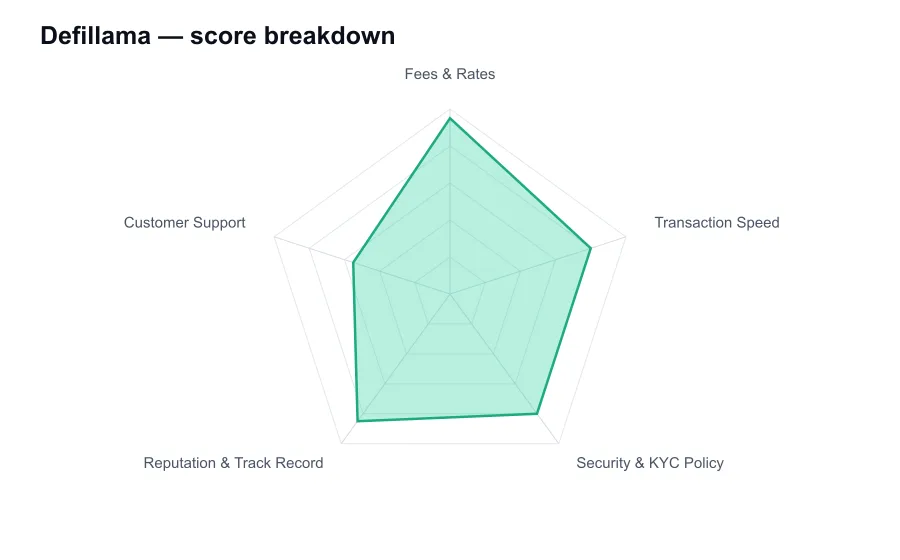
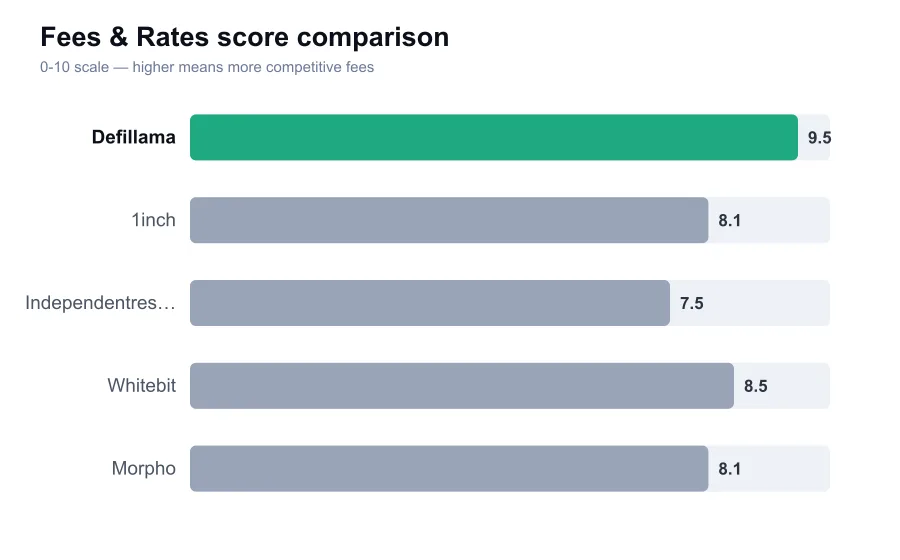
Defillama scores 8.2/10 overall in our independent review, measured against every other provider we've compared, strongest on Fees & Rates (9.5/10) and weakest on Customer Support (5.5/10).
8.2/10 How we score →Editorial independence: our scores and rankings are produced using the fixed criteria above and are not influenced by advertisers. This is an independent ranking site and is not operated by, or affiliated with, any provider we list.
Affiliate disclosure: some links on this page may earn us a commission at no extra cost to you. This does not affect our rankings.
DefiLlama is not an exchange in the conventional sense, and that distinction matters before any score is assigned. It is a crypto data and analytics platform best known for tracking total value locked, protocol activity, yields, bridges, stablecoins, fees, revenue, and chain level metrics. People use it to research where liquidity is, not to hand DefiLlama coins for custody or execute a normal spot trade.
That makes a direct comparison with Curve, EasyBit, Coinbase, or Kraken imperfect. DefiLlama does offer tools that can direct users toward swaps, bridging options, and yield opportunities, but its central product is information. Its value is in helping users see through marketing claims and locate underlying on chain data. A trader who mistakes it for a regulated exchange will have the wrong expectations from the start.
The strongest point is its free access. Core dashboards, protocol pages, historical charts, chain rankings, yield listings, and many research tools are available without paying a retail subscription. There is no conventional trading commission because DefiLlama is not taking the other side of your trade. That makes its fee score look unusually high, but only because the service operates in a different category.
Users should still be careful with the word free. If DefiLlama sends you to a DEX, bridge, or yield protocol, that external service has its own swap fee, slippage, gas cost, bridge charge, and smart contract risk. A yield table can help compare opportunities, but it cannot make a risky farm safe. The attractive number on a dashboard is a starting point for due diligence, not an investment recommendation.
DefiLlama's data coverage is broad enough to be genuinely useful. It tracks hundreds of protocols across a large range of chains and has become a common reference point for journalists, researchers, DAO contributors, and DeFi users. The interface makes it easy to move from a chain level TVL chart to a protocol page, then to yields or revenue data. That speed of exploration is where the product shines.
Data freshness is generally strong for a free public service, but users should not assume every figure is a real time trading signal. On chain data ingestion, API updates, protocol methodology, token pricing, and classification choices can all affect a displayed number. During extreme market volatility, a dashboard may lag the exact state of a pool or protocol. For execution decisions, check the actual protocol and current on chain quote as well.
The platform has built credibility through transparency and a relatively restrained presentation. It doesn't try to sell every listed protocol as the next big thing. In a market full of paid placements, questionable yield rankings, and affiliate driven review pages, that matters. DefiLlama has earned a reputation as one of the more useful public data sources in DeFi, though no aggregation site should be treated as an infallible oracle.
There have been public governance and branding tensions around the DefiLlama project in the past, including a widely discussed dispute in 2023 involving a proposed token and control of the website. The episode highlighted a problem common in crypto projects, namely that a familiar brand can obscure internal governance questions. The platform continued operating, but users should recognize that even a data provider can have organizational risks behind the interface.
Security is not about exchange custody here because DefiLlama does not normally hold customer balances. You can browse most of the site without connecting a wallet or submitting KYC documents. That sharply reduces the usual exchange risks of frozen withdrawals, account takeover, and leaked identity documents. It does not eliminate phishing risk. Scammers regularly imitate well known crypto brands, and a fake link can lead users to a malicious wallet prompt.
The safest way to use DefiLlama is as a research layer. Read the methodology, open the official links carefully, verify contracts through the destination protocol's documentation, and avoid treating a yield ranking as an endorsement. The site can tell you that capital is in a protocol and that a headline APY exists. It cannot decide whether the token economics, audits, leverage, counterparty structure, or smart contract design are acceptable for you.
DefiLlama's lack of KYC is normal for a public analytics website. It is privacy friendly because you can research without creating a profile. It also means the platform cannot provide the sort of personalized account security controls seen at a centralized exchange. That is not really a defect. It is simply evidence that this is a public data utility, not a broker or custodian.
Support is adequate for a technical, open web product but not especially consumer oriented. Documentation, social channels, GitHub activity, and public communication are more relevant than a ticket desk. If a metric looks wrong, a user may be able to raise the issue publicly, but there is no expectation that an agent will walk a novice through a wallet transaction. The product is built for self directed research.
For researchers, DefiLlama is one of the first tabs worth opening. It provides a faster map of DeFi than manually visiting dozens of protocol sites, and its tools are good enough to reveal whether a project has meaningful adoption or merely loud marketing. For users chasing yields, it is helpful precisely because it makes comparison easy. That convenience can also encourage superficial decision making if people stop at the ranking.
I would not score DefiLlama down for failing to behave like an exchange, but I would strongly reject any framing that presents it as one. It has no deposit and withdrawal process, no order book, no standard transaction settlement service, and no exchange style dispute handling. Its transaction speed is really data delivery speed, while its security profile is mostly about the safety of the research workflow and the third party protocols users may discover.
My take is uncomplicated. DefiLlama is a high quality free research product that deserves its strong standing in DeFi, but it is not a venue to trust with execution or custody because it is not built for either role. Use it to ask better questions before moving money. If an investment thesis rests only on a TVL chart or a high APY shown on DefiLlama, the research is not finished.
| Criterion | Score (0-10) | Notes |
|---|---|---|
| Fees & Rates | 9.5 | Core analytics are free, no exchange commission |
| Transaction Speed | 8.0 | Fast dashboards, but not an execution venue |
| Security & KYC Policy | 8.0 | No custody or KYC, third party links need care |
| Reputation & Track Record | 8.5 | Widely used DeFi data source with broad coverage |
| Customer Support | 5.5 | Community and technical channels, limited handholding |
| Pros | Cons |
|---|
DefiLlama is primarily an analytics platform, not a traditional exchange. It may surface routes or links to external services, but those services handle any actual transaction.
Its main dashboards are free to use. If you follow a link to a DEX, bridge, or yield protocol, that separate service may charge trading, network, or bridge fees.
No KYC is generally required to browse its public analytics. Avoid connecting a wallet unless you understand exactly what a connected feature requests.
| Alternative | Score |
|---|---|
| 1inch Review | 8.2/10 |
| Independentreserve Review | 8.1/10 |
| Whitebit Review | 8.1/10 |
| Morpho Review | 8.0/10 |
| Kamino Review | 7.8/10 |
| Liquity Review | 7.8/10 |