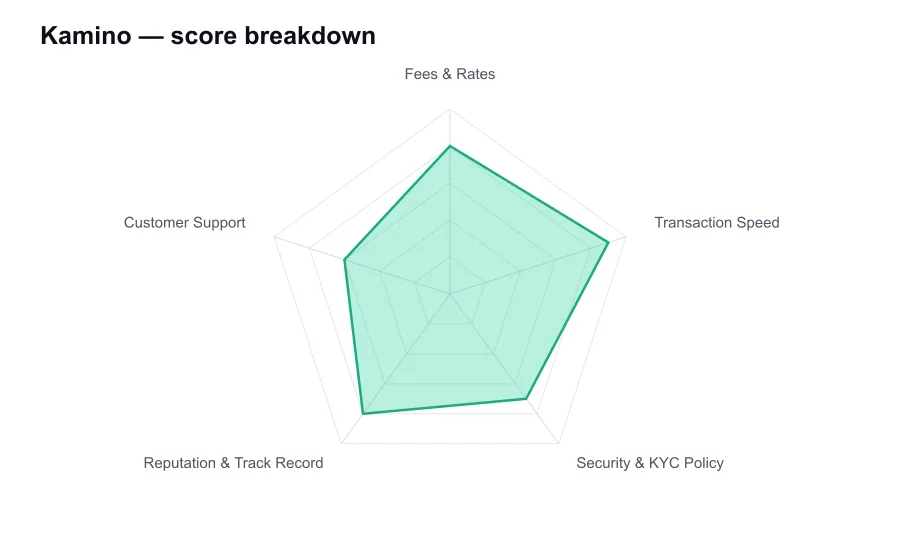
Kamino scores 7.8/10 overall in our independent review, measured against every other provider we've compared, strongest on Transaction Speed (9.0/10) and weakest on Customer Support (6.0/10).
7.8/10 How we score →Editorial independence: our scores and rankings are produced using the fixed criteria above and are not influenced by advertisers. This is an independent ranking site and is not operated by, or affiliated with, any provider we list.
Affiliate disclosure: some links on this page may earn us a commission at no extra cost to you. This does not affect our rankings.
Kamino is not a conventional centralized crypto exchange. It is a Solana-based DeFi protocol that combines lending, borrowing, liquidity provision, automated vault strategies, and swap-related functionality in one interface. That distinction changes how it should be reviewed. There is no customer-service desk safeguarding a forgotten password, no bank transfer rail, and no familiar exchange account holding your assets for you. You interact through a self-custodied Solana wallet and bear the responsibilities that come with that.
Within Solana DeFi, Kamino has become a significant product rather than a novelty. Its lending markets and automated liquidity vaults are designed to make complex on-chain strategies more accessible, especially for users who would otherwise have to manage concentrated liquidity positions manually. It is part of a broader Solana ecosystem that includes protocols such as Jupiter, Marinade, Drift, MarginFi, and Jito. Kamino's attraction is that it packages several capital-efficiency tools into a relatively polished interface.
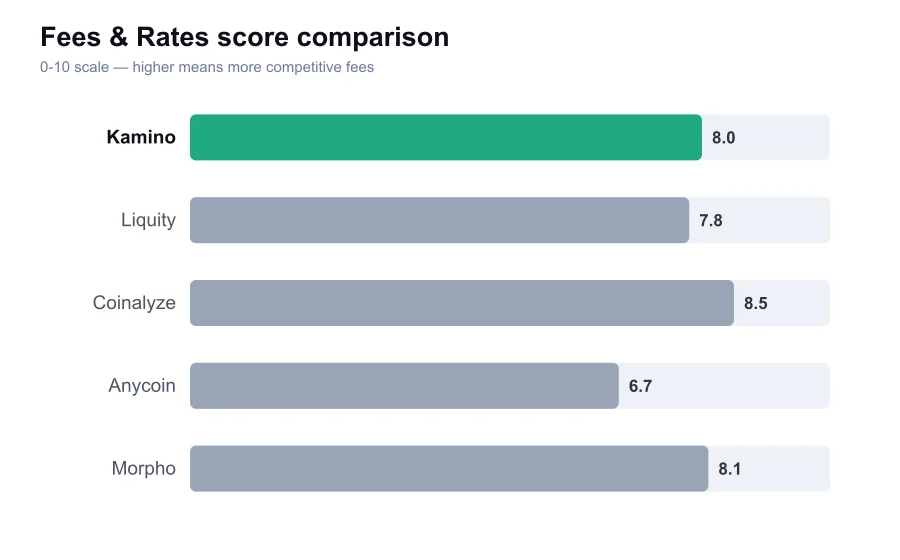
The fee question is more complicated than it is at a normal exchange because there is no single flat trading commission. A user may pay Solana network fees, swap fees and price impact, borrow interest, reserve factors embedded in lending markets, and vault or strategy fees where applicable. Each action can have a different cost structure. That can be efficient, especially on Solana where base transaction fees are generally very low, but it demands more attention than a simple 0.25 percent spot fee.
For a basic swap or position adjustment, the network component is usually tiny compared with Ethereum mainnet. Solana's low fees are one of Kamino's strongest practical advantages. Yet users should not confuse cheap blockchain fees with cheap execution. A large trade through shallow liquidity can still suffer material price impact, and a sophisticated vault may charge management or performance-related fees according to its documented parameters. Read the transaction preview and vault details, because the cheap click is not always the cheap trade.
Borrowing is where the economics become especially important. Kamino Lend lets users deposit supported assets as collateral and borrow other supported assets against them. Interest rates are dynamic, driven by utilization and market conditions. That is useful because rates respond to demand, but it means a position that looked affordable last week may become expensive as utilization rises. Borrowers should monitor annualized rates, collateral value, loan value, liquidation threshold, and health factor rather than focusing only on the amount borrowed.
Leverage is not hidden in DeFi, but it can still surprise people. Borrowing stablecoins against SOL, then buying more SOL, creates amplified exposure even if every individual transaction is clear. A falling collateral price can rapidly reduce the account's health. If the threshold is crossed, liquidation bots may repay debt and seize collateral according to protocol rules. There is no human support agent who can pause the market because a user was asleep. Kamino is powerful precisely because it is automated, and that automation is unforgiving.
Its speed is excellent by the standards of on-chain finance. Solana transactions normally settle in seconds, and that feels dramatically faster than waiting for Ethereum blocks or a centralized exchange's internal withdrawal queue. Kamino's interface is responsive for routine actions, while wallet confirmation remains the key moment where users need to check what they are signing. During periods of Solana congestion, RPC trouble, validator issues, or volatile markets, the experience can deteriorate. Fast chains are not immune to failed or delayed transactions.
Kamino also benefits from Solana's composability. Deposited assets, liquid staking tokens, stablecoins, and liquidity positions can interact with a wider ecosystem without requiring a withdrawal to a separate custodial venue. This is useful for experienced users moving capital between lending, swaps, and yield strategies. It also creates connected risk. An oracle issue, a depeg, a compromised token, a malfunctioning wallet extension, or a stressed liquidity pool can affect a position even if Kamino's own application is functioning exactly as intended.
Security should be assessed in layers. Kamino is a smart-contract protocol, so users face contract risk rather than the familiar risk of an exchange employee mismanaging a custodied wallet. The protocol has undergone security reviews and has built a serious profile in Solana DeFi, but audits are not insurance and a long period without an exploit is not proof of future safety. Every deployed program, oracle dependency, admin permission, and integrated asset remains part of the attack surface.
Self-custody is an advantage if you understand it. Funds are controlled through your wallet, not an exchange login, and you can inspect transactions on Solana explorers. The downside is absolute responsibility. A malicious signature, a drained wallet, a leaked seed phrase, or a transaction sent to the wrong address generally cannot be reversed. Use a dedicated wallet, a hardware wallet where supported, and separate long-term holdings from DeFi collateral. Never connect the wallet containing your entire portfolio to every new application.
Kamino does not impose conventional KYC for ordinary direct protocol access. That is expected for permissionless DeFi, and it is attractive to users who do not want to open a centralized exchange account. It does not remove legal, tax, sanctions, or reporting obligations. Local rules still apply, and interface providers, stablecoin issuers, or front ends may restrict jurisdictions. Users should avoid the fantasy that no-KYC means no responsibility. On-chain activity is often highly traceable even when it is not tied to an exchange profile.
Reputation is strong within the Solana DeFi community, though it is still a protocol in a young and rapidly changing sector. Kamino has built meaningful usage and recognition by focusing on useful lending and liquidity products rather than empty token marketing. Its reputation is better than that of a newly launched yield farm, but it should not be confused with the safety profile of a regulated bank. The history of DeFi is full of respected protocols hit by smart-contract exploits, oracle failures, governance mistakes, or market cascades.
Support is appropriately community-led but weaker than centralized exchange support. Documentation, Discord, social channels, and protocol announcements can help users understand how a feature works. They cannot recover an erroneous transaction or reverse a liquidation. That is the core trade-off. Users who want direct help with account access, a telephone number, or someone to manually investigate a transfer will find the DeFi model frustrating. Kamino is built for people prepared to read documentation before putting capital at risk.
The user experience has improved the accessibility of complicated strategies, but polished design can create dangerous confidence. Automated liquidity vaults make concentrated liquidity easier to access, not risk-free. Returns can fluctuate, liquidity may become one-sided, rewards can change, and the underlying token pair can decline. Lending supply positions are usually simpler, yet stablecoin depegs, borrow demand, and protocol risks still matter. Start with an amount small enough to learn from, and understand the unwind path before opening any position.
Kamino is best for knowledgeable Solana users who want capital efficiency, fast settlement, and self-custodied access to lending or managed liquidity strategies. It is not an ideal first crypto app. Beginners should first learn wallet security, token approvals, borrowing mechanics, liquidation risk, and how to verify URLs. My view is positive but firm: Kamino is one of the better-developed tools in its niche, yet its sophistication is a reason for caution, not a reason to skip due diligence. Use it deliberately, not as a savings account with a prettier interface.
| Criterion | Score (0-10) | Notes |
|---|---|---|
| Fees & Rates | 8.0 | Low Solana network fees, strategy costs vary |
| Transaction Speed | 9.0 | Solana transactions usually settle within seconds |
| Security & KYC Policy | 7.0 | Self-custody and audits, but smart-contract risk remains |
| Reputation & Track Record | 8.0 | Established presence in Solana DeFi |
| Customer Support | 6.0 | Documentation and community help, no transaction reversals |
| Pros | Cons |
|---|
Direct interaction with the protocol generally does not involve conventional exchange-style KYC. Users still need to comply with laws, tax rules, and any restrictions that apply in their jurisdiction.
Yes. Borrowed positions can be liquidated if collateral value falls or debt grows enough to breach the relevant liquidation threshold. Monitor your health factor and leave a meaningful buffer.
Solana network fees are typically low, but total cost can also include swap price impact, borrow interest, and vault or strategy fees. Check the relevant transaction and product details.
Usually no. Blockchain transactions and liquidations are generally irreversible. Support and community channels can explain the protocol, but they cannot restore funds after an incorrect signature.
| Alternative | Score |
|---|---|
| Liquity Review | 7.8/10 |
| Coinalyze Review | 7.8/10 |
| Anycoin Review | 7.8/10 |
| Morpho Review | 8.0/10 |
| Exolix Review | 7.6/10 |
| Trocador Review | 7.6/10 |