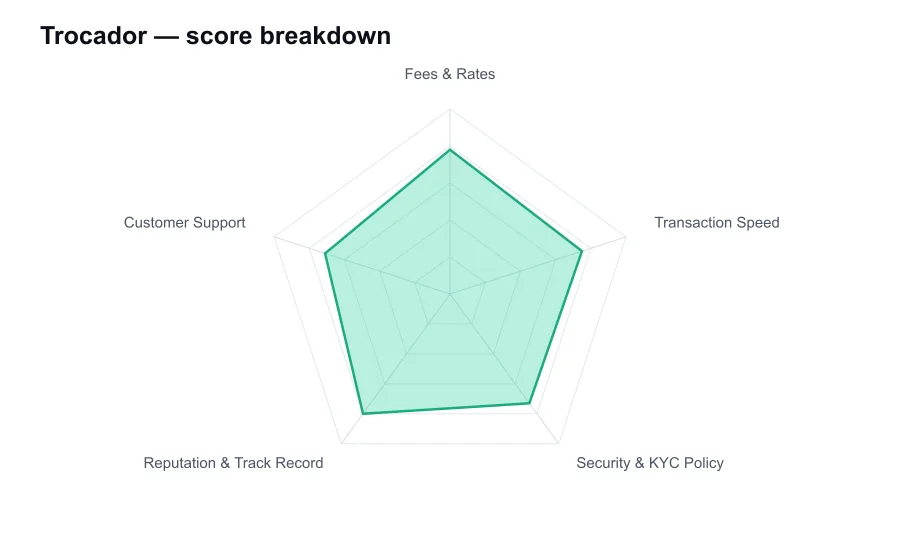
Trocador scores 7.6/10 overall in our independent review, measured against every other provider we've compared, strongest on Reputation & Track Record (8.0/10) and weakest on Customer Support (7.1/10).
7.6/10 How we score →Editorial independence: our scores and rankings are produced using the fixed criteria above and are not influenced by advertisers. This is an independent ranking site and is not operated by, or affiliated with, any provider we list.
Affiliate disclosure: some links on this page may earn us a commission at no extra cost to you. This does not affect our rankings.
Trocador is a crypto exchange aggregator built for users who would rather compare instant swap providers than open accounts at a centralized exchange. It does not operate like a traditional custodial trading venue with an order book and permanent customer balance. Instead, it presents offers from third party exchange partners, lets the user choose a route, and is designed around direct wallet to wallet conversion. Its closest peers include ChangeNOW, SimpleSwap, SwapSpace, StealthEX, and other instant exchange aggregators.
That model has a clear virtue. You can exchange one coin for another without registering for a conventional account, learning a trading terminal, or leaving funds on a platform after the transaction. For a user who holds their own bitcoin, monero, litecoin, or stablecoins and needs a quick conversion, Trocador can be a genuinely practical tool. It has also built a reputation among privacy conscious users by supporting routes that many mainstream exchanges avoid.
The first thing to understand is that Trocador is an aggregator and the chosen partner matters. The offer screen may list multiple providers, each with a different rate, estimated arrival time, available reserve, rating, and fixed or floating rate option. Trocador's value is not simply that it performs a swap. Its value is giving the user a choice instead of forcing one opaque exchange route.
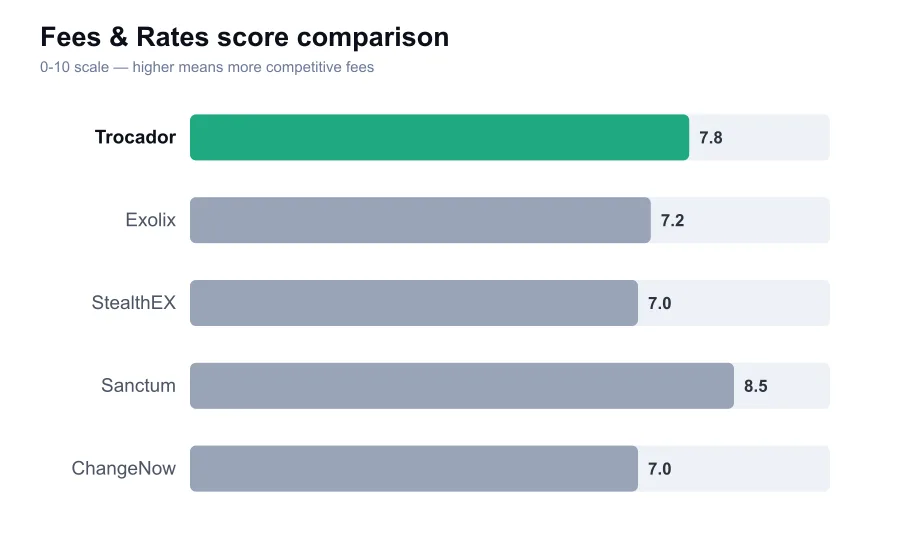
Fees are fairly presented for this type of service, but they still require attention. Trocador applies a small service fee, commonly displayed around 0.5 percent for standard swaps, while partner pricing includes its own spread and execution economics. The platform has also promoted a loyalty style program, Premium Trocador, which can reduce the service fee for users who meet its requirements. The exact final cost is always the quoted output relative to market, not the fee percentage in isolation.
For ordinary conversions, Trocador is often competitive, especially because it exposes several offers in one place. It is not consistently the cheapest route. A direct swap at a liquid exchange, a decentralized exchange on the same network, or an individual provider's own website may occasionally produce a better result. Trocador's comparison tool saves time, but a user making a large exchange should still check at least one outside quote.
Fixed rate swaps deserve the premium they sometimes carry. A fixed rate locks the quoted output within the provider's stated deposit window, reducing the risk that price movement cuts the received amount before processing. Floating rate swaps can be cheaper but expose the user to market changes and, depending on the asset, volatile network conditions. For bitcoin to stablecoin swaps during a sharp market move, fixed rate is usually the less stressful choice.
Speed is good for an instant exchange aggregator, although the word instant needs context. The process begins only after your deposit reaches the selected provider and receives the required confirmations. Then the partner must execute the conversion and send the payout. For many liquid routes, that can be fifteen to forty minutes. Bitcoin, privacy coins, congested networks, large deposits, or manual compliance reviews can take materially longer.
Trocador's route details help users make an informed speed tradeoff. Some providers are faster but offer a slightly worse rate. Others provide a better quote but may take longer. That is useful design, because it lets the user decide whether a few dollars of savings are worth an extra wait. It is still wise not to use an instant exchange for a transfer that must arrive at an exact time, such as a liquidation deadline or an expiring payment request.
The service's security profile is better understood as noncustodial transaction handling, not magic. Trocador is designed so users send funds for an exchange and receive output in their own wallet, rather than maintaining a permanent custodial account. This reduces the risk of leaving a large balance on a centralized exchange. Yet during execution, the selected partner handles the deposited funds. That is unavoidable counterparty exposure until the payout is completed.
Trocador is also widely associated with a no account, no routine KYC approach. For many standard swaps, users can transact by supplying receiving addresses rather than identity documents. That is a significant advantage for people who value privacy and do not want to create another exchange account. It should not be sold as an unconditional promise. Individual exchange partners may pause or review a transaction under their compliance policies, particularly if a route triggers risk controls.
This is the uncomfortable truth about all instant exchangers. If a partner requests KYC after receiving a deposit, the user may face a frustrating support process even if the aggregator itself did not ask for documents upfront. Trocador's provider ratings, refund support, and route selection offer some protection, but they cannot entirely remove a partner's compliance decision. Users with a strict no KYC requirement should understand that no third party swap route can guarantee immunity from review.
Trocador has a stronger reputation than many low visibility swap sites because it has been around for years, is known in privacy oriented crypto circles, and has developed features such as provider ratings and an affiliate ecosystem. Its public standing is still niche rather than institutional. It is not regulated like a major fiat exchange, and users should not confuse community recognition with the protections of a bank or broker.
The platform's refund and dispute assistance is a meaningful differentiator. If a selected provider fails to deliver, an aggregator that can identify the route, communicate with the partner, and help trace the transaction is better than sending funds directly to an unknown exchanger. Still, support cannot reverse an already confirmed blockchain transfer or force instant resolution from a third party. Keep the exchange ID, deposit transaction hash, payout address, and screenshots of the original quote.
Customer support is respectable for a privacy focused instant exchange, mainly through ticket based channels and a visible support presence rather than a call center. Users report that a clearly documented problem has a better chance of resolution than a vague complaint. That may sound obvious, but it matters. Support agents need exact timestamps, amounts, transaction IDs, and the selected provider before they can establish whether a delay is caused by confirmations, the partner, or an incorrect address.
The interface is functional rather than luxurious, which I consider a compliment here. It prioritizes asset selection, quote comparison, rate type, and destination address. A newcomer still needs to understand network compatibility. Sending USDT on one network to a destination address expecting another is not a user experience issue that any aggregator can safely solve after the fact. Read the network labels and avoid copying addresses from old transactions.
Trocador is particularly useful for users who value coin choice. It has long been attractive for conversions involving privacy coins and less common assets, where major centralized exchanges may not offer a convenient route. That flexibility is powerful, but liquidity varies. A large or obscure pair can have a poor rate, low reserve, or only one provider. In those cases, break the trade into sensible sizes or use a more liquid intermediary asset if the added steps are justified.
My opinion is that Trocador is among the better tools in the instant exchange aggregator category. It is transparent enough to let a careful user make choices and established enough to be taken seriously. Its limitations are structural, not cosmetic: partner risk, possible compliance holds, variable rates, and no centralized account recovery. Use it for swaps, not storage, and choose partners with strong ratings and sensible fixed rate terms when certainty matters.
| Criterion | Score (0-10) | Notes |
|---|---|---|
| Fees & Rates | 7.8 | Quote comparison and roughly 0.5% service fee structure. |
| Transaction Speed | 7.5 | Many liquid swaps finish quickly after confirmations. |
| Security & KYC Policy | 7.3 | No permanent custody, but partner risk remains. |
| Reputation & Track Record | 8.0 | Well known niche aggregator with years of operation. |
| Customer Support | 7.1 | Useful ticket support and partner dispute assistance. |
| Pros | Cons |
|---|
Many swaps do not require account registration or routine KYC. However, the selected exchange partner may request verification in exceptional compliance or risk review cases.
Trocador commonly displays a service fee around 0.5 percent, while the chosen provider's rate includes its own spread and costs. Check the final output amount before sending.
Liquid routes often take roughly fifteen to forty minutes after the deposit confirms. Bitcoin confirmations, network congestion, large transfers, and partner reviews can extend that time.
Trocador is intended for exchanges between your own wallets, not long term custody. Provide a wallet address you control and wait for the payout to arrive.
| Alternative | Score |
|---|---|
| Exolix Review | 7.6/10 |
| StealthEX Review | 7.6/10 |
| Sanctum Review | 7.5/10 |
| ChangeNow Review | 7.4/10 |
| Kamino Review | 7.8/10 |
| Liquity Review | 7.8/10 |