
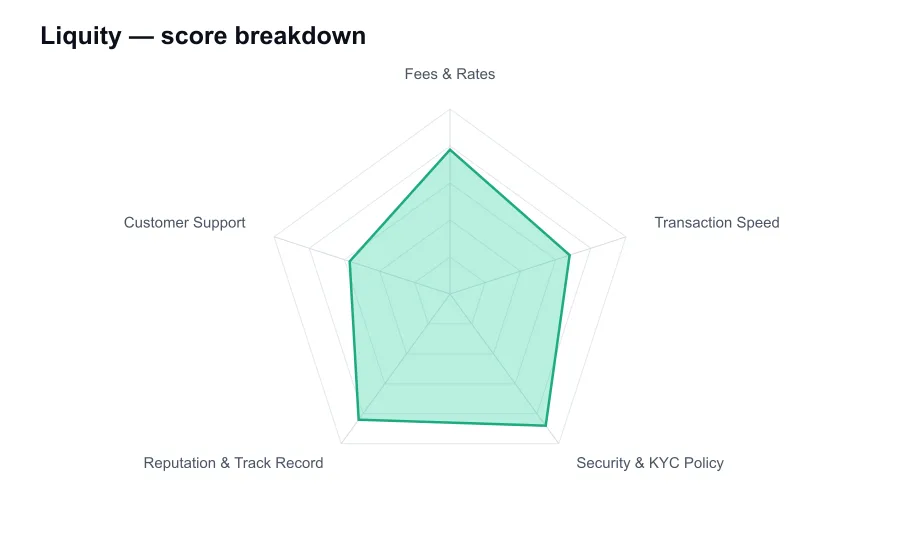
Liquity scores 7.8/10 overall in our independent review, measured against every other provider we've compared, strongest on Security & KYC Policy (8.8/10) and weakest on Customer Support (5.7/10).
7.8/10 How we score →Editorial independence: our scores and rankings are produced using the fixed criteria above and are not influenced by advertisers. This is an independent ranking site and is not operated by, or affiliated with, any provider we list.
Affiliate disclosure: some links on this page may earn us a commission at no extra cost to you. This does not affect our rankings.
Liquity is not an instant exchange in the conventional sense. It is a decentralized borrowing protocol on Ethereum that lets users deposit ETH or approved liquid staking collateral and borrow its stablecoin, BOLD, against that collateral. Its older LUSD system established the project's reputation for interest-free ETH-backed borrowing, while the newer Liquity V2 design expands the model. Comparing Liquity directly with Kingex or LetsExchange would miss the point. This is on-chain financial infrastructure, not a swap desk.
The product is designed for people who already hold ETH and do not want to sell it. Instead of disposing of an asset they expect to appreciate, they can open a collateralized position and draw stablecoins against it. That can be useful for liquidity, trading capital, or paying expenses without triggering a sale. It is also leverage, whether users describe it that way or not. Borrowing against volatile collateral magnifies the consequences of a bad market move.
Liquity's original version became popular because it had no recurring borrowing interest rate. Users paid a one-time borrowing fee that changed with protocol conditions, plus Ethereum gas, and had to maintain at least a 110 percent collateral ratio. That was a strikingly capital-efficient structure, but it also left little room for error. At 110 percent, a modest ETH price decline can put a position in danger. Sensible users kept much more collateral than the minimum.
The newer protocol architecture has more moving parts. Liquity V2 uses user-selected interest rates and introduces mechanisms intended to improve capital efficiency and stablecoin stability. That means discussing fees requires more care than simply repeating the old phrase, interest-free borrowing. Costs can include borrowing interest, upfront fees, redemption-related effects, gas, and potentially the economic impact of selecting an uncompetitive rate. Anyone reviewing Liquity today should verify which version and collateral branch they are actually using.
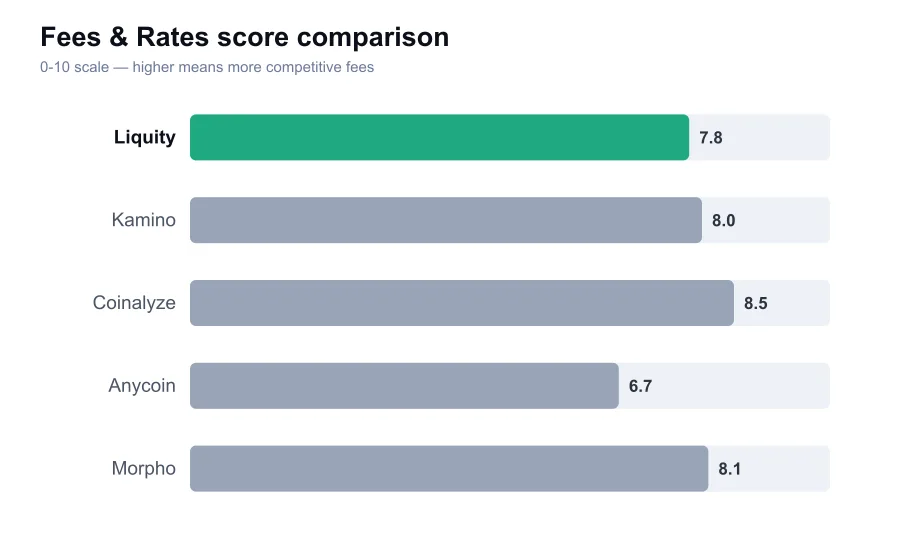
This is a place where the protocol is impressive but not necessarily cheap in every market condition. Ethereum gas can dominate the economics of smaller positions, especially during congestion. A borrower who opens, adjusts, and closes a small position may spend enough on transactions to make the attractive headline borrowing terms irrelevant. Liquity makes most sense for users whose position size justifies mainnet costs, or for those using an officially supported deployment where the execution environment is appropriate.
There is no conventional transaction speed promise because Liquity transactions settle according to Ethereum block production. Under ordinary conditions, a submitted transaction may be included within minutes, depending on the gas fee chosen. Final confidence takes longer, and congestion can make actions expensive or delayed. This becomes especially important during a violent ETH sell-off, exactly when borrowers may want to add collateral or repay debt. DeFi is fastest when you don't urgently need it.
Liquidation mechanics are the heart of the risk. If your collateral ratio falls below the applicable threshold, the protocol can liquidate the position. In the original system, a 110 percent minimum was brutally efficient but unforgiving. Liquity does not know your income, investment horizon, or emotional tolerance. Smart contracts apply rules. Borrowers should monitor their ratio, maintain a wide buffer, and understand the Stability Pool or liquidation mechanism before using the protocol.
The Stability Pool is one of Liquity's more distinctive components. Users can deposit the protocol stablecoin to help absorb liquidated debt and in return receive collateral gains and incentive rewards, depending on the version and deployment. This can be attractive, but it is not a risk-free yield account. Depositors can see their stablecoin balance reduced as liquidations occur, receiving ETH or other collateral exposure instead. Anyone who needs a stable dollar balance should understand that trade clearly.
Security is Liquity's strongest area conceptually. It is a smart-contract protocol, designed to minimize reliance on a company custodying user assets or approving withdrawals. The original system was widely recognized for immutable contracts, extensive documentation, and a deliberately constrained design. Users interact through wallets and retain control until a contract transaction is signed. There is no exchange login to freeze, no support agent who can reverse a completed blockchain action, and no conventional KYC gate.
That autonomy has a hard edge. If you sign a malicious approval, use a fake front end, send funds to the wrong address, or misunderstand a transaction, there is no customer-service department that can retrieve your money. Smart-contract risk remains real even after audits and years of operation. Bugs, oracle issues, governance or deployment changes, integration failures, and wallet compromises all belong in the threat model. DeFi users should use hardware wallets and verify domains with more care than they would on a normal website.
Liquity's protocol design has historically used decentralized price-oracle infrastructure rather than relying on a single centralized feed. This is important because collateralized borrowing cannot function safely without robust price data. Yet no oracle arrangement turns market risk into safety. During severe volatility, the system's rules are meant to settle positions predictably, not protect every borrower from losses. The absence of discretionary intervention is a feature for censorship resistance and a hazard for the unprepared.
KYC is generally not required at the protocol layer. A wallet can interact with public smart contracts without submitting identity documents. That is a meaningful difference from centralized borrowing platforms and instant exchange services. However, users should not interpret permissionless access as legal advice or an assurance that every front end, jurisdiction, fiat ramp, or stablecoin integration has identical compliance treatment. Liquity provides a protocol, while the broader financial environment still has rules.
Reputationally, Liquity is one of the more respected names in decentralized collateralized lending. The project survived multiple market cycles and distinguished itself through a focused product rather than endless feature sprawl. Its original LUSD became a recognized decentralized stablecoin, though it never achieved the scale of USDC or USDT. The protocol's maturity deserves credit, but its smaller user base and the complexity of V2 mean that a new borrower should read current documentation rather than rely on old community explanations.
Support is fundamentally community and documentation driven. Users can find official guides, developer materials, governance discussion, and community channels, but they should not expect an agent to manage their position for them. This is appropriate for a permissionless protocol, though it raises the skill floor. If you need somebody to explain a liquidation notice in plain English or undo a mistaken transaction, a centralized platform with direct support may be a better fit.
Liquity is most suitable for experienced DeFi users who understand collateral ratios, wallet security, Ethereum gas, and liquidation risk. It is not a casual way to get spending money from your ETH. The protocol can be remarkably efficient for a disciplined borrower who maintains substantial overcollateralization and plans for market stress. A user borrowing to chase a speculative altcoin trade at the minimum ratio is using sophisticated machinery in the least sophisticated possible way.
I regard Liquity as serious DeFi infrastructure with unusually strong design principles, not as a simple consumer finance product. It earns high marks for non-custodial access, protocol durability, and transparent rule-based operation. It loses points for the unforgiving realities of smart contracts, Ethereum fees, and liquidation exposure. For people who understand those risks, it can be one of the cleaner ways to borrow against ETH. For everyone else, selling a small portion of ETH or using a regulated lending product may be safer than pretending leverage is free.
| Criterion | Score (0-10) | Notes |
|---|---|---|
| Fees & Rates | 7.8 | Efficient borrowing design, but gas and V2 rates matter. |
| Transaction Speed | 6.8 | Settlement depends on Ethereum blocks and gas conditions. |
| Security & KYC Policy | 8.8 | Non-custodial audited protocol, with smart-contract risk. |
| Reputation & Track Record | 8.4 | Respected DeFi protocol with multi-cycle operating history. |
| Customer Support | 5.7 | Documentation and community, not hands-on account support. |
| Pros | Cons |
|---|
No. Liquity is primarily a decentralized collateralized borrowing protocol. Users deposit supported collateral and borrow its stablecoin rather than directly exchanging one cryptocurrency for another.
Yes. If your collateral ratio falls below the relevant threshold, the protocol can liquidate your position. Maintain a substantial buffer rather than borrowing near the minimum ratio.
The protocol layer is generally permissionless and does not require conventional account KYC. That does not remove legal obligations that may apply to users in their own jurisdiction.
Ethereum transaction fees can be significant. Opening, adjusting, and closing a small position may cost enough in gas to outweigh favorable protocol-level borrowing terms.
| Alternative | Score |
|---|---|
| Kamino Review | 7.8/10 |
| Coinalyze Review | 7.8/10 |
| Anycoin Review | 7.8/10 |
| Morpho Review | 8.0/10 |
| Exolix Review | 7.6/10 |
| Trocador Review | 7.6/10 |