
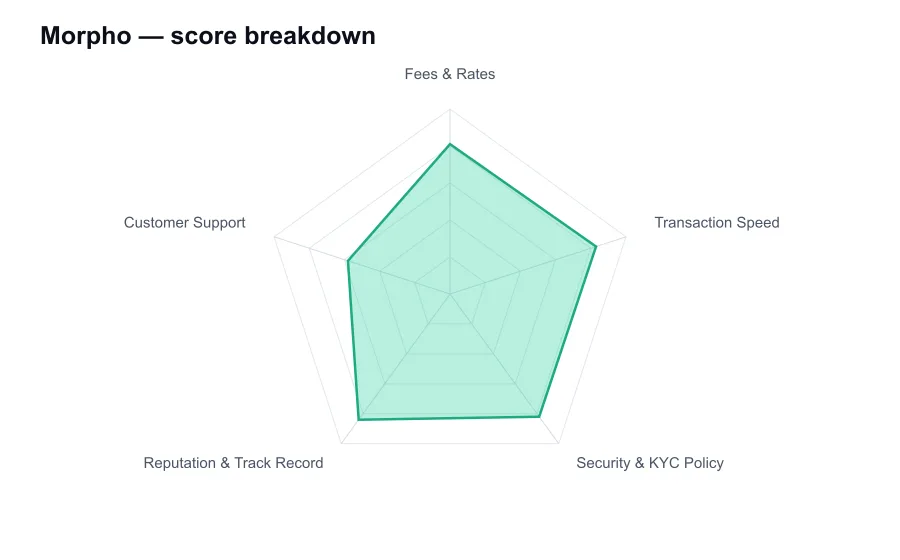
Morpho scores 8.0/10 overall in our independent review, measured against every other provider we've compared, strongest on Reputation & Track Record (8.4/10) and weakest on Customer Support (5.8/10).
8.0/10 How we score →Editorial independence: our scores and rankings are produced using the fixed criteria above and are not influenced by advertisers. This is an independent ranking site and is not operated by, or affiliated with, any provider we list.
Affiliate disclosure: some links on this page may earn us a commission at no extra cost to you. This does not affect our rankings.
Morpho is not an instant exchange in the ordinary sense, and treating it like one would be misleading. It is a decentralized lending protocol and ecosystem built around permissionless borrowing and lending on Ethereum-compatible networks. Users do not deposit cash, call a broker, or swap coins through a central order desk. They supply collateral, borrow against it, or provide liquidity to lending markets through smart contracts.
That distinction changes the review immediately. Morpho's core competition is not ChangeNOW or Coinbase retail. It sits closer to Aave, Compound, Spark, and other onchain money markets. Its strongest appeal is capital efficiency and user control. A wallet connects directly to the protocol, positions are visible onchain, and users can interact without opening a traditional custodial account.
Morpho's architecture has evolved from peer-to-peer optimization around established lending pools to a more modular market design. Morpho Blue allows permissionless market creation using a loan asset, collateral asset, oracle, interest rate model, and liquidation parameter. That flexibility is powerful. It also means a market's safety is not determined by the Morpho name alone, because risk depends on the particular configuration and the people or entities curating access.
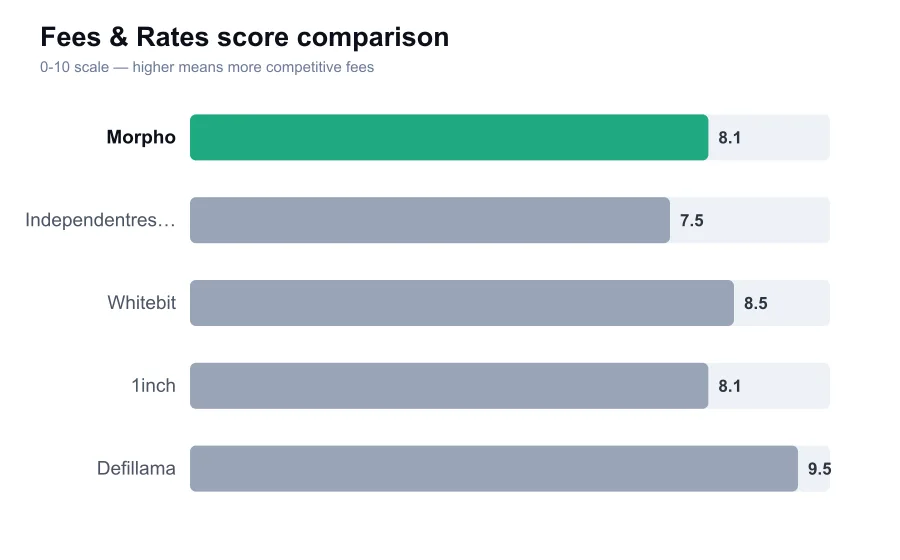
Fees are more nuanced here than at a centralized exchange. Morpho itself does not work like a platform charging a flat trading commission on every click. Borrowing costs come from interest rates set by market conditions and the selected rate model. A vault may charge fees, and users still pay network gas. The cost of capital can be excellent in a deep, well-designed market, but there is no universal percentage that applies to every user.
This can make Morpho genuinely attractive for sophisticated borrowers. If a user has accepted the collateral risk and finds a market with favorable liquidity, the rate can be more competitive or more precisely tailored than a broad pool. It can also become expensive quickly in a stressed market. A variable borrowing rate is not a promise, and a low displayed annualized rate can change after liquidity shifts.
Gas is the practical fee many promotional comparisons omit. On Ethereum mainnet, opening, repaying, adjusting collateral, and closing a position can be costly during congestion. Morpho deployments and integrations on lower-cost networks help, but users must check the chain before calculating returns. Borrowing a small amount to chase a modest yield is often irrational once transaction costs and approval transactions are included.
Speed is one of Morpho's real strengths, with an important qualification. A position can be opened or adjusted as soon as the relevant blockchain confirms the transaction. There is no bank queue, support agent, or manual withdrawal approval in the normal flow. On a fast and inexpensive network, the experience can feel near-instant. On Ethereum during high demand, it is only as fast and affordable as the chain.
The trade-off for that speed is irreversibility. A centralized exchange may sometimes rescue a customer who sends an asset to the wrong network or makes a visible account error. Smart contracts do not offer that kind of discretion. Sign the wrong transaction, use an unsafe frontend, or misunderstand a collateral ratio, and there may be no support ticket capable of undoing the result.
Security is where Morpho deserves both credit and serious scrutiny. The protocol is built in the open, and its contracts, documentation, audits, and risk framework are more inspectable than the black-box systems of many smaller crypto businesses. That is a material advantage. Users can see positions and market parameters rather than trusting a company statement about internal balances.
Open code does not mean risk-free code. Smart contract risk, oracle risk, governance or curator risk, liquidation risk, and frontend phishing risk remain. Morpho Blue's permissionless design raises the stakes because not every market deserves the same confidence. A user should examine collateral quality, loan-to-value limits, oracle design, liquidity concentration, and the curator behind a vault before depositing meaningful capital.
KYC is generally not built into direct protocol interaction. A wallet can interact with public smart contracts without the account-opening process common at regulated exchanges. However, access can be influenced by the frontend, a user's jurisdiction, RPC providers, or sanctions screening at other points in the transaction path. More importantly, no-KYC access does not remove tax reporting duties or make borrowed funds consequence-free.
Morpho's reputation is strong within DeFi because it has attracted serious technical attention and meaningful integrations. It is not a fly-by-night swap site. Its standing comes from protocol design, ecosystem adoption, and visibility among onchain users rather than from conventional consumer branding. Still, DeFi reputation should never be converted into a blanket claim that every vault, collateral asset, or strategy is safe.
Support is the weakest part for inexperienced users, not because documentation is absent but because the answer to many problems is educational rather than operational. Community channels, documentation, interfaces, and third-party integrators can help explain a transaction. They cannot guarantee recovery after liquidation or compensate a user who chose an unsuitable market. This is software finance, not a bank relationship.
Morpho fits users who already understand collateralized borrowing, health factors, and wallet security. It is particularly compelling for DeFi-native lenders who want transparent market parameters and for borrowers willing to manage risk actively. It is a bad first stop for someone who simply wants to buy Bitcoin, trade a token, or earn yield without understanding how liquidation works.
My verdict is favorable on the protocol and cautious on the user experience. Morpho is one of the more serious pieces of lending infrastructure in DeFi, with a design that rewards informed users rather than sheltering uninformed ones. Its permissionless nature is a feature, not a customer-service promise. Use established markets, keep a collateral buffer, and assume you alone are responsible for every transaction you sign.
| Criterion | Score (0-10) | Notes |
|---|---|---|
| Fees & Rates | 8.1 | No standard swap commission, rates and gas drive cost. |
| Transaction Speed | 8.3 | Onchain execution is fast once the network confirms. |
| Security & KYC Policy | 8.2 | Transparent contracts, but smart contract and liquidation risk. |
| Reputation & Track Record | 8.4 | Well regarded DeFi lending infrastructure. |
| Customer Support | 5.8 | Documentation and community, not bank-style rescue support. |
| Pros | Cons |
|---|
No. Morpho is primarily a decentralized lending protocol. Users supply assets, borrow against collateral, or deposit into lending vaults rather than trade through a conventional exchange order book.
Direct interaction with public smart contracts generally does not follow the usual exchange account model. Frontends, jurisdictions, and other service providers can still impose restrictions or screening.
Yes. If borrowed debt relative to collateral crosses a market's liquidation threshold, liquidators can close or reduce the position. Keep a meaningful buffer and monitor volatile collateral.
Costs can include borrowing interest, vault fees where applicable, swap costs if you trade elsewhere, and blockchain gas. The exact cost depends on the market, chain, and transaction timing.
| Alternative | Score |
|---|---|
| Independentreserve Review | 8.1/10 |
| Whitebit Review | 8.1/10 |
| 1inch Review | 8.2/10 |
| Defillama Review | 8.2/10 |
| Kamino Review | 7.8/10 |
| Liquity Review | 7.8/10 |