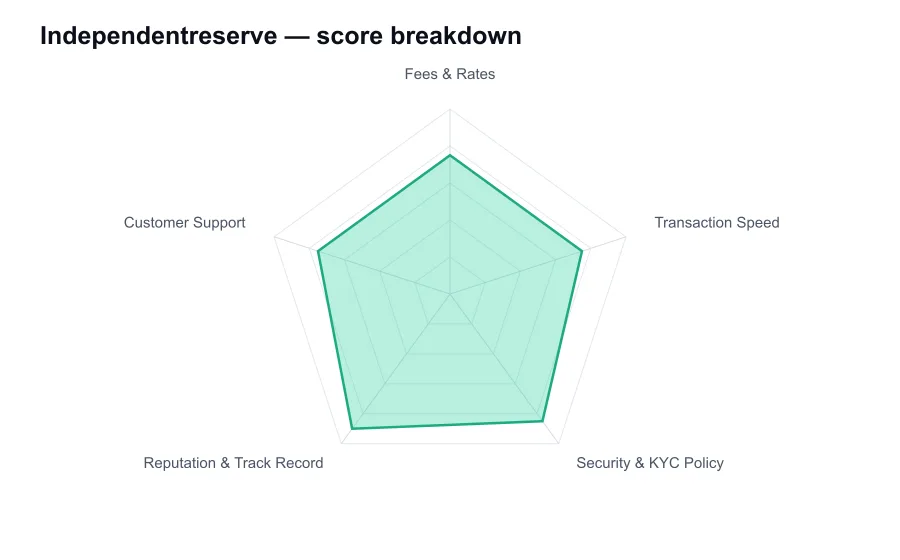
Independentreserve scores 8.1/10 overall in our independent review, measured against every other provider we've compared, strongest on Reputation & Track Record (9.0/10) and weakest on Customer Support (7.5/10).
8.1/10 How we score →Editorial independence: our scores and rankings are produced using the fixed criteria above and are not influenced by advertisers. This is an independent ranking site and is not operated by, or affiliated with, any provider we list.
Affiliate disclosure: some links on this page may earn us a commission at no extra cost to you. This does not affect our rankings.
Independent Reserve is one of the more credible names in the Australian crypto market. Founded in 2013, it has survived several boom and bust cycles without chasing every speculative trend, which is partly why it has earned a loyal following among Australian investors and SMSF users. It is not trying to be the loudest exchange or the broadest casino of altcoins. Its strength is a more conservative, compliance-led approach to buying, selling, and holding major digital assets.
The exchange's market position is quite clear. Independent Reserve is built for Australians, with services also extending into Singapore, and it puts AUD banking access, tax reporting tools, account verification, and institutional-style controls ahead of meme-coin discovery. That focus makes it less exciting than Binance or some offshore platforms, but it also makes the product easier to recommend to someone who values a local operating framework and a company that has been around long enough to be tested.
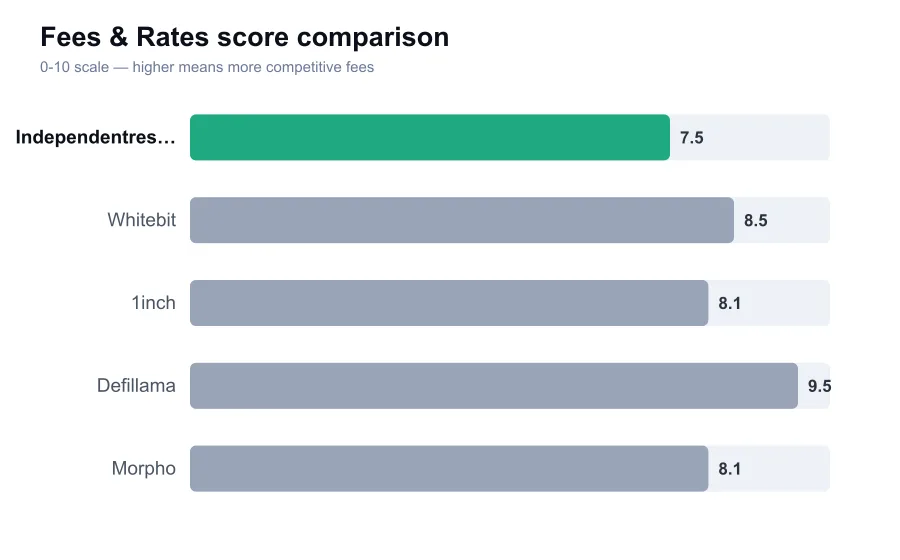
Its headline trading fees are competitive, though users need to understand the distinction between a simple instant purchase and an order placed on the exchange market. The published spot trading fee begins at 0.5 percent and reduces with 30-day trading volume, reaching 0.02 percent at the highest tiers. That starting rate is not the cheapest in Australia. Swyftx and CoinSpot may feel simpler for casual buyers, while major global exchanges can have lower base spot fees, but the declining schedule is fair and clearly disclosed.
For a casual investor buying a few hundred dollars of Bitcoin, Ethereum, or XRP, a 0.5 percent trading fee is not outrageous. It is substantially more transparent than a service that claims zero commission while concealing a large spread. Still, price-sensitive users should compare the actual execution price. Independent Reserve offers an order-book environment, so limit orders can help avoid paying more than intended. That is a better route than blindly accepting a market order during a fast price move.
Deposits and withdrawals require the same practical attention as they do on every exchange. Australian dollar transfers through local banking rails are usually efficient, but settlement depends on the sending bank, payment method, account name matching, and compliance checks. Crypto withdrawals also carry blockchain network charges, which vary by asset and network conditions. Independent Reserve is good at displaying the relevant information, though no exchange can make Bitcoin congestion or Ethereum gas disappear.
Speed is solid rather than spectacular. AUD deposits can often arrive quickly through supported Australian payment methods, especially during normal banking availability, but users should not assume every transfer is instant. New accounts, unusual deposits, and name mismatches may take longer. Once funds are available, orders placed against the market execute according to available liquidity. The platform is designed for normal investing and business use, not for ultra-low-latency day trading or derivatives speculation.
That distinction matters. Independent Reserve has reasonable liquidity in its core markets, but it does not offer the enormous global volume of Binance, Coinbase, or Kraken. A normal retail order in a major asset is unlikely to be a problem. A large order can move through the book less elegantly than it would on a top-tier global venue. Bigger buyers should use limit orders, consider staged execution, or speak with the exchange about its over-the-counter service rather than hitting the market with a large order.
Security is a genuine positive. Independent Reserve has long emphasized offline storage arrangements, account security, and operational controls. It offers two-factor authentication and security features appropriate for a custodial exchange, while its Australian presence creates a stronger expectation of accountable processes than an anonymous offshore site. The company has also publicized an insurance arrangement called Premium Account, intended to provide additional protection for eligible accounts against certain theft-related events. Customers should read the policy terms carefully because insurance is never a blanket guarantee.
The exchange is not a no-KYC option, and that is by design. Identity verification is required to use the service properly, with requirements varying by customer type and jurisdiction. Some users will dislike the paperwork, particularly those used to permissionless wallets or instant swap sites. I see it as a reasonable trade for the product being offered. Independent Reserve is trying to operate inside a regulated financial environment, and clear verification is preferable to a platform that suddenly asks for documents after it has accepted a deposit.
Privacy-minded users should nevertheless understand what that means. A verified centralized exchange creates records linking the account holder, banking activity, and wallet flows. That is normal for regulated providers, not a unique fault of Independent Reserve. Users who need on-chain privacy should not expect a compliant fiat gateway to behave like a self-custodied protocol. For ordinary investors who want an AUD on-ramp with clear rules, the compliance posture is more reassuring than burdensome.
Its reputation is among its best assets. Independent Reserve has operated since 2013 and has held an Australian Financial Services Licence through its subsidiary arrangements, alongside registration with AUSTRAC as a digital currency exchange. Regulatory structures can change and users should check current status for their own situation, but the important point is that this is an identifiable, long-running business. It has a far more substantial record than the anonymous exchange sites that appear during bull markets and vanish after them.
Customer support is competent, although it is not the reason to choose the platform. The help centre covers common account, deposit, withdrawal, and verification issues, and support channels are geared toward a regulated service rather than a casual Telegram chat. Users with unusual source-of-funds issues or corporate accounts may need patience, because compliance reviews are rarely instant. That can be frustrating, but a slower documented answer is better than an untraceable support agent making improvised promises.
The platform is particularly well suited to SMSF investors and longer-term Australian holders. Its tax tools, portfolio tracking, recurring purchasing options, and local market orientation reduce some of the administrative burden that comes with crypto ownership. It also offers an OTC desk for larger clients, a useful feature for buyers who do not want a substantial order exposed to the public order book. These are practical services, not flashy ones, and they fit the exchange's restrained character.
There are limitations. The asset selection is narrower than that of the largest international exchanges, and users looking for perpetual futures, high-leverage products, launchpad tokens, staking promotions, or an endless stream of new listings will be disappointed. The basic fee tier is respectable, not exceptional. Its interface is functional rather than thrilling. None of those complaints outweigh the core strengths for its intended audience, but they do explain why active global traders may prefer another venue.
My take is that Independent Reserve deserves to be considered one of the safer centralized choices for Australian users who accept KYC and want a sober, well-established platform. It is not the cheapest exchange for every trade, and it is not where I would go for cutting-edge DeFi tokens or aggressive trading strategies. But it does the fundamentals well: transparent fees, credible local standing, decent security controls, and a long operating record. For buying established crypto with AUD and keeping the process orderly, it is a strong choice.
| Criterion | Score (0-10) | Notes |
|---|---|---|
| Fees & Rates | 7.5 | 0.5% base spot fee, falling to 0.02% |
| Transaction Speed | 7.5 | Efficient AUD rails and solid core-market execution |
| Security & KYC Policy | 8.5 | KYC, account controls, offline custody focus |
| Reputation & Track Record | 9.0 | Australian exchange operating since 2013 |
| Customer Support | 7.5 | Useful local support, compliance reviews can take time |
| Pros | Cons |
|---|
Its published spot trading fee starts at 0.5 percent and declines with 30-day trading volume, down to 0.02 percent at the highest tier. Network withdrawal fees vary by asset.
Yes. Identity verification is part of using the platform, with requirements depending on the customer and jurisdiction. It is not designed as an anonymous exchange.
It is widely used by Australian SMSF investors because of its local focus, reporting tools, and established operating history. Trustees should still obtain their own tax and compliance advice.
No. The exchange concentrates on a more selective asset list than Binance or other global venues. It is strongest for established cryptocurrencies and AUD pairs.
| Alternative | Score |
|---|---|
| Whitebit Review | 8.1/10 |
| 1inch Review | 8.2/10 |
| Defillama Review | 8.2/10 |
| Morpho Review | 8.0/10 |
| Kamino Review | 7.8/10 |
| Liquity Review | 7.8/10 |