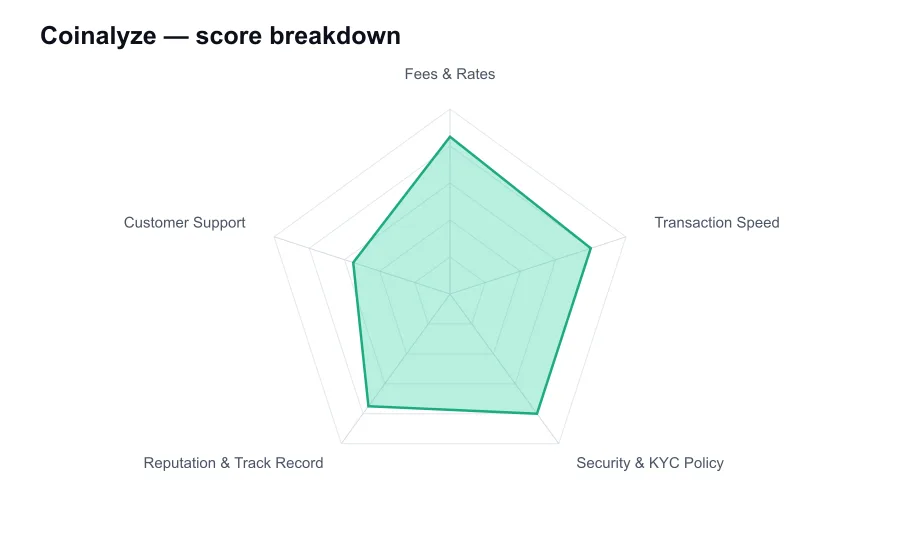
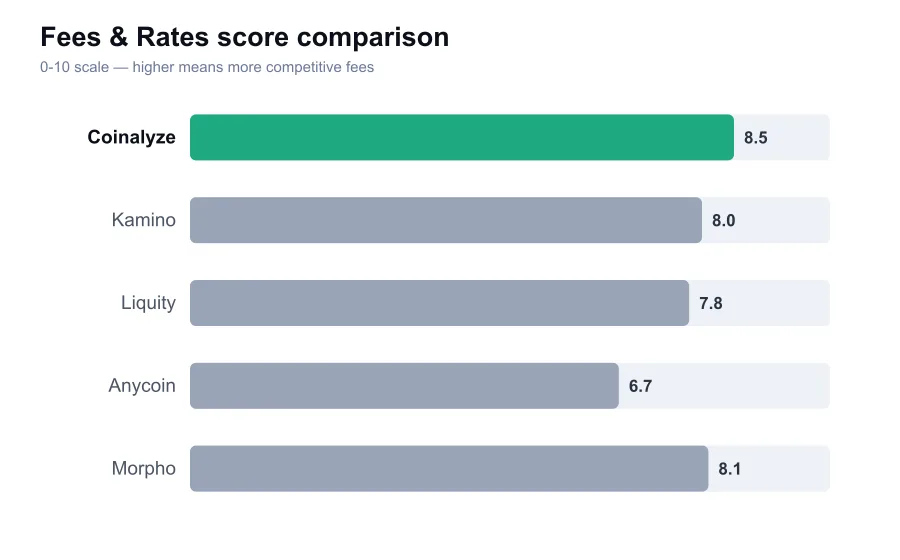
Coinalyze scores 7.8/10 overall in our independent review, measured against every other provider we've compared, strongest on Fees & Rates (8.5/10) and weakest on Customer Support (5.5/10).
7.8/10 How we score →Editorial independence: our scores and rankings are produced using the fixed criteria above and are not influenced by advertisers. This is an independent ranking site and is not operated by, or affiliated with, any provider we list.
Affiliate disclosure: some links on this page may earn us a commission at no extra cost to you. This does not affect our rankings.
Coinalyze is a derivatives and market-data terminal for crypto traders, not an exchange where you deposit coins and place an order. Its value is in watching the activity around perpetual futures, dated futures, funding rates, open interest, liquidations, and price action across multiple venues. That makes it closer in spirit to a lightweight analytics workspace than to Binance, Bybit, Coinbase, or a swap service. People expecting custody or fiat ramps have arrived at the wrong product.
The site earns its audience by putting information that is scattered across exchange interfaces into a more usable comparative view. A trader can look at open-interest changes alongside price, compare contract markets, and use familiar charting tools without bouncing through five separate exchange tabs. That is genuinely helpful for derivatives-focused users. It is especially handy for identifying whether a move has broad futures participation or is isolated to one venue.
There is a big caveat, though. Derivatives analytics can give a false sense of precision. Rising open interest is not a buy signal, falling funding is not a guaranteed reversal, and liquidation data is never a map of where price must go next. Coinalyze offers useful context, not an oracle. Traders who treat every heatmap or funding extreme as an automatic trade will lose money faster, just with better charts.
Fees are one of its strongest points for casual use because viewing market data does not carry an exchange-style maker, taker, spread, deposit, or withdrawal charge. The free experience is the real entry point. Premium access and plan availability can change, so anyone considering a paid tier should verify the live pricing, data limits, alerts, historical depth, and billing terms directly on the site instead of trusting a stale third-party review.
The more meaningful cost is indirect. Better data can encourage more trading, and the actual financial damage comes from the exchange where trades are placed. A user who sees a setup on Coinalyze then enters a leveraged perpetual on Bybit, Binance, OKX, or another venue still pays that venue's trading fees, funding, spread, and liquidation costs. Coinalyze doesn't remove those expenses. It only helps you see the environment more clearly.
Speed is good where it counts for a browser analytics tool. Charts and derivatives metrics are designed for active market monitoring, and the interface is materially more useful than slow, end-of-day reporting. But it is not a colocated institutional execution feed, and traders should not confuse displayed data with a promise of tick-perfect, zero-latency market intelligence. A volatile liquidation cascade can develop between browser refreshes and exchange APIs can lag or change.
That limitation matters most for scalpers. If your strategy depends on capturing a few basis points, your exchange order book, your connection, and your execution discipline matter far more than a public web dashboard. Coinalyze is better for developing a directional thesis, confirming unusual derivatives participation, and observing market structure over minutes or hours. It is not the tool I would rely on alone for split-second entries in a fast perpetual market.
Security is refreshingly simple because Coinalyze is not publicly positioned as a custodian. It should not need your coins, seed phrase, or trading capital to show charts. That sharply reduces the catastrophic counterparty risk associated with depositing assets at a smaller exchange. The sensible rule remains the same: never disclose a wallet recovery phrase, never install a browser extension on a charting site's instruction, and use a unique password for any account you create.
The KYC picture is also lighter than at a trading venue. Basic chart viewing does not carry the same identity requirements as opening an account that can accept funds and execute derivatives orders. If a paid subscription requires billing details, that is ordinary commerce rather than exchange-level customer due diligence. The absence of KYC is convenient, but it should not be romanticized as a privacy shield. Your browser, payment provider, and exchange accounts are separate data trails.
Coinalyze's reputation rests on utility and continuity rather than brand grandeur. It is a known name among traders who watch open interest and funding, and its coverage of derivatives metrics makes it more credible than a random social-media dashboard. It does not have the institutional footprint of TradingView, Bloomberg, Kaiko, or major exchange research desks. Still, for the specific job of crypto futures monitoring, it has been useful enough to earn repeat traffic.
Its support model is understandably thinner than what customers expect from a broker holding their money. The important test is whether documentation explains symbols, exchange coverage, calculation methodology, alert behavior, and subscription handling clearly. A support ticket can resolve an account problem, but it cannot adjudicate a trade you made elsewhere after misreading a chart. That line may sound obvious, yet plenty of users blame analytics platforms for execution decisions that were entirely their own.
I like Coinalyze best as a companion screen. Keep a chart open beside the exchange, compare open-interest behavior with spot price, and use funding as a measure of positioning pressure rather than a contrarian button. Traders who journal will get more from it than traders who chase every flashing number. Review whether the indicator actually improved your entries after a few weeks. If it didn't, reduce the noise instead of adding more indicators.
The platform also benefits from a clear comparison with TradingView. TradingView is broader, has a huge charting community, and can be a more flexible home for technical analysis. Coinalyze is more purpose-built for derivatives data and market-wide futures context. Many serious traders will use both. The question is not which one replaces the other, but whether Coinalyze's specialized metrics deserve a permanent place in your workflow.
My take is positive, with a firm boundary. Coinalyze is a capable, low-friction market intelligence tool for people who understand crypto futures and want better visibility into leverage and positioning. It isn't an exchange, it isn't a wallet, and it won't make a weak strategy profitable. Its free access and focused data are real advantages. Use it to ask smarter questions about a market, not to outsource judgment to a liquidation chart.
| Criterion | Score (0-10) | Notes |
|---|---|---|
| Fees & Rates | 8.5 | Core market viewing avoids exchange-style trading and withdrawal fees. |
| Transaction Speed | 8.0 | Responsive derivatives monitoring, but not an execution-grade feed. |
| Security & KYC Policy | 8.0 | No custody requirement for ordinary chart use reduces major risk. |
| Reputation & Track Record | 7.5 | Well-known niche tool for futures metrics and open interest. |
| Customer Support | 5.5 | Adequate for a data product, not broker-level assistance. |
| Pros | Cons |
|---|
No. Coinalyze is a market-data and charting platform, not a crypto exchange or brokerage.
No exchange trading fee applies because trades are not placed on Coinalyze. Any trading costs are charged by the exchange you use.
Basic market viewing is not the same as opening an exchange account. Check the current site terms if you plan to purchase a subscription.
It is useful context, not a prediction. Combine it with price structure, liquidity, risk limits, and your own execution plan.
| Alternative | Score |
|---|---|
| Kamino Review | 7.8/10 |
| Liquity Review | 7.8/10 |
| Anycoin Review | 7.8/10 |
| Morpho Review | 8.0/10 |
| Exolix Review | 7.6/10 |
| Trocador Review | 7.6/10 |