
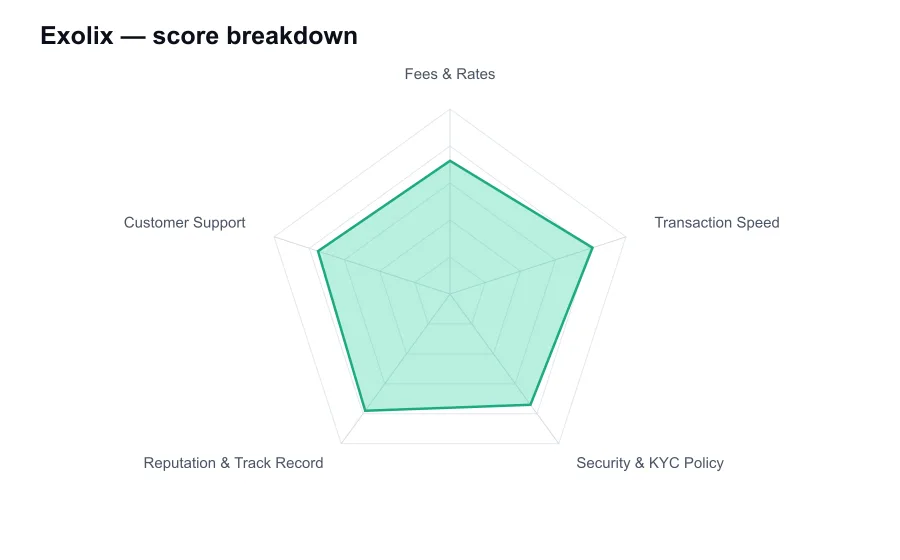
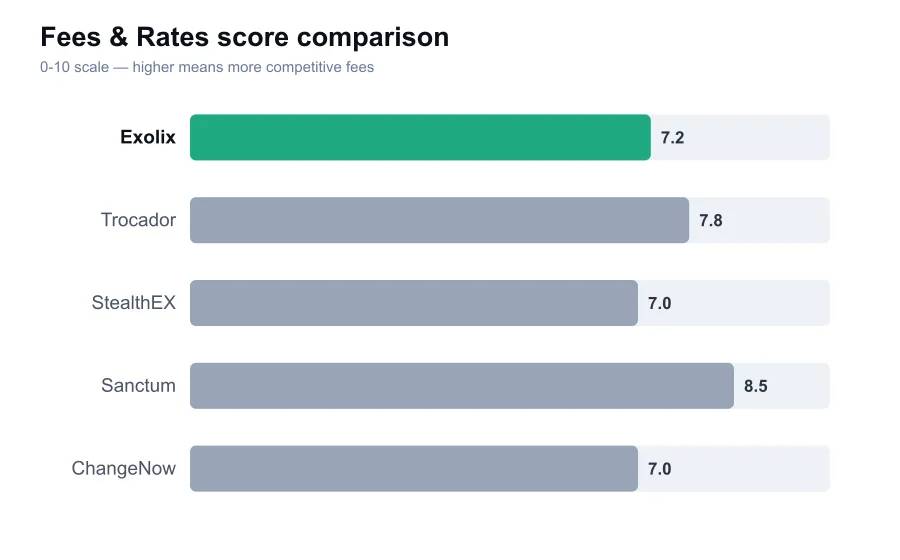
Exolix scores 7.6/10 overall in our independent review, measured against every other provider we've compared, strongest on Transaction Speed (8.1/10) and weakest on Fees & Rates (7.2/10).
7.6/10 How we score →Editorial independence: our scores and rankings are produced using the fixed criteria above and are not influenced by advertisers. This is an independent ranking site and is not operated by, or affiliated with, any provider we list.
Affiliate disclosure: some links on this page may earn us a commission at no extra cost to you. This does not affect our rankings.
Exolix is a noncustodial instant exchange built for people who want to swap crypto without opening a conventional trading account. It sits in the same broad market as ChangeNOW, SimpleSwap, StealthEX and LetsExchange, but its pitch is a little sharper: a broad asset list, fixed and floating quotes, and an exchange flow that rarely asks for personal data. That makes it useful, though it doesn't turn it into a magic privacy machine.
The service is an aggregator rather than a venue where you place bids against other users. You select the asset to send, choose what you want back, provide a receiving address and send the deposit. Exolix then sources liquidity through partners and completes the payout. That design is convenient because users don't have to manage order books, but it also means the final experience depends partly on third party liquidity and blockchain conditions.
Its interface is clean and, more importantly, it doesn't make the basic swap flow feel like a puzzle. The quote screen explains whether a transaction uses a fixed or floating rate, shows the expected payout, and gives a transaction page after the order is created. Newcomers should still slow down at the address step. A polished widget can't save a user who sends USDT on the wrong network or pastes an exchange deposit address without the required memo.
Exolix advertises more than 2,000 assets and a large number of network combinations. That range is a real strength for a swap service. Major pairs such as BTC, ETH, SOL, USDT and USDC are easy to find, while smaller coins appear more often here than at a centralized exchange that focuses on deep, regulated spot markets. Availability isn't the same thing as deep liquidity, however. Exotic pairs can produce visibly worse quotes and less predictable completion times.
There is no simple published percentage that applies to every trade. Exolix builds the network fee, market spread and partner execution cost into the displayed quote. This is normal for instant swap platforms, but it makes lazy comparisons misleading. The sensible way to judge price is to obtain a quote from Exolix and two direct rivals at the same time, then compare the exact amount received. On liquid pairs, its pricing is often reasonable. It is rarely the cheapest place to make a large trade.
Fixed rates are the feature that makes Exolix more compelling during a volatile market. A fixed quote gives a user more certainty about the intended payout, assuming the deposit arrives within the stated window and meets the required amount. The premium for that certainty can be meaningful, especially when network fees are elevated. Floating rates can return more, but the amount can move with the market while the exchange is being processed. Choose fixed for a time sensitive payment, not because the word fixed sounds inherently better.
Small transactions deserve particular caution. Bitcoin miner fees, Ethereum gas and minimum deposit rules can eat a surprising share of a modest order. Exolix shows minimums before the user proceeds, which helps, yet a displayed quote doesn't make a tiny swap economical. Anyone routinely converting small balances will get a better deal by batching transactions or using a low fee network where the destination supports it.
Speed is generally good for supported, liquid routes. An ordinary swap can move through the service in roughly five to twenty minutes after the incoming transaction has adequate confirmations. That isn't a guarantee. Bitcoin confirmations, an overloaded Ethereum network, a wallet's withdrawal batching, or a manual compliance review can easily extend the wait. Exolix is faster than opening a verified exchange account for a one off swap, but it cannot outrun the chains it uses.
The company describes the service as noncustodial, and that is broadly accurate in the practical sense that it doesn't hold a standing user balance behind a password. Funds are sent to an order address and then exchanged. Still, users should understand the distinction. During processing, the provider and its liquidity partners control the transaction path. Noncustodial is not the same as trustless, and it doesn't eliminate counterparty risk if an order is delayed or disputed.
Exolix promotes a no registration approach, but it maintains an AML policy and can request verification where a transaction triggers risk controls. That's the honest reality across this category. Users wanting a guaranteed no document experience shouldn't assume any instant exchanger can promise that, particularly for larger or flagged transactions. The policy is not unusual, but the discretion involved is frustrating because an order can become inconvenient precisely when funds are already in transit.
Security on the user side is mostly about operational care. Verify the official domain, bookmark it, inspect the receiving address and don't accept support instructions sent through unsolicited messages. Exolix's public order tracking and support route are useful, but no swap service can reverse a completed blockchain payout. For meaningful sums, make a small test transfer first, then send the main amount only after confirming the network and destination behavior.
Exolix has been operating since 2018, which gives it more history than a freshly launched exchange widget. Its public reputation is solid rather than elite. Many users report straightforward completions and responsive agents, while the usual complaints involve delayed orders, KYC requests after a deposit, or a final payout that differed from a user's expectation of the floating quote. Those complaints don't prove misconduct, but they are a reminder to read the quote type before paying.
Support is available around the clock through live chat and email, and the practical quality is better than the canned response reputation that plagues some competitors. Routine order questions can get an answer quickly. Complex compliance cases are another story. Front line support can't always accelerate a partner review, and users may find the explanations thin while waiting. Keep the order ID, transaction hash, amount and screenshots ready. It saves a lot of back and forth.
I like Exolix most as a convenience tool for a normal sized, uncomplicated crypto to crypto conversion. It is more flexible than a major regulated exchange for someone who doesn't want an account, and its fixed quote option is genuinely useful. I would not use it blindly for a five figure transaction, an illiquid token, or funds that must arrive at an exact minute. It earns trust through a long operating record and a workable product, not through impossible promises.
| Criterion | Score (0-10) | Notes |
|---|---|---|
| Fees & Rates | 7.2 | Competitive quotes, but spreads vary by route and size |
| Transaction Speed | 8.1 | Most liquid swaps finish quickly after confirmations |
| Security & KYC Policy | 7.4 | Noncustodial flow, with possible AML checks |
| Reputation & Track Record | 7.8 | Operating since 2018 with a substantial public footprint |
| Customer Support | 7.5 | 24 hour chat is useful, reviews can still take time |
| Pros | Cons |
|---|
Most ordinary crypto swaps can be started without registration or routine KYC. Exolix can request identity documents if its AML systems flag an order, a wallet or a transaction pattern.
Liquid routes often complete within five to twenty minutes after the incoming deposit receives required confirmations. Congestion, slow Bitcoin confirmations and compliance reviews can make an order take longer.
No single flat percentage applies to every swap. The displayed quote includes the service's pricing, liquidity costs and applicable network fees, so compare the final received amount.
| Alternative | Score |
|---|---|
| Trocador Review | 7.6/10 |
| StealthEX Review | 7.6/10 |
| Sanctum Review | 7.5/10 |
| ChangeNow Review | 7.4/10 |
| Kamino Review | 7.8/10 |
| Liquity Review | 7.8/10 |