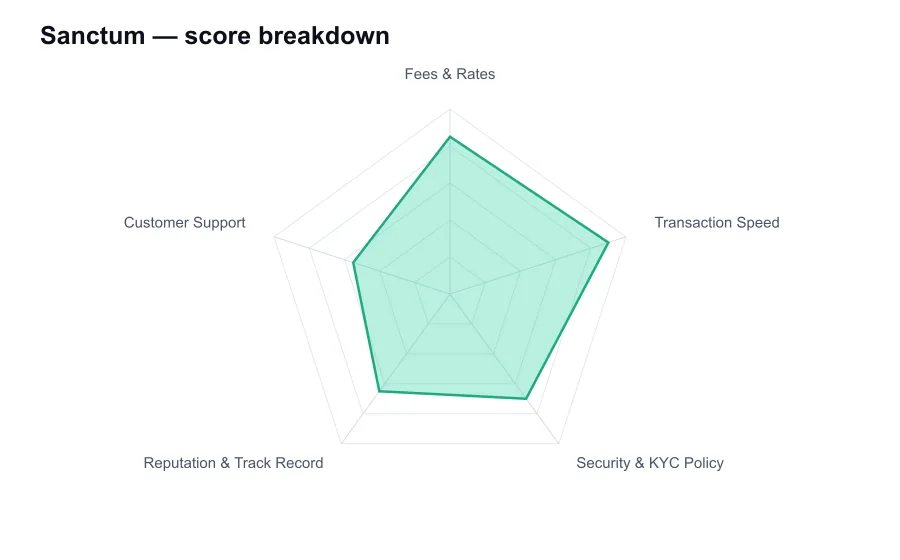
Sanctum scores 7.5/10 overall in our independent review, measured against every other provider we've compared, strongest on Transaction Speed (9.0/10) and weakest on Customer Support (5.5/10).
7.5/10 How we score →Editorial independence: our scores and rankings are produced using the fixed criteria above and are not influenced by advertisers. This is an independent ranking site and is not operated by, or affiliated with, any provider we list.
Affiliate disclosure: some links on this page may earn us a commission at no extra cost to you. This does not affect our rankings.
Sanctum is not a conventional crypto exchange. It is a Solana liquid staking infrastructure project that lets users move between SOL and a growing range of liquid staking tokens, or LSTs. That distinction matters. A person looking to buy Bitcoin with a card should go elsewhere. A Solana holder who wants staking exposure without being locked into one validator, however, will find Sanctum one of the more inventive products in the ecosystem.
Its core pitch is simple enough: stake SOL, receive a liquid asset, and keep the ability to use that asset across Solana DeFi. The difficult part has always been liquidity. Smaller LSTs can be hard to swap without ugly price impact. Sanctum's Infinity pool was designed to make many LSTs broadly interchangeable, which has made it an important piece of plumbing for users holding tokens such as jitoSOL, mSOL, bSOL, and community or validator-linked LSTs.
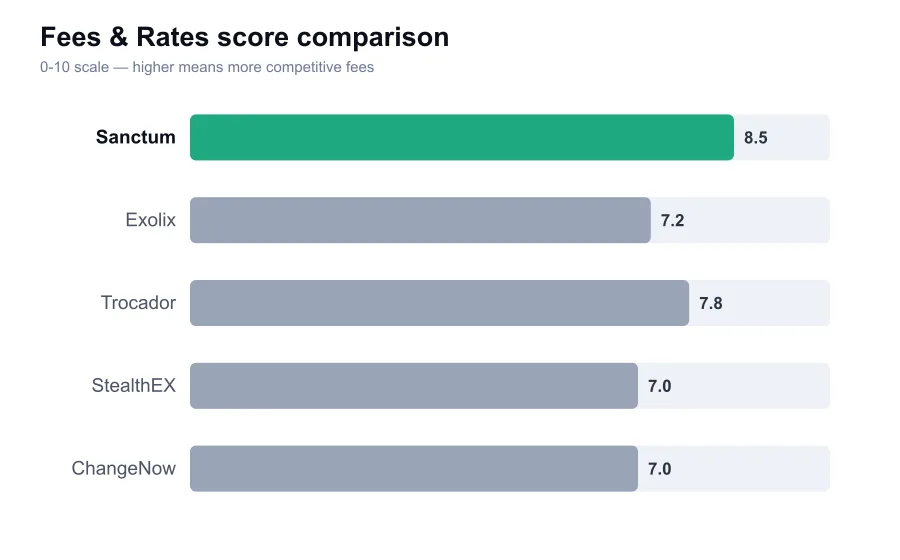
Fees are one of Sanctum's strongest points, though the marketing needs to be read carefully. Sanctum does not generally charge a blunt, platform-wide trading commission in the way Coinbase or Kraken does. The cost of entering or leaving an LST position can instead come from the underlying validator's staking commission, a swap spread, liquidity conditions, and Solana network fees. That can be genuinely cheap, but it is not the same as free.
For common, liquid assets, a swap through Infinity can be extremely competitive. During normal Solana conditions, transaction fees are tiny and swaps often carry minimal price impact. It is a better environment for moving between established LSTs than selling one on a centralized exchange, withdrawing, and re-staking. The savings are most visible for users already on Solana and already comfortable keeping their own wallet custody.
The catch is that less popular LSTs do not magically become liquid just because they are listed. An unusual validator token may face a worse implied rate, especially during volatile markets or when pool balances are uneven. I would not trust a headline rate blindly. Inspect the quoted output, compare it against the asset's redemption value where applicable, and understand whether the trade is using Infinity liquidity or another route.
Speed is excellent in the narrow context Sanctum serves. Solana transactions normally settle in seconds, and a successful stake, unstake, or LST swap generally feels close to instant compared with Ethereum liquid staking workflows. Delays are more likely to come from wallet approval, a congested Solana period, or the mechanics of native unstaking, not from a back-office queue controlled by Sanctum.
Instant liquidity should not be confused with native unstaking. If you want to turn an LST into SOL immediately, you are normally relying on a market, pool, or quoted route. Native stake deactivation has its own epoch-based timing. This is an important distinction for anyone treating an LST as a cash equivalent. Sanctum makes liquidity easier to access, but it cannot eliminate the economic risk of a thin market.
Sanctum is non-custodial in the practical sense that users connect a Solana wallet and approve on-chain transactions. There is no routine account opening process, no identity check for ordinary use, and no company-held balance waiting to be frozen. That is attractive to privacy-minded DeFi users. It also means there is no password reset desk to rescue someone who signs a malicious transaction or loses a seed phrase.
The security trade-off is smart contract exposure. Users are trusting deployed programs, pool design, price assumptions, wallet interfaces, and the LST issuers themselves. Sanctum has published audit and security material around its products, which is far better than asking users to accept opaque code on faith. Still, audits are not insurance. A protocol handling pooled liquidity remains a higher-risk proposition than holding SOL in a hardware wallet.
There is also a concentration question. Sanctum's work makes it easier for many LSTs to coexist, which can support validator diversity. Yet shared liquidity infrastructure can become a meaningful dependency for the Solana staking market. If a major route, interface, or pool mechanism were disrupted, the effect would be wider than a single small staking provider having a bad day. That is a structural risk rather than a proven flaw, but serious users should recognize it.
Its reputation is promising rather than fully seasoned. Sanctum became far more visible during Solana's 2024 revival, and its products gained traction because they solved a real market problem, not because of a flashy retail campaign. The team has been active in the Solana ecosystem and has built relationships with validator and LST projects. That gives it more credibility than a random swap site, but it does not grant it the long operating history of Lido or Coinbase.
The project has also leaned heavily into points, campaigns, and community incentives. Those programs can bring useful liquidity, though they can attract mercenary capital and create confusion about what users are actually earning. I prefer Sanctum as a practical staking-liquidity tool, not as a vehicle for chasing the next campaign. If the incentives disappeared tomorrow, the product still needs to stand on execution and depth.
Customer support is the least polished part of the proposition. Documentation, Discord, and social channels are the normal routes, which is standard in DeFi but unsatisfying if a transaction needs urgent interpretation. There is no bank-style phone line, no guaranteed response window, and no ability for staff to reverse an on-chain action. Experienced wallet users will cope. First-time crypto users may find the support model unforgiving.
Sanctum is a sharp tool for an informed Solana participant. Its low-friction LST liquidity, fast settlement, and non-custodial design are compelling, particularly for people who want to diversify staking exposure without constantly unwrapping and re-staking SOL. I would not present it as a beginner exchange or a substitute for simple self-custody. Use it for what it is, verify every route before signing, and keep only the level of smart contract risk you can afford.
| Criterion | Score (0-10) | Notes |
|---|---|---|
| Fees & Rates | 8.5 | Low network costs, but LST spreads and validator fees still apply |
| Transaction Speed | 9.0 | Solana swaps usually settle within seconds |
| Security & KYC Policy | 7.0 | Non-custodial and audited, with smart contract risk |
| Reputation & Track Record | 6.5 | Respected Solana infrastructure, but still relatively young |
| Customer Support | 5.5 | Community-led support, not a traditional help desk |
| Pros | Cons |
|---|
Ordinary on-chain use does not require a conventional account or identity verification. You connect a compatible Solana wallet and approve transactions yourself.
Sanctum does not present a universal retail trading commission. Your effective cost can include LST swap spread, pool conditions, validator fees, and Solana network fees.
You may be able to swap an LST for SOL through available liquidity. Native stake withdrawal still follows Solana's stake deactivation timing and is not inherently instant.
| Alternative | Score |
|---|---|
| Exolix Review | 7.6/10 |
| Trocador Review | 7.6/10 |
| StealthEX Review | 7.6/10 |
| ChangeNow Review | 7.4/10 |
| LetsExchange Review | 7.3/10 |
| BitcoinVN Review | 7.3/10 |