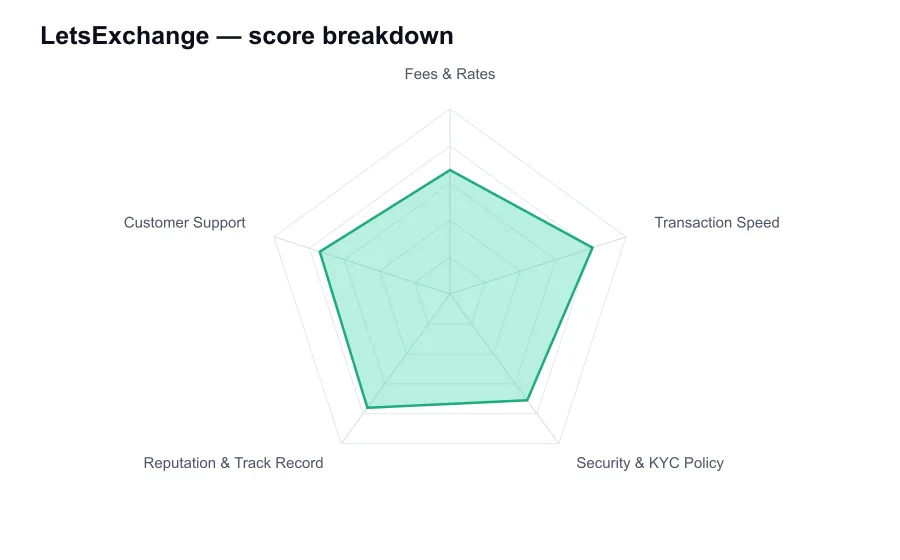
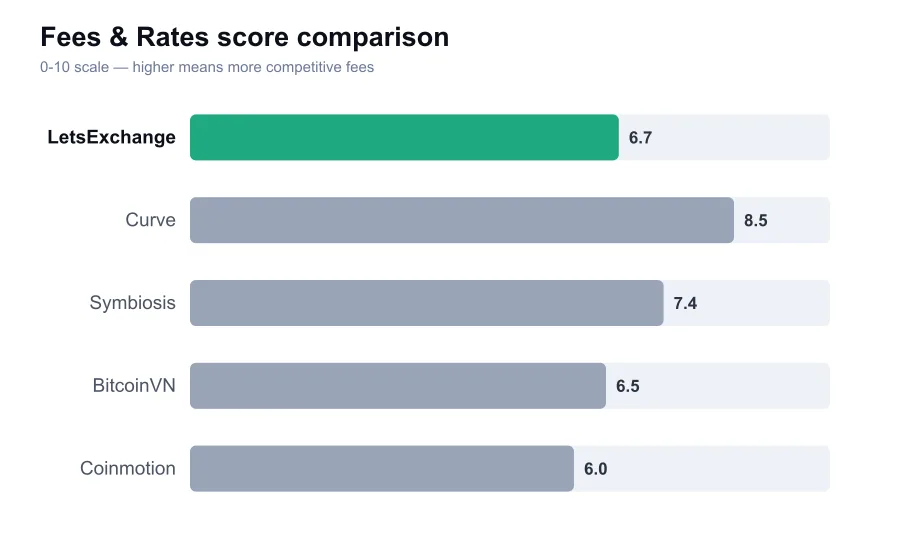
LetsExchange scores 7.3/10 overall in our independent review, measured against every other provider we've compared, strongest on Transaction Speed (8.1/10) and weakest on Fees & Rates (6.7/10).
7.3/10 How we score →Editorial independence: our scores and rankings are produced using the fixed criteria above and are not influenced by advertisers. This is an independent ranking site and is not operated by, or affiliated with, any provider we list.
Affiliate disclosure: some links on this page may earn us a commission at no extra cost to you. This does not affect our rankings.
LetsExchange is one of the more visible instant crypto exchange services, built for users who want to convert one asset into another without operating a conventional trading account. It competes with ChangeNOW, Changelly, StealthEX, and a long list of white-label swap providers. Its main appeal is breadth. The platform lists a very large range of coins, tokens, and networks, including plenty of assets that are awkward to find on mainstream regulated exchanges.
That broad catalog is both its selling point and its risk. A customer can move from a major coin into a niche token without learning how to bridge networks, use an unfamiliar decentralized exchange, or manage a centralized exchange account. Yet asset availability does not automatically mean deep liquidity. The more obscure the pair, the more likely the eventual route depends on third-party liquidity and the less meaningful a headline estimate becomes.
LetsExchange offers floating-rate and fixed-rate swaps. Floating rate means the final payout follows the market while the transaction is processed. Fixed rate locks the quoted amount for a limited period, provided the sender transfers correctly and promptly. The fixed option is particularly valuable in crypto because a ten-minute delay can matter during a fast market. It is not magic, though. The quote can be less attractive because someone is absorbing the price movement risk.
There is no simple platform-wide trading commission such as 0.1 percent posted on every pair. Instead, LetsExchange incorporates its service margin, liquidity-provider pricing, and network costs into the quote. It says the displayed rate is transparent before confirmation, and that is more useful than vague fee language, but the real comparison remains the amount you receive. On major pairs, I would check at least one competitor and a spot exchange before proceeding. The difference can be surprisingly wide.
This does not make LetsExchange unusually bad. Every instant exchange has to earn money and cover execution risk. The difference is whether the user understands the cost. For a $100 conversion, convenience may be more important than shaving off a few dollars. For a $10,000 conversion, a 1 percent or 2 percent difference can pay for the extra work of using Kraken, Coinbase Advanced, Binance where available, or a decentralized route. LetsExchange is best treated as a quote engine, not a default price source.
In terms of speed, the service is often good with mainstream assets. Once the deposit transaction receives required confirmations, a normal liquid swap can be processed in minutes. Transfers on fast networks can feel nearly immediate, while Bitcoin, Ethereum mainnet, and congested token networks predictably take longer. The website's estimation tools are useful, but any instant exchange is only as fast as the chain and the liquidity partner behind the selected route.
A practical strength is the range of network choices for stablecoins and popular assets. Selecting a lower-cost chain can save money and time, but it also creates room for user error. USDT on Tron is not the same thing as USDT on Ethereum, and an address may need a memo or tag on certain networks. LetsExchange provides transaction details, yet the customer still bears the responsibility of matching the exact asset and network. A cheap network choice is not a bargain if it sends funds into a recovery case.
LetsExchange describes itself as non-custodial, meaning it does not function as a long-term balance holder in the way a centralized exchange does. Funds are received and exchanged as part of a specific order. This is preferable to leaving coins on a platform indefinitely, especially for users who only need conversion. Still, the coins are under the service's control during execution. Non-custodial in this context means reduced ongoing custody exposure, not that a transaction cannot be delayed or disputed.
The platform does not require routine account registration for a basic exchange. That is a legitimate advantage for privacy-conscious users and for those who simply dislike filling out forms for a small conversion. But it is not an anonymity guarantee. LetsExchange has AML procedures and can request KYC information where its risk controls identify a transaction for review. This is standard across reputable instant swap services, yet users regularly misunderstand it. A no-signup flow does not mean every payment is beyond compliance screening.
That policy is sensible from a legal and security perspective, but the timing can be unpleasant. If a swap is flagged after the customer has sent assets, the funds may be held while documents are requested. Users with privacy concerns, difficult-to-document funds, or any exposure to questionable counterparties should not assume they can bypass checks by using an instant exchanger. The safest practice is to use clean wallets, avoid prohibited activity, and read the terms before sending, not after a hold appears.
LetsExchange has operated long enough to build recognizable industry visibility, integration partnerships, and a substantial online review footprint. It is more established than a random swap site launched last month. Its public identity and API or widget integrations have helped it become a familiar name to wallet users. Still, it is not a heavily regulated global exchange with public financial statements, segregated customer accounts, or the kind of legal structure that institutions demand.
Reputation in this segment is inevitably uneven. Positive reports tend to praise fast execution and broad token support. Negative reports often center on delayed orders, changing floating rates, and verification requests. That pattern is not evidence of fraud by itself, but it does reveal the practical downside of routed liquidity and automated compliance. I would trust LetsExchange more for a conventional, well-supported asset pair than for an urgent conversion involving a thin token or an unusually large amount.
Customer support is available around the clock through live chat and ticket channels, and the service has a visible support presence compared with many smaller instant exchangers. That matters, because problems are almost always transaction-specific. Support agents need the order ID, the deposit hash, the sending address, and the receiving address. The better your records, the better the conversation tends to go. Users should not expect phone support or the account-manager treatment offered to high-volume clients at major centralized platforms.
The interface itself is one of LetsExchange's best arguments. It is simple enough for someone who understands wallets but has no interest in trading screens. The platform also offers exchange API and widget tools for partners, which helps explain its market reach. For consumers, the central question is not whether it can swap a token. It plainly can. The question is whether its displayed payout beats the alternatives by enough to justify using a service with less direct control over execution.
LetsExchange earns a stronger recommendation than many anonymous-looking instant swap sites because it has a recognizable operating history, extensive asset support, and functional support channels. It still belongs in a carefully managed part of a crypto workflow. Test it with a small amount, use fixed rate when certainty matters, and do not mistake a large asset list for equal liquidity across every listing. Its convenience is real. So is the need to verify the quote.
My final take is that LetsExchange is a capable retail swap service with better coverage than most rivals, but it is not the cheapest way to trade liquid assets. It is excellent for bridging a gap between assets or networks without giving a centralized exchange long-term custody. It is less compelling for repeat traders and large conversions, where transparent order books usually win. Use it for flexibility and speed, not for blind faith in the best available price.
| Criterion | Score (0-10) | Notes |
|---|---|---|
| Fees & Rates | 6.7 | Competitive quotes, but spreads vary by route and pair. |
| Transaction Speed | 8.1 | Fast execution on liquid assets after confirmations. |
| Security & KYC Policy | 7.1 | Non-custodial swaps with risk-based AML checks. |
| Reputation & Track Record | 7.6 | Well-known instant exchange with broad integrations. |
| Customer Support | 7.4 | 24/7 chat and ticket support for order issues. |
| Pros | Cons |
|---|
LetsExchange generally presents a final quote rather than one universal percentage fee. The quote can include liquidity costs, service margin, and network costs, so compare the amount you will receive.
A normal exchange can often be started without registration, but AML systems may flag an order and require identity or source-of-funds information. No-signup does not mean no possible verification.
Yes, network options are a major feature, but you must select the exact supported chain at both ends. Confirm whether a destination needs a memo, tag, or a specific token standard.
| Alternative | Score |
|---|---|
| BitcoinVN Review | 7.3/10 |
| Curve Review | 7.3/10 |
| Symbiosis Review | 7.3/10 |
| Coinmotion Review | 7.3/10 |
| FixedFloat Review | 7.2/10 |
| Godex Review | 7.2/10 |