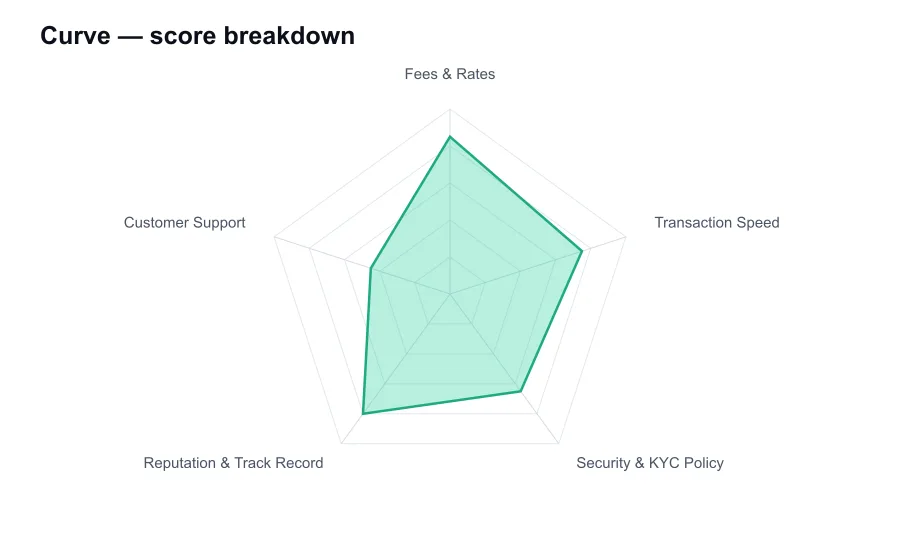
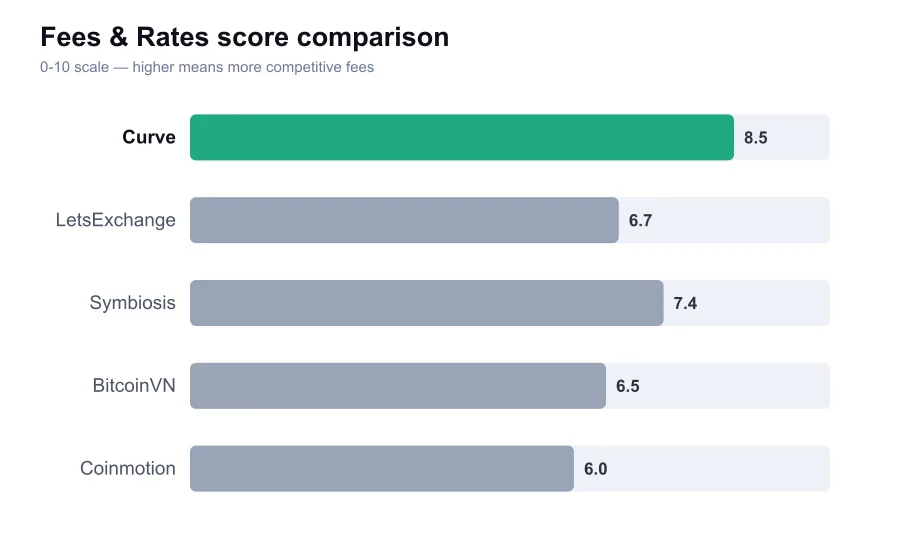
Curve scores 7.3/10 overall in our independent review, measured against every other provider we've compared, strongest on Fees & Rates (8.5/10) and weakest on Customer Support (4.5/10).
7.3/10 How we score →Editorial independence: our scores and rankings are produced using the fixed criteria above and are not influenced by advertisers. This is an independent ranking site and is not operated by, or affiliated with, any provider we list.
Affiliate disclosure: some links on this page may earn us a commission at no extra cost to you. This does not affect our rankings.
Curve is one of DeFi's foundational exchanges, although calling it a simple exchange undersells what it does. It is an automated market maker built primarily for assets that should trade close to the same price, such as stablecoins, wrapped Bitcoin variants, and liquid staking tokens. Its best pools have long been places where sophisticated users go to make large stablecoin swaps with less slippage than they would find on a conventional constant product DEX.
The important distinction is that Curve is a protocol, not a customer service heavy centralized exchange. You connect a self custody wallet, approve contracts, and interact with liquidity pools directly. There is no account dashboard with a password reset button, no custody of your coins by Curve, and usually no identity check. That design is exactly why it remains useful, but it also asks more of the user than Coinbase, Kraken, or even a polished instant swap service.
Curve's pricing can be excellent, particularly for a swap such as USDC to USDT or stETH to ETH in a deep, balanced pool. The classic pool fee is commonly 0.04%, though individual pools and newer pool designs can use different fee settings. In practice, the displayed price is only part of the cost. Ethereum gas can turn a tiny swap into an uneconomical one, especially during a busy market, and an imbalanced pool can create meaningful price impact.
The protocol's dynamic fee logic is sensible. Fees can rise as a pool becomes more imbalanced, which helps protect liquidity providers from traders extracting value during stressed conditions. For traders, that means Curve is not always the cheapest venue at the exact moment a stablecoin is wobbling. A quoted 0.04% fee is not a promise that a large order will settle near par if the pool is already heavily tilted toward the asset you are buying.
This is why experienced users compare routes through aggregators such as 1inch, Matcha, CoW Swap, or Paraswap instead of assuming Curve will win every trade. Curve often supplies the liquidity beneath those routes, which says a lot about its market importance. But direct use makes the most sense when you know the pool, understand the token wrappers involved, and can judge whether gas and price impact justify bypassing an aggregator.
Speed is determined far more by the underlying chain than by Curve's interface. On Ethereum mainnet, a swap is normally visible quickly but final settlement depends on block inclusion and the gas price you choose. On networks such as Arbitrum, Optimism, Base, and Polygon, the interaction can feel substantially faster and cheaper. The trade off is that bridge risk, chain fragmentation, and different pool depth become part of the decision.
Curve has a reputation for deep liquidity, but it also has a history that should stop anyone from treating it as risk free plumbing. The July 2023 Vyper compiler vulnerability affected several Curve pools and led to a major exploit. Curve has also been exposed to the broader risks of DeFi, including oracle assumptions, smart contract bugs, depegs, governance concentration debates, and liquidity that can disappear when incentives change.
That history does not mean Curve is uniquely unsafe. It means the protocol has been tested in public, sometimes painfully. Curve's team, white hats, liquidity providers, and wider DeFi community have responded to incidents and recovered significant funds in past events. Still, recovery efforts are not a guarantee. If you deposit into a pool, you are accepting smart contract risk and the risk that supposedly stable assets may not remain stable.
The lack of KYC is a real advantage for users who value privacy and permissionless access. A wallet can interact with Curve without supplying a passport, selfie, or residential address. But no KYC does not equal anonymity in an absolute sense. Public blockchain transactions are traceable, wallet activity can be analyzed, and fiat on and off ramps often impose their own checks.
Security also depends heavily on the wallet you bring. Curve cannot protect someone who signs a malicious approval, uses a compromised browser extension, or sends funds to a fake site. Bookmarking curve.fi, checking transaction prompts, revoking unused token approvals, and using a hardware wallet for substantial balances are basic precautions here. The protocol's permissionless design offers fewer guardrails than a regulated broker, by design.
Curve's governance and CRV token created one of DeFi's most influential liquidity incentive systems. The veCRV model encouraged long term locking and generated the so called Curve Wars, where protocols competed for CRV voting power and emissions. That influence built a powerful liquidity network, but it has also made Curve governance feel opaque and highly financialized to ordinary users. This is a platform shaped by professional DeFi participants, not beginners.
Customer support is the weak point, though that is normal for a protocol rather than a company holding customer accounts. Documentation, Discord, community channels, and public developer resources can help with ordinary questions. They are not a substitute for a support agent who can reverse a mistaken transfer or investigate a missing deposit. If a transaction is confirmed correctly on chain, there is usually nothing for Curve support to undo.
The interface has improved over the years, but it still rewards patience. Token names, pool variants, gauges, LP tokens, wrappers, and reward mechanisms can confuse someone who only wants to exchange one coin for another. The protocol also evolves quickly, so a tutorial from two years ago can be misleading. Users should read current pool information rather than blindly following old social posts.
For the right job, Curve remains exceptionally good. It is one of the strongest places in DeFi for efficient stable asset trading and for liquidity provision by users who understand impermanent loss, depeg exposure, and incentive risk. I would not recommend it as a first crypto purchase or as a place to park savings just because a pool advertises a high yield. Curve is powerful infrastructure, not a safety deposit box.
My view is that Curve deserves respect, not blind trust. Its fees can be very competitive, its liquidity remains strategically important, and its no KYC model is genuinely useful. Yet its exploit history, complex pool mechanics, and limited human support make it a poor fit for anyone who needs certainty and recourse. Treat it as an advanced DeFi venue, verify every pool before depositing, and keep position sizes sensible.
| Criterion | Score (0-10) | Notes |
|---|---|---|
| Fees & Rates | 8.5 | Often 0.04% in classic pools, plus network gas |
| Transaction Speed | 7.5 | Fast on L2s, Ethereum speed depends on gas |
| Security & KYC Policy | 6.5 | Self custody, but material smart contract risk |
| Reputation & Track Record | 8.0 | A major DeFi liquidity venue with a tested history |
| Customer Support | 4.5 | Community help, not account level rescue support |
| Pros | Cons |
|---|
No. Curve is a permissionless DeFi protocol, so users generally connect a wallet rather than open a verified account. Your wallet activity remains public on the blockchain.
Many classic Curve pools use a 0.04% trading fee, but fees vary by pool and can change with pool conditions. You also pay the blockchain network fee.
It carries smart contract, liquidity, and stablecoin depeg risk. Curve has been exploited in the past, so no pool should be treated as risk free.
| Alternative | Score |
|---|---|
| LetsExchange Review | 7.3/10 |
| BitcoinVN Review | 7.3/10 |
| Symbiosis Review | 7.3/10 |
| Coinmotion Review | 7.3/10 |
| FixedFloat Review | 7.2/10 |
| Godex Review | 7.2/10 |