
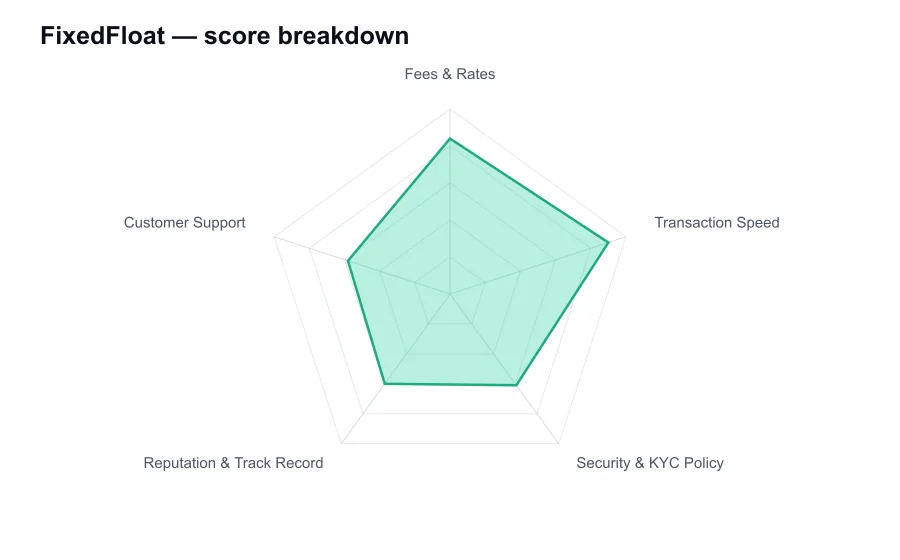
FixedFloat scores 7.2/10 overall in our independent review, measured against every other provider we've compared, strongest on Transaction Speed (9.0/10) and weakest on Customer Support (5.8/10).
7.2/10 How we score →Editorial independence: our scores and rankings are produced using the fixed criteria above and are not influenced by advertisers. This is an independent ranking site and is not operated by, or affiliated with, any provider we list.
Affiliate disclosure: some links on this page may earn us a commission at no extra cost to you. This does not affect our rankings.
FixedFloat is a crypto exchange service with a distinctly technical personality. It is built around rapid, automated, noncustodial swaps and has long been popular with users who value Lightning Network support, direct wallet to wallet conversion and an interface that doesn't demand an account. Compared with friendlier mass market services such as ChangeNOW, FixedFloat feels leaner and more utilitarian. For the right user, that is a virtue.
The name refers to its two rate modes. Float Rate follows the market while the transaction is being executed, while Fixed Rate aims to lock the quoted payout for the stated deposit conditions. The choice matters. A floating exchange can work well in a stable market and may offer a better result, but it exposes the user to price movement. Fixed rate swaps cost more because the service absorbs more execution risk. That is a sensible trade, not a free feature.
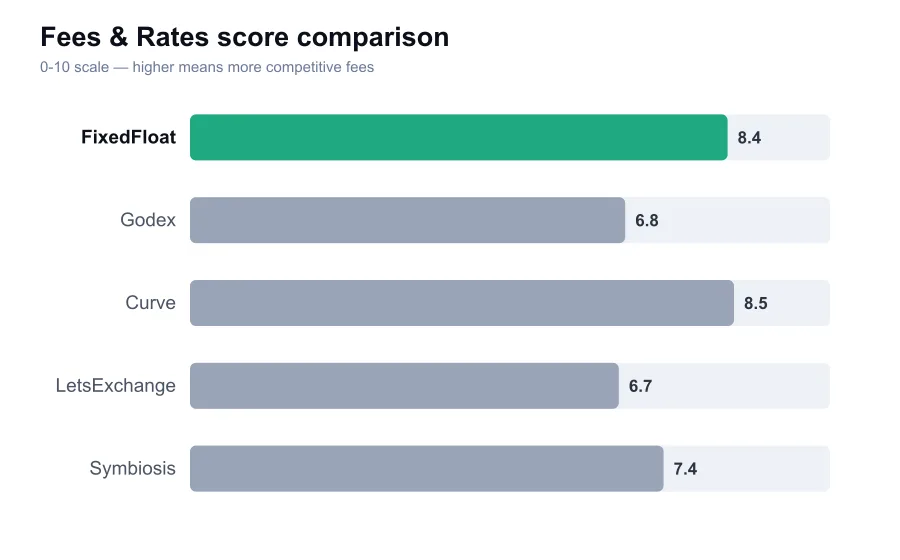
FixedFloat has historically published one of the clearer fee structures in the instant exchange sector. Its Float Rate pricing has been listed at 0.5 percent plus network fees, while Fixed Rate has been listed at 1 percent plus network fees. Users should verify current terms on the quote screen because service policies can change. Still, the willingness to state a baseline fee is a major advantage over competitors that only reveal a final number with no clue where the margin lies.
The quoted network fee deserves attention. It is not a decorative line item. Bitcoin fees can spike, Ethereum gas can make a small ERC20 conversion irrational, and outgoing fees vary by network. FixedFloat's transparent service percentage does not mean the total cost is always low. On large, liquid swaps it can be competitive and very predictable. On a small transaction, the fixed burden of onchain fees can overwhelm the percentage charge.
Its Lightning Network functionality is where FixedFloat has often stood apart. Users who understand invoices, liquidity and payment limits can use Lightning related routes to avoid waiting for ordinary Bitcoin block confirmations in suitable cases. That can make a BTC conversion feel dramatically faster and cheaper. It is not a beginner feature just because it is fast. A malformed invoice, expired invoice or receiving wallet limitation creates a failure mode that a standard onchain user may not anticipate.
For regular onchain swaps, the engine is impressively quick when everything is normal. Once a deposit meets the required confirmations and liquidity is available, a payout is often initiated within minutes. This is one of the more automated services in the field. The qualifier matters because Bitcoin confirmation requirements, a fee starved incoming transaction, Ethereum congestion or a maintenance event can all slow the process. Automation reduces waiting caused by human handling, not the laws of blockchain settlement.
The interface gives experienced users the information they need without drowning them in decorative content. It shows exchange IDs, addresses, status indicators and rate choices clearly. There are also API capabilities that make it attractive to developers and merchants who need programmatic swaps. That said, a bare bones experience can feel unforgiving. Someone unfamiliar with confirmations or wallet networks may find a conventional exchange's guardrails more reassuring.
FixedFloat does not require routine account creation or standard KYC for ordinary exchanges. This is a significant attraction for privacy minded users and for those who simply refuse to hand a passport to every service they try. The policy is not an absolute promise of anonymity. Like other exchange providers, FixedFloat can apply AML procedures and seek information in cases its systems consider suspicious. Anyone presenting it as an unconditional no KYC solution is overselling it.
Noncustodial is also a qualified benefit. FixedFloat doesn't keep an ongoing deposit account in the way a centralized exchange does, so there is less temptation to leave funds exposed in a hosted wallet. During a swap, funds still pass through the provider's execution process. A user must trust the service to make the payout, and must protect themselves against phishing copies of the site. Bookmark the official address and do not follow links from fake support accounts.
The difficult issue is reputation. FixedFloat built a strong following through speed, automation and Lightning support, but its record is not spotless. In 2024, security researchers and the company publicly discussed a compromise involving suspicious transactions and the temporary suspension of service. That episode is important. The service later resumed, but an incident affecting an exchange's operational environment should prevent anyone from treating its technical polish as proof of invulnerability.
That history changes my recommendation for transaction size. FixedFloat remains useful for a well understood, modest swap, particularly for technically capable Bitcoin and Lightning users. It is not where I would route funds whose loss or delay would seriously harm me. The incident also underlines why noncustodial exchange services should not be used as a holding place. Send in, receive out, and move on. Never leave value in the middle of a process longer than necessary.
Support has not traditionally been FixedFloat's strongest selling point. The service emphasizes automation, which is exactly why ordinary orders are fast, but automated businesses can feel distant when an exception occurs. Its support channels and order status information are useful for routine questions. Users caught in an unusual review, a chain issue or a historic service suspension may find that there is no instant human fix. That is the price of a streamlined operation.
There is a real audience for FixedFloat. If you understand wallets, can assess a network fee, and know why you are selecting fixed versus floating rate, it is one of the more capable tools in this market. If you are converting your first crypto purchase and would panic at a delayed confirmation, choose something with more guided support. The product rewards competence more than it teaches it.
My view is that FixedFloat remains technically excellent but operationally harder to recommend without reservations than it once was. Its clear fee model, rapid automation and Lightning expertise are genuine strengths that few instant exchangers match. Yet reputation is earned not only by smooth days but by the worst day a service has faced. Use it deliberately, with a small test and realistic expectations, rather than treating speed as a substitute for risk management.
| Criterion | Score (0-10) | Notes |
|---|---|---|
| Fees & Rates | 8.4 | Published 0.5% float and 1% fixed baseline, plus network fees |
| Transaction Speed | 9.0 | Excellent automation and strong Lightning Network utility |
| Security & KYC Policy | 6.1 | Noncustodial design, tempered by the 2024 security incident |
| Reputation & Track Record | 6.0 | Strong technical following, but a serious incident weighs heavily |
| Customer Support | 5.8 | Automation excels until an unusual case needs human help |
| Pros | Cons |
|---|
FixedFloat has listed a 0.5 percent service fee for Float Rate and 1 percent for Fixed Rate, with network fees added. Confirm the current quote because network costs and policies can change.
Routine swaps generally do not require account registration or standard KYC. The service can still apply AML controls and request information for transactions that trigger risk screening.
It relies heavily on automated processing and supports Lightning Network routes. Onchain exchanges still depend on the incoming transaction receiving enough confirmations and on network conditions.
The service resumed operations, but the incident is a material reason to limit exposure. Use a test transaction, avoid oversized swaps and do not treat any instant exchanger as a storage wallet.
| Alternative | Score |
|---|---|
| Godex Review | 7.2/10 |
| LetsExchange Review | 7.3/10 |
| BitcoinVN Review | 7.3/10 |
| Curve Review | 7.3/10 |
| Symbiosis Review | 7.3/10 |
| Coinmotion Review | 7.3/10 |