
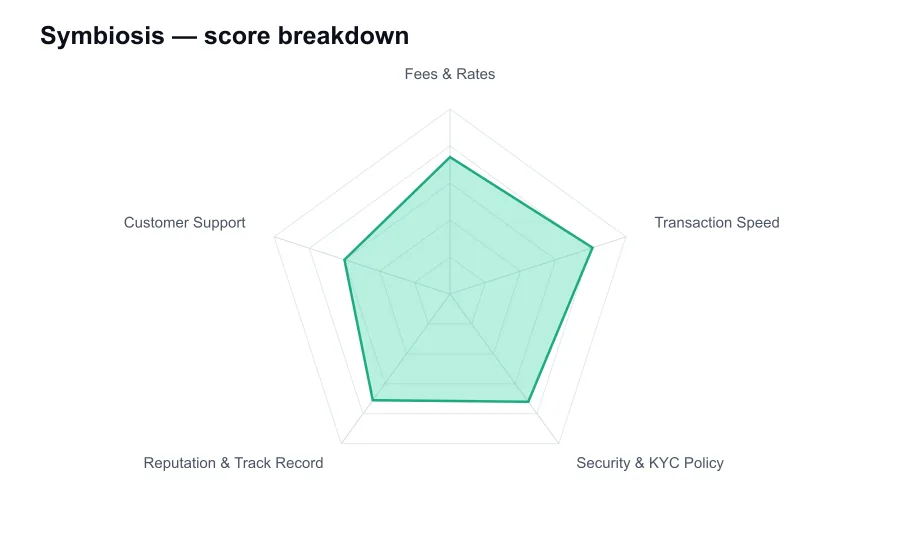
Symbiosis scores 7.3/10 overall in our independent review, measured against every other provider we've compared, strongest on Transaction Speed (8.1/10) and weakest on Customer Support (6.0/10).
7.3/10 How we score →Editorial independence: our scores and rankings are produced using the fixed criteria above and are not influenced by advertisers. This is an independent ranking site and is not operated by, or affiliated with, any provider we list.
Affiliate disclosure: some links on this page may earn us a commission at no extra cost to you. This does not affect our rankings.
Symbiosis is not a conventional crypto exchange. It is a cross chain liquidity protocol built for people who already use DeFi and want to move assets between networks without manually juggling bridges, wrapped tokens, gas tokens, and several browser tabs. Its practical rivals are services such as Across, Stargate, THORChain, LI.FI powered aggregators, and native bridges. That position matters, because judging Symbiosis as if it were Coinbase or Kraken misses the point entirely.
The product's appeal is immediate. A user can swap and bridge in one route, for example moving USDC from an EVM chain to another supported network while receiving an asset that is actually usable at the destination. In its better routes, Symbiosis removes the annoying intermediate step where you receive a bridged token, then need a separate swap and a little native gas. That is real utility, particularly for smaller DeFi users who don't want to think like a bridge operator.
The interface has historically been more approachable than many protocol first cross chain tools. You select source chain, destination chain, token, and desired output, then the app quotes the route. Wallet connection is all that is normally required. There is no account opening, no email registration, and no routine identity check for ordinary onchain swaps. That makes it appealing to privacy minded users, although it also means the user carries much more responsibility for every transaction.
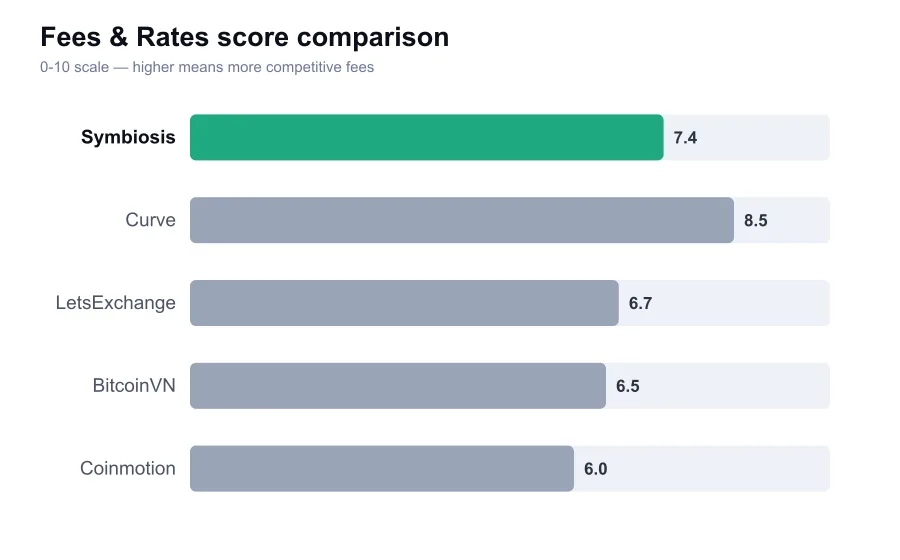
Fees are where a cross chain aggregator needs to be read carefully. Symbiosis does not present a simple flat retail trading fee that covers everything. The price quote can include liquidity provider costs, route or protocol charges, source and destination network gas, bridge execution costs, and the spread embedded in the swap. The exact cost varies substantially by chain, token, liquidity conditions, and route. A cheap looking percentage can still produce a poor result if the token has thin liquidity.
For liquid stablecoin routes, Symbiosis can be competitively priced. The convenience of a single transaction flow can make a modest premium worthwhile compared with paying separate swap and bridge charges. But users should never assume it will be the cheapest path. A direct native bridge, a route through Across, or a swap on a destination chain can occasionally beat the quoted output. The relevant number is the final amount received, not the first fee label that catches your eye.
The platform does a decent job of showing estimated output before confirmation, but DeFi quotes are not promises in the way a card purchase total is a promise. Market movement, price impact, bridge relayer availability, and gas changes can all affect execution. Fixed rate style routes offer more certainty where available, while variable routes may settle with an adjusted result. Large transfers deserve a test transaction, especially if the destination asset is unfamiliar or the route crosses several liquidity pools.
Speed is one of Symbiosis's stronger qualities, though it depends heavily on the networks involved. Many supported routes can complete in minutes rather than the long waiting periods associated with older canonical bridges. The source transaction must first confirm, then the protocol and relayers need to complete destination side execution. Under normal conditions, a stablecoin transfer between active EVM chains often feels quick enough for routine portfolio management.
That said, cross chain speed is not fully in Symbiosis's control. Ethereum congestion, a slow source chain, destination gas shortages, wallet approval issues, and liquidity imbalances can turn a quick quote into a longer wait. A user who needs money to arrive at a precise minute should not rely on any bridge based exchange route. Symbiosis is fast in the DeFi sense, not instant in the bank transfer sense.
Security is the most important reason to keep expectations realistic. Symbiosis is a noncustodial protocol, so it generally does not hold a retail account balance in the way a centralized exchange does. Your connected wallet controls the transaction and there is no password database to protect. That reduces some familiar exchange risks, including a platform freezing a normal wallet balance, but it replaces them with smart contract risk, bridge risk, wallet phishing risk, and irreversible transfer risk.
The project has published audit information and has operated as a visible multichain protocol, which is better than trusting a newly launched anonymous bridge. Still, audits are not insurance and no bridge should be treated as risk free. Cross chain systems have repeatedly been among crypto's most expensive attack surfaces. The sensible approach is to use a hardware wallet, verify the official domain, review token approvals, and avoid parking funds in a route just because a yield or campaign looks attractive.
Its no routine KYC model is a genuine feature for users who value permissionless access. It is not a guarantee that every transaction will be frictionless. Sanctions screening can occur at infrastructure or liquidity partner level, and a destination wallet or centralized off ramp may apply its own restrictions. Users should also understand that no KYC means no conventional recovery desk. Send to the wrong chain or sign a malicious approval, and there may be nobody with the ability to reverse it.
Symbiosis has a recognizable record in the DeFi niche, but it does not have the institutional history, licensing footprint, or balance sheet transparency of a major regulated exchange. Its reputation rests mainly on continued protocol operation, integrations, community activity, and the quality of its cross chain execution. That is enough for experienced onchain users to consider it, but not enough to make it a place for life savings or a first crypto purchase.
Support is available through community channels and documentation rather than a traditional staffed brokerage call center. For a stuck transaction, users will usually need a transaction hash, source and destination wallet addresses, route details, and patience. Community support can be helpful with a clear technical issue. It is less reassuring for an anxious newcomer who simply wants a phone number and a guaranteed resolution time.
Documentation has improved the experience, particularly around supported networks and basic bridging mechanics, but some edge cases remain technical. A failed route may require understanding whether the source swap succeeded, whether the bridge message was relayed, or whether destination execution needs a manual claim. That is normal in DeFi, yet it is exactly why Symbiosis is more suitable for users who can read a block explorer than for people learning what a wallet is.
I like Symbiosis as a practical cross chain tool, not as a blind default. It earns its place by packaging bridge and swap steps into a cleaner transaction than many DIY workflows. Its competitive quotes and noncustodial design are meaningful advantages. The compromise is unavoidable: pricing is route dependent, support is limited by DeFi's self service nature, and smart contract risk never disappears.
My view is that Symbiosis is best used deliberately. Compare the received amount against one or two alternatives, begin with a small transfer, and use it for assets and chains you understand. For active multichain DeFi users, it can save time and reduce operational mistakes. For a newcomer who wants fiat deposits, human account recovery, and regulated custody, it is simply the wrong category of service.
| Criterion | Score (0-10) | Notes |
|---|---|---|
| Fees & Rates | 7.4 | Competitive route quotes, but network and liquidity costs vary. |
| Transaction Speed | 8.1 | Many active routes settle within minutes. |
| Security & KYC Policy | 7.2 | Noncustodial, audited protocol, but bridge risk remains. |
| Reputation & Track Record | 7.1 | Established DeFi presence, not a regulated exchange. |
| Customer Support | 6.0 | Documentation and community help, no traditional desk. |
| Pros | Cons |
|---|
Routine wallet based swaps and bridges generally do not require account registration or standard KYC. External wallets, on ramps, and destination services may have their own compliance requirements.
Many routes complete in minutes, but timing depends on source confirmations, network congestion, relayer activity, liquidity, and destination chain conditions.
No. The final quote can include swap spread, liquidity costs, bridge execution costs, and gas. Check the amount you will receive before approving the transaction.
| Alternative | Score |
|---|---|
| LetsExchange Review | 7.3/10 |
| BitcoinVN Review | 7.3/10 |
| Curve Review | 7.3/10 |
| Coinmotion Review | 7.3/10 |
| FixedFloat Review | 7.2/10 |
| Godex Review | 7.2/10 |