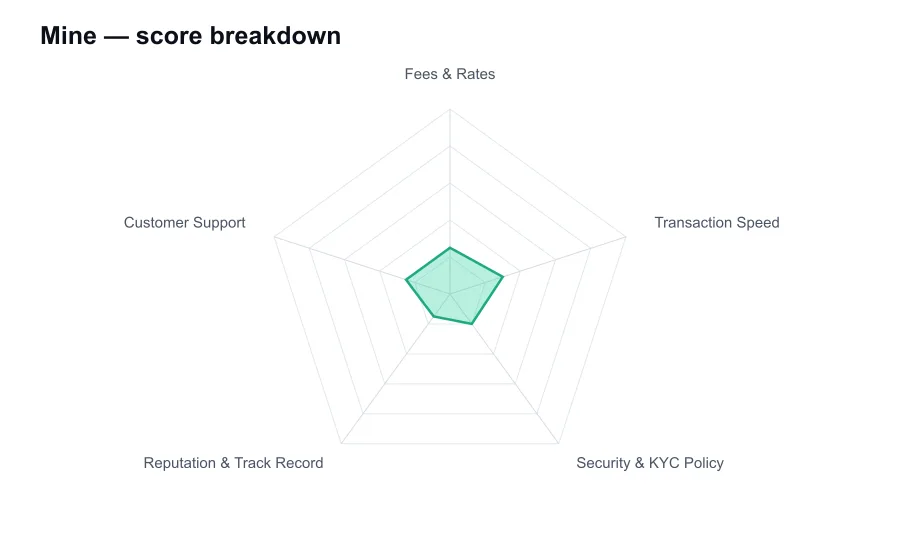
Mine scores 2.3/10 overall in our independent review, measured against every other provider we've compared, strongest on Transaction Speed (3.0/10) and weakest on Reputation & Track Record (1.5/10).
2.3/10 How we score →Editorial independence: our scores and rankings are produced using the fixed criteria above and are not influenced by advertisers. This is an independent ranking site and is not operated by, or affiliated with, any provider we list.
Affiliate disclosure: some links on this page may earn us a commission at no extra cost to you. This does not affect our rankings.
Mine is an unusually difficult name to evaluate as a crypto exchange provider because it is generic and shared across mining businesses, token projects, apps, and unrelated companies. That is not a minor branding inconvenience. In crypto, identity confusion is a direct security problem. If a user cannot confidently distinguish the intended service from similarly named websites and social accounts, the risk of depositing to an impersonator rises before any trading risk is even considered.
I could not establish a single, sufficiently authoritative official exchange identity for Mine that would justify publishing a website address or presenting it as a verified mainstream trading venue. Rather than invent certainty, this review treats Mine as an unverified provider label. That may sound severe, but a publication readers trust should not turn an ambiguous name into a false endorsement merely because a trading interface or token page exists somewhere online.
A legitimate platform should make several facts straightforward to verify: the legal entity operating it, country of registration, physical or regulatory contact details, service terms, supported assets and networks, fee methodology, custody arrangement, and complaint route. Mine does not have a broad, independently corroborated public profile that makes these facts clear. A user should not need to rely on a Telegram post or a search advertisement to determine who holds their funds.
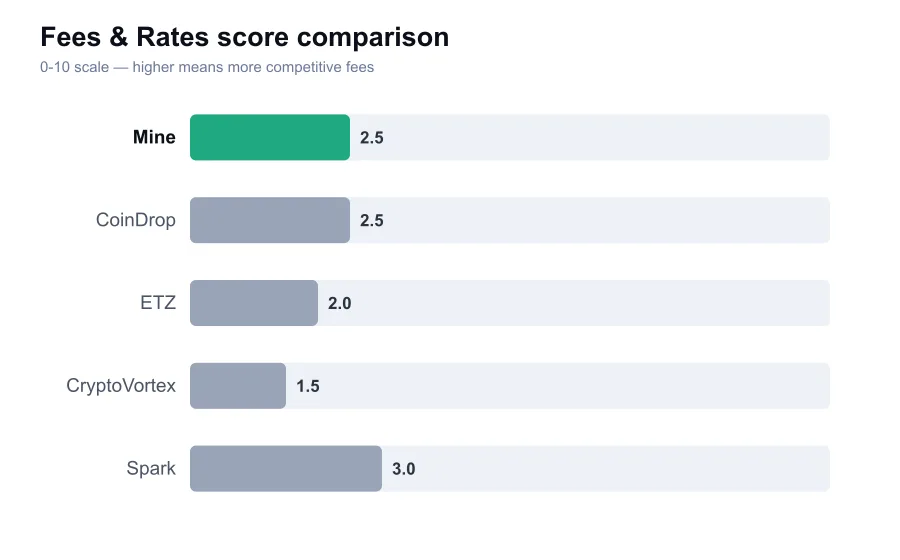
The fee question illustrates the issue perfectly. I could not verify a current official maker and taker table, an instant-swap spread policy, deposit rules, withdrawal charges, or a credible explanation of whether quoted prices include execution markups. Without that information, a low advertised fee means nothing. Hidden spread is one of the oldest ways small crypto services make a trade look inexpensive while delivering a materially worse result than a liquid market.
If someone encounters a Mine-branded quote, compare it against a real reference price from a high-liquidity venue at the same moment. Then add the full cost of moving the asset, including network fees and any minimum withdrawal amount. Do not send a large deposit simply because the displayed rate beats a familiar exchange by a suspicious margin. Exceptional prices often signal stale data, thin liquidity, unsupported transaction paths, or a problem much worse than any of those.
Speed is impossible to score generously without evidence. Fast crypto exchange services need reliable deposit detection, clear confirmation thresholds, adequate liquidity, working hot-wallet operations, and risk controls that don't leave legitimate withdrawals in limbo. A platform can process one small transaction promptly and still fail during congestion or market volatility. Mine has no substantial, verifiable collection of operational data or credible long-term user evidence that would support strong claims in this category.
For any unproven service, test transactions are more than a sensible precaution. They are the only responsible method, if one uses it at all. Use a trivial amount, choose a familiar asset and network, preserve the transaction hash, and wait until the asset reaches a wallet you control. Never test with funds that need to arrive by a deadline. Also confirm memo, tag, and network requirements directly from the receiving platform, not from a cached search result.
Security disclosure is limited or too ambiguous to verify. I could not establish public proof of reserves, independent security audits, named custody partners, cold-storage procedures, incident reporting standards, insurance coverage, or a well documented vulnerability disclosure program tied to one confirmed Mine exchange. These details don't guarantee safety, but their absence makes a safety claim impossible to assess. In crypto, opacity is itself a risk factor.
KYC and compliance procedures are similarly unclear. Some users see vague or absent KYC messaging as a privacy benefit. I see it as a reason to be cautious if there is no precise policy explaining prohibited jurisdictions, source-of-funds reviews, document handling, retention, and refund procedures. The ugly scenario is not being asked for identification before a trade. It is being asked after a deposit, with no transparent appeal process and no clear timeline for the funds.
Reputation cannot be built from anonymous review snippets, promotional influencer posts, or a large follower count. A dependable exchange leaves a trail: corporate records, named executives, years of press coverage, regulator disclosures where applicable, public incident responses, and a diverse body of customer experience. Mine does not have a sufficiently clear trail of that kind. The provider therefore scores poorly not because every unknown platform is fraudulent, but because it has not earned the presumption of reliability.
Support is where customers discover whether a platform is real in the practical sense. A failed transfer demands more than a chatbot. It requires a ticket reference, a knowledgeable response, access to blockchain records, and someone empowered to resolve a problem. I could not verify established support hours, official response channels, or escalation standards for Mine. Do not trust unsolicited support accounts, particularly those that ask to move a conversation to a private chat.
The generic name makes phishing defense especially important. Type the verified address manually once it has been independently confirmed, bookmark it, inspect the certificate and domain carefully, and never install a browser extension or mobile application from a direct message. Search engines can display advertisements from impostors, and cloned pages can duplicate a legitimate looking interface almost perfectly. A wallet signature can authorize damage faster than a password theft.
There is no sensible case for using Mine as a primary exchange, payroll destination, merchant settlement account, or long term custodian while its identity and operations remain hard to verify. The apparent convenience of a new service does not compensate for the absence of recourse. A regulated exchange may have its own drawbacks, including KYC and withdrawal reviews, but at least users can evaluate the operator and understand where to escalate a dispute.
Mine could change this assessment by establishing a distinct official brand presence and publishing complete legal, technical, and economic documentation. It would need verifiable company details, clear trading and withdrawal fees, visible security controls, independently reviewed code or custody evidence where relevant, and support accountability. Those are not burdens designed to favor big companies. They are the basic signals that separate a financial service from a website asking for crypto.
My final judgment is simple: Mine is too ambiguous and insufficiently verified to recommend. The downside of being wrong is a lost deposit or an unrecoverable wallet approval, while the upside is merely using another exchange interface. That is an awful risk-reward calculation. Use recognized platforms for normal crypto activity, and regard any Mine-branded service as high risk until you can independently prove exactly who operates it and how it protects customers.
| Criterion | Score (0-10) | Notes |
|---|---|---|
| Fees & Rates | 2.5 | No dependable verified fee or spread disclosure found. |
| Transaction Speed | 3.0 | No credible public performance record to assess. |
| Security & KYC Policy | 2.0 | Operator identity and security controls are not clearly verifiable. |
| Reputation & Track Record | 1.5 | Generic identity creates major verification and phishing concerns. |
| Customer Support | 2.5 | No established official support and escalation record. |
| Pros | Cons |
|---|
I could not verify one authoritative official exchange domain with enough confidence to publish it. Treat similarly named sites and social accounts as unverified until independently confirmed.
I could not confirm a reliable public schedule for trading fees, spreads, deposits, or withdrawals. Do not rely on an advertised quote without comparing it to a liquid market.
I would not recommend sending funds because the provider identity, security disclosures, and operating record are too unclear to assess responsibly.
| Alternative | Score |
|---|---|
| CoinDrop Review | 2.4/10 |
| ETZ Review | 1.8/10 |
| CryptoVortex Review | 1.7/10 |
| Spark Review | 2.9/10 |
| Magnatus Review | 3.0/10 |
| HotExchange Review | 3.1/10 |