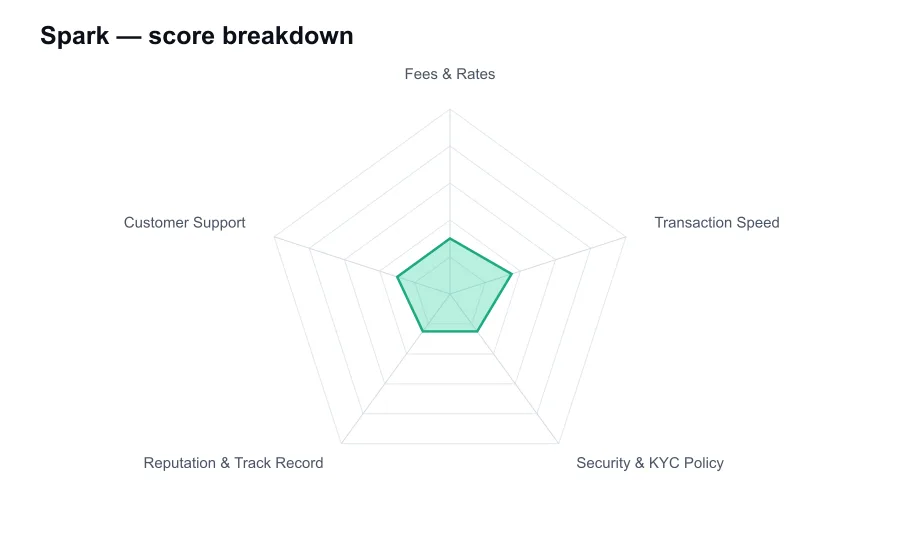
Spark scores 2.9/10 overall in our independent review, measured against every other provider we've compared, strongest on Transaction Speed (3.5/10) and weakest on Reputation & Track Record (2.5/10).
2.9/10 How we score →Editorial independence: our scores and rankings are produced using the fixed criteria above and are not influenced by advertisers. This is an independent ranking site and is not operated by, or affiliated with, any provider we list.
Affiliate disclosure: some links on this page may earn us a commission at no extra cost to you. This does not affect our rankings.
Spark is the hardest name in this group to assess because the branding is vague and several unrelated crypto products have used it. That alone is a problem. A swap service should make its legal identity, operating company, supported regions, custody model, and fee mechanics easy to locate before a user has to send funds. Spark does not have the public footprint, documentation depth, or established independent review trail I would expect from a serious exchange provider.
That does not automatically mean it is dishonest. Small crypto services can be legitimate, especially during an early launch phase. But anonymity is not a feature when it extends to the operator rather than merely protecting users from unnecessary data collection. A service asking people to trust it with an irreversible blockchain transfer needs to earn that trust through clear disclosures, visible infrastructure, and a record of resolving real problems.
The first issue is basic verification. I could not confidently identify a single established instant exchange business operating under the standalone Spark name with the same level of public documentation available from StealthEX, ChangeNOW, FixedFloat, or SimpleSwap. There are well known crypto projects called Spark, including lending and Bitcoin related products, but those are not necessarily retail swap desks. Treating every product with the word Spark in its name as the same provider would be careless.
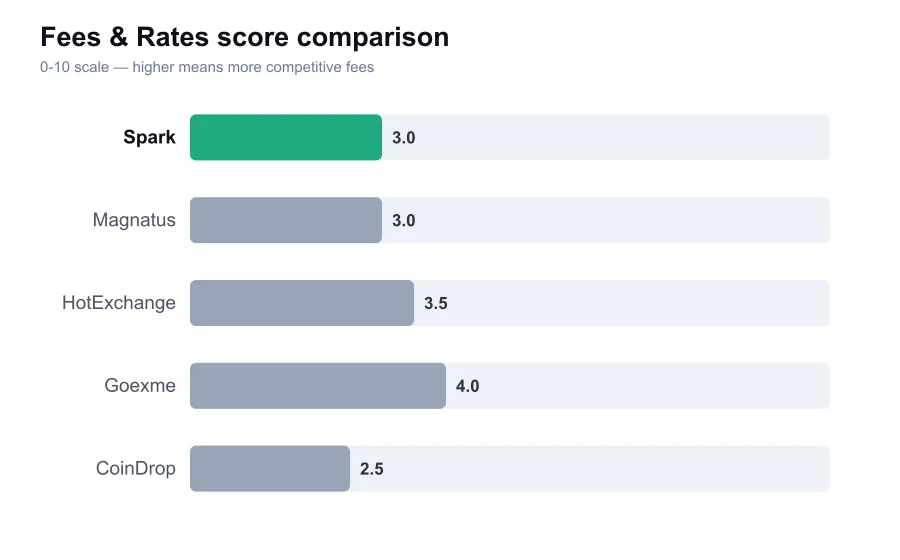
That uncertainty affects the fee score more than people might think. A reputable instant exchange can charge a spread, a fixed service fee, miner fees, and partner liquidity fees, provided it shows the quote before the deposit is made. With Spark, the available public material is too thin to verify a standard fee schedule, a fixed rate premium, or how the final quoted amount is calculated. A low headline price means very little if the execution rate cannot be independently checked.
If you encounter a Spark branded swap page, compare its quote with at least two established alternatives before sending anything. Check the exact deposit amount, expected receive amount, network fee, and whether the rate is fixed or floating. A floating quote can legitimately move during confirmation, particularly for smaller or volatile assets. It should not, however, turn into a vague explanation for a materially worse result without transaction details.
Speed is also impossible to rate generously without observable service data. Blockchain settlement itself may be quick, but an instant exchange has to detect the incoming deposit, wait for the required confirmations, obtain liquidity, complete the conversion, and broadcast the outgoing transaction. Bitcoin and Ethereum swaps can take from several minutes to well beyond an hour during congestion. A provider with limited transparency gives users no reliable way to distinguish ordinary network delay from a stalled order.
A good exchange status page should show the order state, deposit address, confirmations received, transaction hash, expected completion, and a clear route to human help. Those details matter most when a swap goes wrong. If Spark offers them consistently, that would improve the case for using it. I could not verify a mature public status system or a documented service level that would justify treating it as a fast, battle tested venue.
Security is where the lack of clarity becomes more serious. Noncustodial swaps are often safer than keeping a balance at a centralized exchange because the provider should only handle funds during the conversion. That description is not enough by itself. Users need to know whether Spark controls the exchange execution, routes it to partners, retains logs, uses address screening, and can freeze an order for compliance checks.
No KYC is not synonymous with no risk. Many instant exchanges let users start without registration but reserve the right to request identity documents if blockchain analytics flags a transaction. That is a defensible anti money laundering practice if the policy is stated clearly. The bad version is discovering it only after your coins are held and support cannot explain what documents are needed or how long a review will take.
Spark's reputation score is necessarily low, not because there is a large, proven body of complaints, but because there is not enough dependable evidence of a long operating history. Reputation is built from more than a polished landing page and a few promotional mentions. I look for dated company information, active support channels, external review patterns, public incident handling, and evidence that the brand has survived difficult market periods.
This is especially important in the swap market because cloned websites are common. Before using any little known service, verify the domain through official social accounts, avoid links from ads or direct messages, and send a very small test transaction. Bookmark the site after verifying it. Never rely on a search result alone, since impersonation pages can look nearly identical to the real service.
Customer support is another area where Spark needs proof rather than promises. A chat bubble is not meaningful if it leads to generic replies or disappears once an order is delayed. The useful test is whether support can identify an order, explain its onchain state, provide relevant transaction hashes, and give a realistic resolution path. Until that record is visible, users should assume support capacity may be limited.
I would not use an unclear Spark branded exchange for a large conversion, a time sensitive payment, or assets that would be difficult to replace. There are too many established noncustodial services with published operating policies to justify taking that leap. A small test may be reasonable for an experienced user who has independently verified the exact operator and domain, but it is not a recommendation for newcomers.
My view is blunt. Spark might refer to a legitimate niche product, but the standalone exchange identity is too poorly substantiated to score as a dependable provider. Lack of verifiable detail is itself an operational risk in crypto. Until Spark publishes clear ownership, fee treatment, KYC rules, support standards, and a sustained public track record, it belongs in the watchlist rather than the regular trading toolkit.
| Criterion | Score (0-10) | Notes |
|---|---|---|
| Fees & Rates | 3.0 | No reliably verifiable public fee schedule |
| Transaction Speed | 3.5 | Little public evidence of execution performance |
| Security & KYC Policy | 2.5 | Operator and policy transparency need work |
| Reputation & Track Record | 2.5 | Too little established independent track record |
| Customer Support | 3.0 | Support quality is difficult to verify publicly |
| Pros | Cons |
|---|
The standalone Spark exchange identity is not clear enough to verify confidently. Confirm the exact operator, domain, terms, and transaction model before sending funds.
I could not verify a consistent public KYC policy for a standalone Spark exchange. Assume identity checks may be requested if a transaction is flagged.
No. Without a well documented operating history and transparent support process, use only a small test amount after independently verifying the service.
| Alternative | Score |
|---|---|
| Magnatus Review | 3.0/10 |
| HotExchange Review | 3.1/10 |
| Goexme Review | 3.3/10 |
| CoinDrop Review | 2.4/10 |
| Mine Review | 2.3/10 |
| Lizex Review | 3.6/10 |