
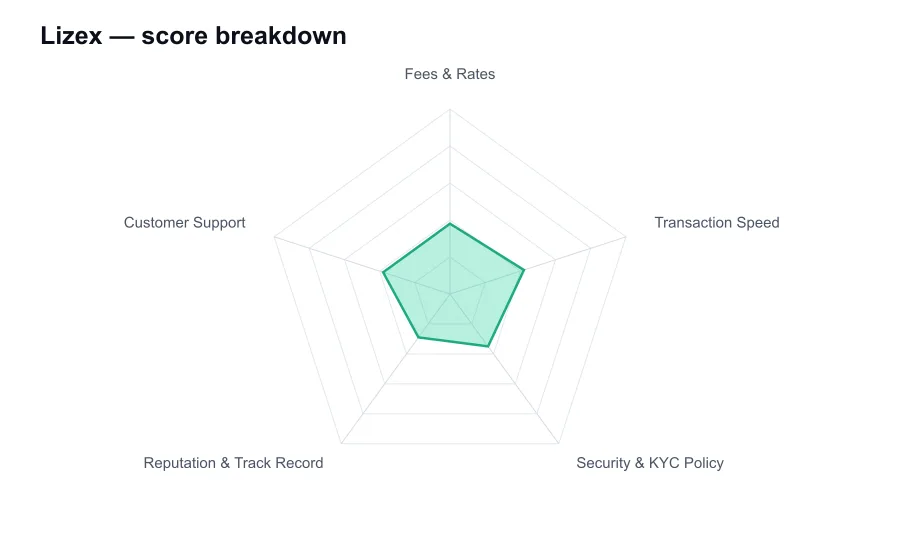
Lizex scores 3.6/10 overall in our independent review, measured against every other provider we've compared, strongest on Transaction Speed (4.2/10) and weakest on Reputation & Track Record (2.9/10).
3.6/10 How we score →Editorial independence: our scores and rankings are produced using the fixed criteria above and are not influenced by advertisers. This is an independent ranking site and is not operated by, or affiliated with, any provider we list.
Affiliate disclosure: some links on this page may earn us a commission at no extra cost to you. This does not affect our rankings.
Lizex is a much less established name than the major crypto exchanges and instant-swap brands in this review. That fact should shape the entire evaluation. A lesser-known provider can offer a clean interface, attractive pricing, and useful pairs, but it has not earned automatic trust simply by existing online. In crypto, a polished website is cheap to build. A durable reputation, transparent ownership, reliable liquidity, and a proven record of handling withdrawals are much harder to establish.
The available public footprint around Lizex is limited compared with platforms such as Kraken, Coinbase, Bitstamp, LetsExchange, or even established niche decentralized protocols. I would not treat it as a provider with the same level of independently verifiable operating history. That does not prove wrongdoing. It does mean a critical reviewer cannot responsibly fill gaps with assumptions. If a service's legal entity, leadership, jurisdiction, licensing status, or security practices are unclear, that uncertainty is itself a material risk.
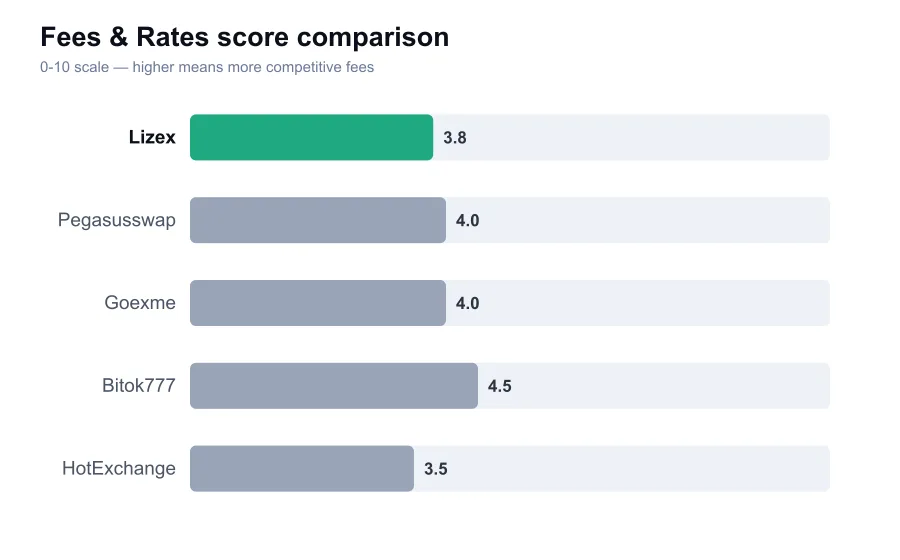
For an exchange provider, the first test is whether users can see exactly what they are paying. Lizex should publish a clear trading-fee schedule, withdrawal-fee policy, spread methodology, and any deposit charges. Without readily verifiable fee documentation, users have no reliable way to distinguish a competitive rate from an attractive-looking price padded by a spread. Hidden cost is especially dangerous with crypto conversions because the customer often notices it only after the transaction has settled.
A low advertised fee is not enough. The effective cost of trading includes the bid-ask spread, available order-book depth, slippage, network withdrawal charge, and any conversion fee applied before withdrawal. A small provider can claim a low maker or taker fee while offering thin liquidity that costs far more than a larger venue. Before using Lizex, compare the final expected result against a known exchange and inspect whether the price differs materially from a widely referenced market rate.
There is also a basic liquidity issue. Deep markets are not just useful for professional traders. They determine whether a buyer can enter and exit without being punished by slippage. Large exchanges support this through broad user participation, market makers, and established banking or liquidity relationships. A small platform may show a pair on screen but still route it through external providers, pause it during volatility, or offer a price that moves sharply once an order is placed.
Speed claims deserve the same skepticism. Blockchain deposits depend on network confirmations, and withdrawals require an exchange to process requests and broadcast transactions. A reliable venue publishes confirmation requirements, withdrawal status, transaction IDs, maintenance notices, and realistic processing windows. If Lizex cannot demonstrate these basics consistently, users should not send funds on the assumption that a withdrawal will be immediate. The right way to test any little-known exchange is a tiny deposit, a small trade, and a prompt withdrawal.
Security is where the burden of proof is highest. Reputable custodial exchanges normally disclose some combination of cold-storage practice, two-factor authentication, withdrawal confirmation controls, device management, proof-of-reserves work, penetration testing, bug bounty activity, compliance registration, or named security leadership. No single item proves safety, and proof of reserves alone does not prove solvency. But a platform that offers little verifiable detail provides customers few reasons to believe their assets are protected.
Users should never confuse login security with exchange solvency. Lizex may allow a password and two-factor authentication, but that only protects the account from one class of attack. It does not tell customers whether the operator holds adequate reserves, segregates user assets, has secure key management, or can survive a market shock. These are the questions that became impossible to ignore after exchange collapses across the industry. A provider needs evidence, not reassuring slogans.
KYC policy is another area where clarity matters. If Lizex collects identification, users should know which legal entity receives it, what verification partner is involved, how documents are stored, and under what circumstances withdrawals can be restricted. If it advertises no KYC, users should still read the compliance terms closely. Many crypto services permit a low-friction start but reserve the right to request documents after funds arrive. That can be legally understandable, but it is a poor surprise for a customer with money already locked in a review.
The safest posture is to assume that any centralized provider can apply AML controls, request source-of-funds documents, or delay a transfer. With a well-known regulated exchange, customers at least have a clearer corporate counterparty and more public avenues for escalation. With an obscure name, that same event is much harder to assess. Do not send funds that you cannot afford to have unavailable for an extended period. This is not paranoia. It is basic counterparty management.
Reputation cannot be manufactured by a few testimonials, referral posts, or an impressive Trustpilot-style score without context. Look for long-running independent discussion, identifiable executives, company registration details, consistent user reports over several market cycles, and evidence that withdrawals work during busy periods. Lizex does not presently have the depth of public track record I would want before recommending it for meaningful balances. Lack of visible controversy is not the same as a strong reputation.
Support is particularly important at smaller exchanges because processes are less likely to be automated at institutional quality. A good provider offers clear help channels, published service hours, ticket references, status updates, and a transparent complaint process. A bad one hides behind chat widgets, generic mailbox replies, or social-media messages. Before depositing with Lizex, test the support channel with a specific question about withdrawal fees, jurisdiction, and KYC. The quality and speed of the answer will tell you more than marketing copy.
Even responsive support does not solve a weak operating history. A friendly agent can explain a pending ticket, but cannot substitute for audited controls, liquidity, or legal accountability. This is why I would not judge Lizex by interface design or a promotional rate. The relevant comparison is not with the worst sites in crypto. It is with exchanges that have survived stress events, maintain recognizable compliance programs, and have enough customer history for reviewers to identify recurring strengths and failures.
For someone determined to try Lizex, caution should be practical rather than theatrical. Use a unique password and authenticator-based two-factor authentication. Never reuse a password from email or another exchange. Deposit the minimum amount necessary, avoid storing assets there, record every transaction hash, and withdraw a test amount before making a larger commitment. Do not pay an unexpected extra fee to unlock a withdrawal. That is a major warning sign across the industry.
I would also avoid relying on any unknown platform for fiat transfers, leverage, yield products, or long-term custody unless its regulatory position and terms are independently verified. Those services create more points of failure than a simple crypto withdrawal. If Lizex offers unusually high returns, unrealistic referral rewards, or prices that consistently beat liquid global markets, that should increase skepticism rather than enthusiasm. In markets this competitive, offers that look too generous often have a catch.
Lizex may eventually develop the disclosure, user history, and infrastructure needed to compete with recognized providers. At present, the evidence available to a cautious reviewer is not strong enough to recommend it beyond a tightly controlled test. The score here reflects uncertainty, not an assertion that every transaction will fail. But customers do not need to prove an exchange unsafe before choosing a safer alternative. The operator needs to prove it deserves custody of customer assets.
My final judgment is blunt. Lizex has not demonstrated the track record or transparency required for serious use. A curious, technically experienced user could conduct a very small test after independently verifying the official domain and terms. Most people should choose an established exchange or a well-known non-custodial protocol instead. In crypto, the best reason to avoid an unproven provider is not fear. It is that trustworthy alternatives already exist.
| Criterion | Score (0-10) | Notes |
|---|---|---|
| Fees & Rates | 3.8 | Fee transparency and effective pricing need verification. |
| Transaction Speed | 4.2 | Limited independent evidence of consistent execution speed. |
| Security & KYC Policy | 3.5 | Public security and custody evidence appears limited. |
| Reputation & Track Record | 2.9 | Insufficient independently verifiable operating track record. |
| Customer Support | 3.8 | Test support before depositing meaningful funds. |
| Pros | Cons |
|---|
There is not enough widely verifiable public information to treat Lizex as equivalent to established exchanges. If you use it, begin with a minimal test and withdraw promptly before sending more.
I would not keep meaningful long-term balances on a provider with a limited independently verified track record. Move assets to self-custody or a better-established venue after any test transaction.
Verify the official domain independently, enable authenticator-based two-factor authentication, send the minimum amount, make one small trade if needed, and test a withdrawal to your own wallet.
| Alternative | Score |
|---|---|
| Pegasusswap Review | 3.7/10 |
| Goexme Review | 3.3/10 |
| Bitok777 Review | 4.1/10 |
| HotExchange Review | 3.1/10 |
| YaObmen Review | 4.2/10 |
| Magnatus Review | 3.0/10 |