
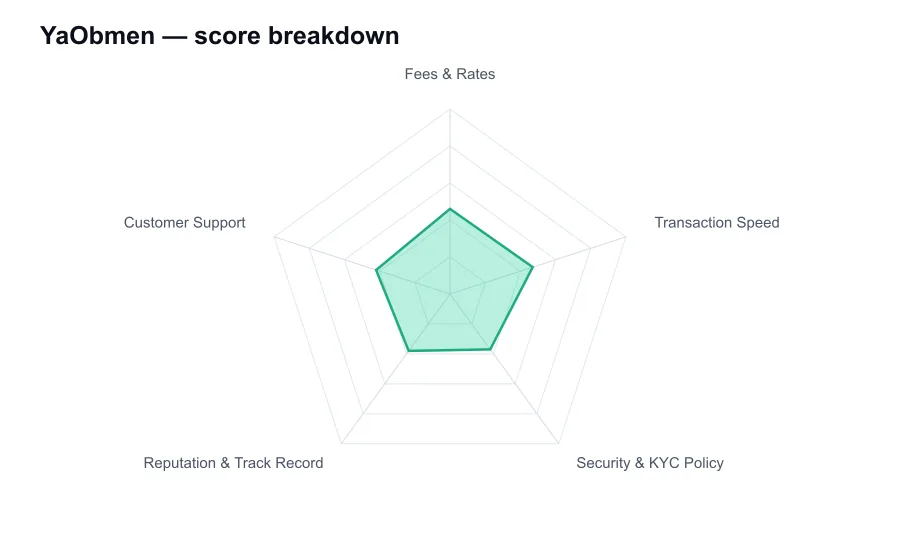
YaObmen scores 4.2/10 overall in our independent review, measured against every other provider we've compared, strongest on Transaction Speed (4.7/10) and weakest on Security & KYC Policy (3.7/10).
4.2/10 How we score →Editorial independence: our scores and rankings are produced using the fixed criteria above and are not influenced by advertisers. This is an independent ranking site and is not operated by, or affiliated with, any provider we list.
Affiliate disclosure: some links on this page may earn us a commission at no extra cost to you. This does not affect our rankings.
YaObmen is the kind of small exchange brand that can appeal to users looking for a practical conversion route outside the giant global platforms. It appears to belong to the regional exchanger tradition, where a customer chooses a direction, follows payment instructions, and receives the requested asset or payout. That model has existed for years and can be useful in markets underserved by large exchanges. It also demands more caution because the customer is relying heavily on one operator's rate, procedures, and willingness to resolve exceptions.
The service is not positioned as a full-scale trading venue. You should not expect advanced charting, an institutional API suite, proof-of-reserves reporting, or a broad public compliance framework comparable with a major regulated exchange. YaObmen is a transaction service. That distinction matters because the right question is not whether it has every feature. The right question is whether it can quote fairly, process accurately, protect data, and resolve problems honestly when a payment does not follow the ideal path.
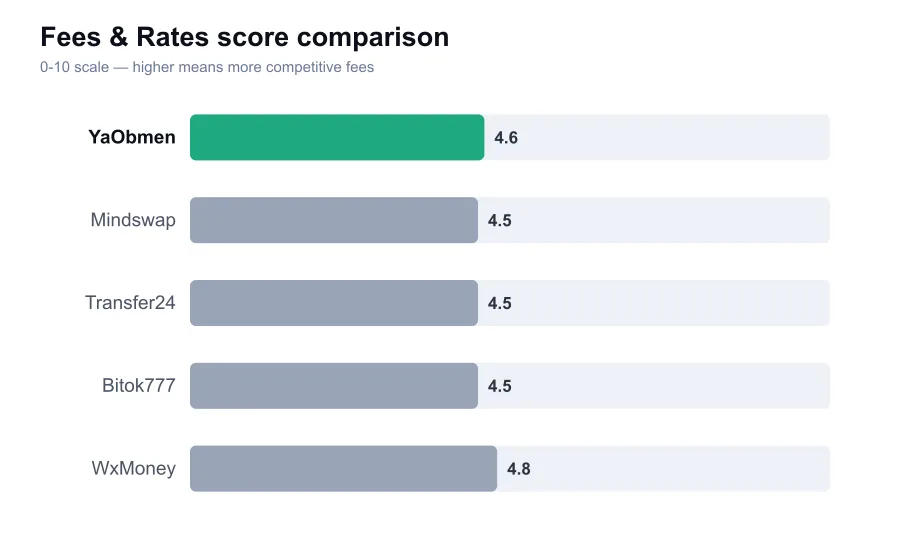
Fees are the first point where prospective users need to slow down. I could not verify a durable public fee schedule that makes YaObmen's all-in markup easily comparable across routes. The effective price is likely expressed through the rate offered for the specific order, along with any payment or network costs. A user should never assume that a favorable looking headline exchange rate is the whole deal. Calculate the final amount received and compare it against alternatives before transferring anything.
This is especially important if you are exchanging between crypto and a payment method rather than simply swapping major coins. Payment rails have their own costs, reserve requirements, and fraud controls. A smaller exchanger may price those risks into the quote. That can be legitimate, but it should be visible in the resulting payout. If the difference versus a reputable alternative is substantial, do not rationalize it as the price of convenience. It is usually better to use the more transparent route.
The best pricing discipline is to capture the YaObmen quote and compare it at the same moment with at least two alternatives. Do not compare yesterday's price with today's market. Check whether the rate is fixed or floating, how long the payment window lasts, whether the provider accepts an exact amount only, and what happens to an accidental overpayment. These details are more important than a banner claiming attractive rates. A transaction can become expensive through a delayed quote or a restrictive refund policy.
Speed can be perfectly adequate for normal transactions, but YaObmen should not be used with the assumption that every order is automated. Many regional exchange operations combine software with manual payment review. That can work well during staffed hours and become slow if a bank transfer needs checking, a wallet payment arrives incorrectly, or a compliance question appears. Blockchain confirmation times also remain outside the provider's control. A fast interface does not alter the finality rules of Bitcoin, Ethereum, or any other network.
I could not find a robust, independently verifiable set of public statistics showing YaObmen's typical completion times or support resolution performance. For that reason, I would not rate it as a proven fast settlement provider. A small crypto-to-crypto order might be completed promptly, but that is different from a dependable commitment. If you are paying an invoice, catching a purchase window, or sending funds that someone else must receive at a specific time, use a platform where you already hold the destination asset.
The security and identity questions deserve a harder look than most casual users give them. With YaObmen, I could not independently confirm the level of corporate disclosure, formal regulation, security auditing, or custody controls that a cautious customer would want before moving significant capital. This absence does not prove bad faith. It does create an information imbalance. The operator knows its processes. The customer does not, and that is why the customer should limit the size and complexity of any initial transaction.
Do not interpret a low-friction checkout as a promise that documents will never be requested. Anti-fraud and anti-money-laundering checks can be introduced by the exchanger, its bank, its payment processor, or its blockchain-risk tooling. A transaction may be delayed while a provider asks for information. Before using YaObmen, read the current policy on verification, cancellation, and refunds. If you cannot accept the possibility of a review, use a service whose requirements are known before the funds are sent.
There are also basic operational risks that customers can control. Never pay from an account owned by another person if the instructions require matching payer details. Do not send a rounded amount when the order specifies an exact one. Verify whether a crypto address needs a memo, destination tag, or comment. Keep every receipt and transaction hash. Most support disputes are harder than they need to be because the user has skipped one of these seemingly minor instructions, then discovers that a payment cannot be matched automatically.
YaObmen's public reputation is not strong enough for me to call it a trusted high-value counterparty. A presence on exchanger monitoring sites or a collection of onsite reviews can provide some reassurance, but neither is the same as a long public record of handling complaints, outages, and compliance disputes. I want more than positive snapshots. I want transparent ownership, durable public feedback across several independent channels, and visible rules for what happens when an exchange cannot be completed normally.
Support is likely to determine whether a customer remembers the service positively or negatively. A normal order may require no human contact. An irregular one depends entirely on whether an agent can identify the issue, communicate in plain language, and give a realistic timeline. Before you place an order, test the support route with a concise question about a pair or a payment method. A direct answer is encouraging. An evasive answer, or no answer, should disqualify the provider for anything beyond a tiny experiment.
YaObmen is a possible fit for someone who already understands regional exchange workflows and needs a small, carefully checked conversion. It is not a place for storing crypto, using leverage, receiving a salary, or moving business working capital. The user should be comfortable with self-custody, prepared to document the transfer, and able to tolerate the prospect of a manual review. Anyone who needs certainty should pay the premium for a larger service with disclosed procedures and established accountability.
My verdict is reserved. YaObmen may be capable of completing a routine exchange, but its limited verifiable transparency means it has not earned broad trust. The service can be considered for a low-value route only after the exact quote, rate type, and support responsiveness have been checked. Do not let a convenient payment option override those safeguards. For serious money or time-sensitive transfers, this is a weaker choice than a mature exchange with a public operating history.
| Criterion | Score (0-10) | Notes |
|---|---|---|
| Fees & Rates | 4.6 | Effective cost is mainly visible in the order quote. |
| Transaction Speed | 4.7 | Manual checks and payment rails can add delay. |
| Security & KYC Policy | 3.7 | Limited public evidence on controls and legal structure. |
| Reputation & Track Record | 3.8 | Insufficient independently documented long-term record. |
| Customer Support | 4.2 | Support should be tested before a funded order. |
| Pros | Cons |
|---|
A clear universal flat-fee schedule was not independently verifiable. Check the final payout on the active order, including any network or payment method costs, and compare the result with alternatives.
Potentially. Payment mismatches, blockchain-risk checks, or internal anti-fraud procedures can create a review. Read the current verification and refund terms before you send funds.
I would not recommend it for significant value given the limited publicly verifiable transparency. Use a small test transfer first and consider a major exchange for larger sums.
| Alternative | Score |
|---|---|
| Mindswap Review | 4.3/10 |
| Transfer24 Review | 4.3/10 |
| Bitok777 Review | 4.1/10 |
| WxMoney Review | 4.4/10 |
| BtcChange24 Review | 4.7/10 |
| XChangic Review | 4.7/10 |