
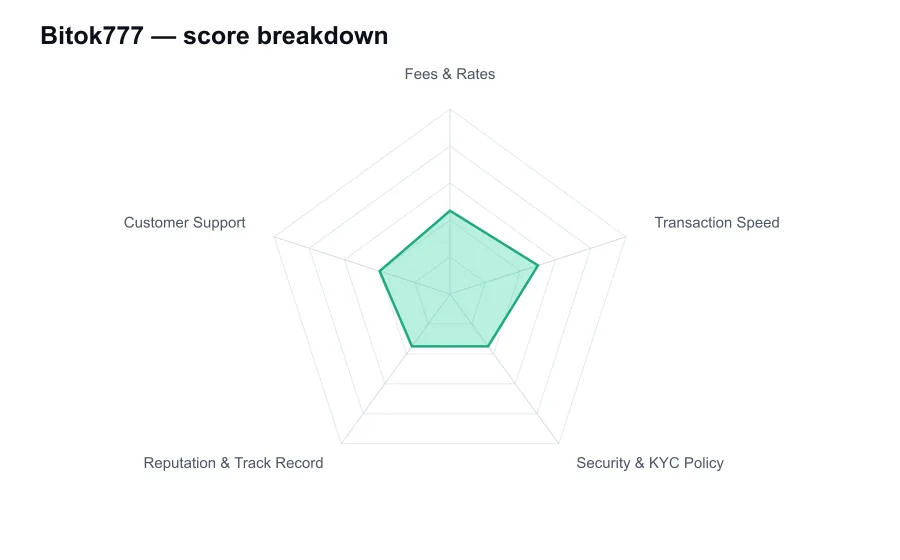
Bitok777 scores 4.1/10 overall in our independent review, measured against every other provider we've compared, strongest on Transaction Speed (5.0/10) and weakest on Reputation & Track Record (3.5/10).
4.1/10 How we score →Editorial independence: our scores and rankings are produced using the fixed criteria above and are not influenced by advertisers. This is an independent ranking site and is not operated by, or affiliated with, any provider we list.
Affiliate disclosure: some links on this page may earn us a commission at no extra cost to you. This does not affect our rankings.
Bitok777 appears in the part of the crypto exchange market that deserves the most skepticism: the small, lightly documented conversion-service segment. These businesses can be useful. Some process ordinary swaps every day without drama and provide a faster route than opening an account at a large exchange. But they operate in a trust-poor environment where a polished page, a favorable quote, and a few reviews can be mistaken for evidence of strong controls. My assessment starts from that reality rather than from the marketing promise of a quick exchange.
The service model is familiar. A user selects an asset to send, chooses an asset to receive, enters a wallet address, and transfers funds to the provider. Once the incoming payment is accepted, Bitok777 is expected to complete the payout. That is operationally simple for the customer, but it is not trustless. The customer temporarily gives control of funds to an intermediary whose liquidity, ownership, security practices, and compliance process may not be independently easy to assess. That is a substantial difference from trading on a highly visible exchange or using a decentralized protocol.
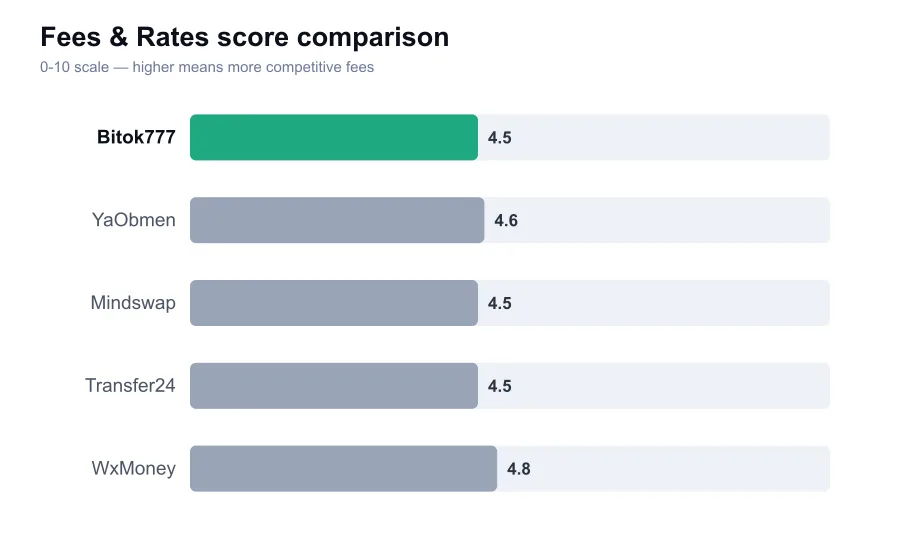
Fees are likely to be felt mostly through the quote rather than through a tidy commission table. This is the standard small-exchanger approach, and it can obscure more than it reveals. A displayed rate may incorporate the provider's margin, expected network expense, liquidity cost, and a buffer for market volatility. None of those is inherently improper. The issue is that the customer cannot tell whether the margin is modest or excessive without comparison. The only number that matters is how much arrives in the receiving wallet.
I would be particularly wary of a quote that looks dramatically better than established competitors. In crypto, unusually favorable pricing is not automatically a bargain. It can be an outdated rate, a route with hidden conditions, a temporary liquidity mismatch, or a lure designed to get a deposit. Compare Bitok777's final payout against at least two recognized swap providers and a major exchange route. If the difference seems too good to be credible, do not send first and investigate later. The irreversible nature of crypto transfers removes the usual consumer safety net.
For users who want rate certainty, the fixed-versus-floating distinction cannot be skipped. A floating transaction may pay less if the market moves before the service processes a confirmed deposit. A fixed transaction should state the exact deposit window, expected amount, and what happens if the incoming payment is late or incomplete. Without clear terms, the provider has too much latitude to define the outcome after it holds your coins. That might never matter in a routine trade. It matters enormously on a volatile day or during a disagreement.
Speed is hard to score generously for a small service with limited public operational evidence. A routine transaction involving a well-supported asset may complete quickly once blockchain confirmations arrive. That is the easy case. The difficult cases include a pending deposit, a wallet maintenance period, a large order, a flagged address, an incorrect network, or a payout that needs to be sourced manually. On those occasions, the user is not really evaluating swap technology. They are evaluating the competence and honesty of the people behind the operation.
Claims of instant processing should always be read as a best-case description. Bitcoin confirmation times vary. Ethereum fees and congestion can disrupt token routes. Stablecoins exist on several incompatible chains, and a customer can make an unrecoverable error by selecting the wrong one. Even a competent provider cannot eliminate those facts. Bitok777 should give customers a clear order status and network-specific instructions. If instructions are vague, do not assume support can rescue a transfer sent to an incorrect chain.
Security is the weakest area because there is little substitute for verifiable transparency. A user wants to know who operates the service, where it is established, what security measures protect hot wallets, how reserves and liquidity are managed, and what happens after a disputed or flagged transfer. A small provider may choose not to publish every technical detail, which is understandable. But an absence of meaningful company information, public security practices, or accountable support channels should reduce the amount of trust a customer is willing to extend.
The KYC question also needs a mature answer. An account-free order flow is not the same thing as an unconditional no-KYC service. Crypto businesses can screen transactions and request identification if they believe a transfer creates compliance risk. A legitimate policy should explain that possibility before payment, describe what happens during a review, and set out a refund process. The worst outcome is not being asked for documents. The worst outcome is having funds held under an unclear policy with no predictable way to resolve the matter.
Bitok777's public reputation does not carry the same weight as the record of an established regional broker or a large licensed exchange. This does not prove misconduct. It does make the burden of due diligence heavier for the customer. Look beyond aggregate star ratings. Search for detailed, dated accounts of transactions, especially reports involving delays, refunds, and verification. Check whether the provider responds substantively to criticism. An exchange service that only looks good while every order is smooth has not demonstrated much.
Users should be cautious with referral sites and review widgets too. Monitoring-site listings can be useful for discovering services and comparing rates, but their presence should not be read as a guarantee of solvency or fair treatment. Some review systems are vulnerable to selective solicitation, and most cannot resolve a blockchain dispute for you. Independent discussion, clear legal information, a documented support process, and a conservative first test tell you more than a colorful badge beside a provider's name.
Customer support is not an optional extra for Bitok777. It is central to the value proposition, because the user has no branch, no chargeback mechanism, and often no formal account manager. Before initiating an order, ask a concrete question that a real support agent should be able to answer, such as confirmation requirements for a specific asset or the handling of a wrong amount. Judge the speed, clarity, and precision of the response. A vague reply or an unreachable channel is reason enough to use another service.
The sensible operating rule is simple: don't let a small exchanger become your bank. Use your own sending wallet, use a receiving wallet you control, preserve transaction IDs and screenshots, and start with a small amount. Never send money to a support agent through an unrelated chat account, and never reveal a seed phrase to solve a supposed transaction problem. Genuine support may request an order number or transaction hash. It should never need the recovery words to your wallet.
I would place Bitok777 in the high-caution category. It may be capable of handling a small, ordinary swap, but the available reasons to prefer it over better documented alternatives are not compelling for most users. Convenience is only valuable if the provider remains reachable and predictable when something deviates from the normal path. For meaningful value, I would choose a more established exchange or broker. If you use Bitok777 at all, make the first order a disposable test, not a leap of faith.
| Criterion | Score (0-10) | Notes |
|---|---|---|
| Fees & Rates | 4.5 | Quote-based costs require careful comparison and lack clear fee granularity. |
| Transaction Speed | 5.0 | Routine orders may be fast, but public evidence on exceptions is limited. |
| Security & KYC Policy | 3.5 | Limited verifiable transparency calls for strict self-custody discipline. |
| Reputation & Track Record | 3.5 | A limited public track record warrants a conservative trust assessment. |
| Customer Support | 4.0 | Test support before sending because it is your main dispute channel. |
| Pros | Cons |
|---|
I would not. Limited public transparency makes it more prudent to use a well-established exchange or broker for meaningful amounts.
Compare the exact amount you will receive with multiple services and a major exchange route. The difference from market price is the practical cost.
A low-friction swap flow does not prevent transaction screening. Read the service terms and refund rules before initiating any order.
| Alternative | Score |
|---|---|
| YaObmen Review | 4.2/10 |
| Mindswap Review | 4.3/10 |
| Transfer24 Review | 4.3/10 |
| WxMoney Review | 4.4/10 |
| Pegasusswap Review | 3.7/10 |
| Lizex Review | 3.6/10 |