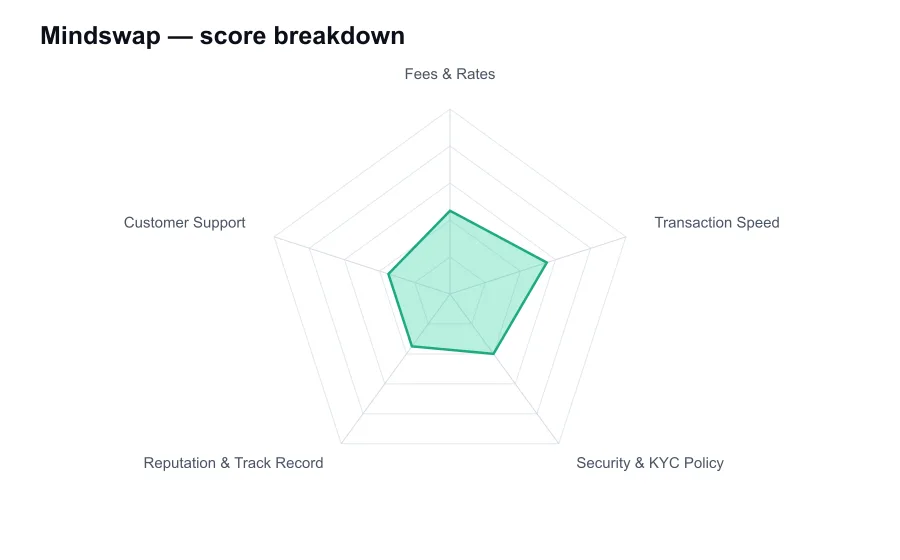
Mindswap scores 4.3/10 overall in our independent review, measured against every other provider we've compared, strongest on Transaction Speed (5.5/10) and weakest on Customer Support (3.5/10).
4.3/10 How we score →Editorial independence: our scores and rankings are produced using the fixed criteria above and are not influenced by advertisers. This is an independent ranking site and is not operated by, or affiliated with, any provider we list.
Affiliate disclosure: some links on this page may earn us a commission at no extra cost to you. This does not affect our rankings.
MindSwap belongs to the decentralized exchange category, where users connect a wallet and trade through smart contracts rather than deposit assets with a traditional broker. That model has genuine appeal. It can reduce custodial risk, avoid a lengthy account-opening process, and give direct access to onchain assets. It also transfers much more responsibility to the user, and MindSwap does not have the public scale or battle-tested status of Uniswap, PancakeSwap, or Curve.
The name has appeared in more than one crypto context over time, which is itself a warning for prospective users. Before connecting a wallet, confirm the exact official domain, chain, contract address, and social channels from trustworthy primary sources. Fake DEX pages are extremely common, and wallet approval scams do not need to defeat a protocol's code. They only need a user to sign an unlimited token allowance on a convincing clone.
MindSwap's appeal, where it is available and functioning, is likely to be access to smaller onchain assets and a wallet-first trading flow. That can be useful for a trader who already knows the network, has native gas tokens, and understands slippage. It is not a reason by itself to use the platform. Liquidity is the deciding factor, because a DEX's interface matters far less than the quality and depth of the pools beneath it.
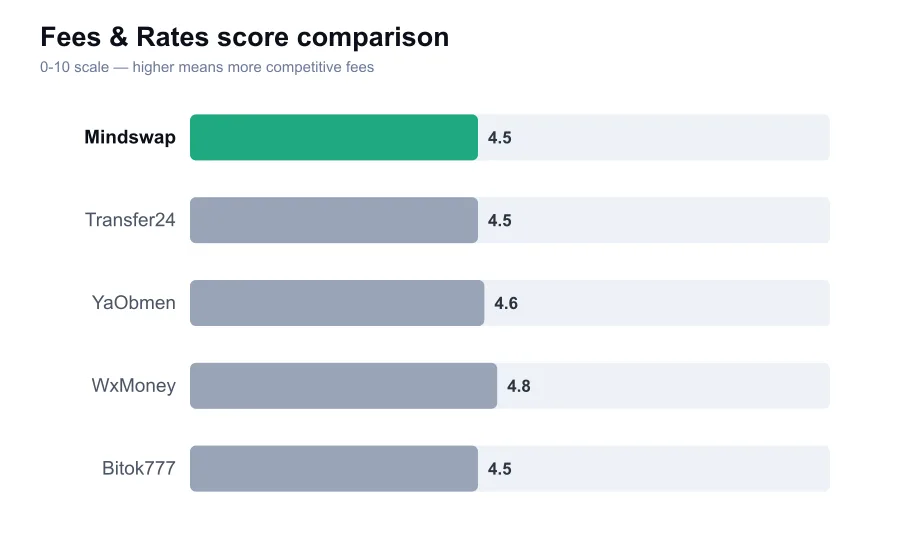
Fees on a DEX generally come from more than one place. There is usually a protocol or liquidity-provider trading fee, the network gas fee, and price impact caused by trading against a limited pool. A platform can advertise a low percentage fee while a moderately sized trade loses several percent to slippage. With MindSwap, I could not verify a sufficiently clear and current universal fee schedule or enough independently measured liquidity data to call its pricing competitive.
That makes pre-trade discipline non-negotiable. Check the minimum received amount, inspect the route, compare the execution price against a liquid reference market, and reject a trade if price impact looks unreasonable. Don't increase slippage tolerance casually just to force a transaction through. High slippage settings can turn a delayed trade into an expensive one, especially with thin tokens, volatile pairs, or liquidity pools that are being actively arbitraged.
Speed is a similar story. The swap itself may be completed quickly after a blockchain confirmation, but that is not a unique advantage. Nearly any DEX on a low-cost chain can feel fast under light congestion. What users care about is whether the transaction executes at the expected price, whether failed transactions cost gas, and whether the interface accurately reflects the network state. There is too little verifiable performance evidence to rank MindSwap ahead of larger competitors.
A DEX lets users retain control of their wallet, which is a meaningful security positive compared with leaving coins in a centralized exchange account. Yet self-custody has a sharp edge. Lost seed phrases, malicious approvals, wrong-chain transfers, and fake token contracts are generally irreversible. MindSwap cannot provide the same recovery path that a regulated exchange may offer for a compromised login, and users shouldn't expect customer service to reverse a signed onchain action.
The protocol layer introduces another set of risks. Smart contracts can contain flaws, administrator keys can create governance risk, price oracles can fail, and liquidity providers can withdraw suddenly. I found limited independently verifiable public material establishing a long audit history, formal proof-of-reserves relevance, or a broad bug bounty footprint for MindSwap. For a DEX, audits and transparent contract verification aren't optional marketing extras. They are part of the minimum evidence users should seek.
KYC may be minimal or absent at the wallet connection level, as is common for decentralized exchange interfaces. That can be valuable for users who want privacy and permissionless access. It does not eliminate compliance risk, however. Front ends can block regions, analytics providers can screen addresses, and later fiat off-ramps can still require identity verification. No-KYC should mean fewer onboarding steps, not immunity from law or from the consequences of handling sanctioned or stolen funds.
MindSwap's reputation is its weakest category. It lacks the extensive, independently documented operating history and developer scrutiny that have made the biggest DEX protocols credible despite their risks. A smaller protocol can be innovative, but it needs to earn trust through transparent code, audits, accountable governance, reliable documentation, and years of normal operation. I did not find enough evidence to say MindSwap has cleared that bar.
Support on decentralized venues is usually community driven, and MindSwap should be approached with that expectation. Discord, Telegram, documentation pages, or social accounts can help explain an interface, but none is a guarantee of timely assistance. Be especially careful with direct messages. Legitimate support teams generally do not need a seed phrase, private key, remote access to a device, or an unsolicited signature to solve a swap issue.
There is a narrow use case for a platform like this. A technically capable user may want to test a specific low value pair that is unavailable on a large DEX, and may be willing to accept the execution and protocol risk. That person should use a separate wallet, grant only limited approvals, confirm the token contract in a trusted explorer, and revoke permissions after trading. This is laboratory behavior, not ordinary investing.
For most users, the superior answer is boring. Trade widely held assets on a deep, established venue, then move them to self-custody if that is the goal. Uniswap on its supported networks, PancakeSwap for relevant ecosystems, and reputable centralized exchanges for fiat access give users clearer liquidity benchmarks and more public scrutiny. MindSwap has not demonstrated a compelling enough advantage to outweigh the additional uncertainty.
The project could materially improve its standing by maintaining a single unmistakable official identity, publishing verified contracts and audit reports prominently, explaining fee tiers and governance controls, and providing real-time liquidity and incident information. Those aren't cosmetic improvements. They would allow users to assess the platform rather than simply hope that a swap works.
My conclusion is that MindSwap should be treated as an unproven specialist DEX, not as a general trading home. The self-custody model is attractive, but the platform's limited verifiable reputation and opaque practical metrics make it hard to recommend. If curiosity wins, use a tiny amount and assume you are your own risk team. For routine swaps or meaningful capital, established liquidity and a stronger public record are worth far more than novelty.
| Criterion | Score (0-10) | Notes |
|---|---|---|
| Fees & Rates | 4.5 | Protocol costs may be low, but liquidity and spreads are unclear. |
| Transaction Speed | 5.5 | Onchain execution can be quick, with limited verified benchmarks. |
| Security & KYC Policy | 4.0 | Self-custody helps, but audit and governance evidence is limited. |
| Reputation & Track Record | 3.5 | Lacks the long public record of leading DEX protocols. |
| Customer Support | 3.5 | Expect community help, not account-level transaction recovery. |
| Pros | Cons |
|---|
Wallet-based DEX access may involve no conventional account verification, but requirements can change by interface, region, and later fiat off-ramp. Check the current terms first.
Gas, price impact, routing, and token liquidity can add materially to the cost. Review the minimum received amount and price impact before signing.
Normally no. Blockchain transactions and wallet approvals are generally irreversible. Never share a seed phrase or private key with anyone claiming to be support.
| Alternative | Score |
|---|---|
| Transfer24 Review | 4.3/10 |
| YaObmen Review | 4.2/10 |
| WxMoney Review | 4.4/10 |
| Bitok777 Review | 4.1/10 |
| BtcChange24 Review | 4.7/10 |
| XChangic Review | 4.7/10 |