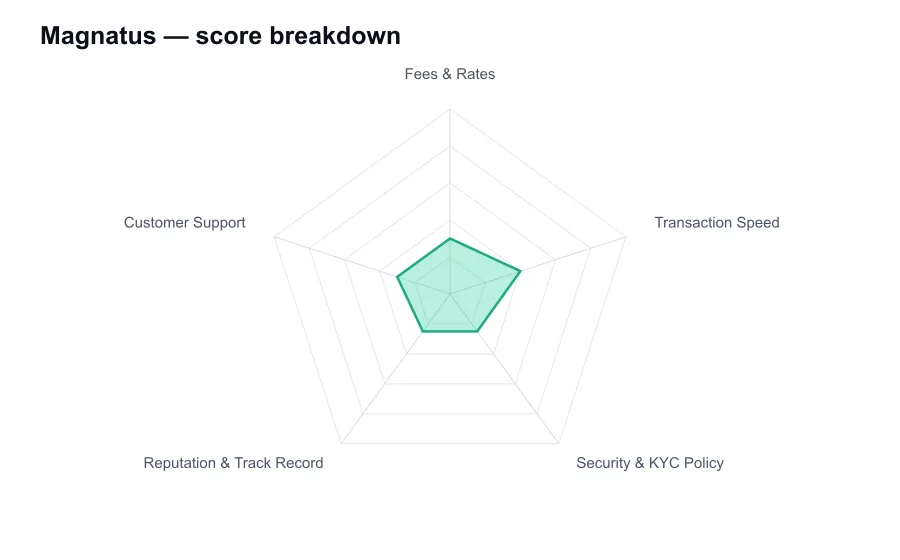
Magnatus scores 3.0/10 overall in our independent review, measured against every other provider we've compared, strongest on Transaction Speed (4.0/10) and weakest on Reputation & Track Record (2.5/10).
3.0/10 How we score →Editorial independence: our scores and rankings are produced using the fixed criteria above and are not influenced by advertisers. This is an independent ranking site and is not operated by, or affiliated with, any provider we list.
Affiliate disclosure: some links on this page may earn us a commission at no extra cost to you. This does not affect our rankings.
Magnatus appears in the long tail of small crypto swap and exchange brands rather than alongside household names such as Kraken, Coinbase, or Bitstamp. That distinction matters. A little known trading venue can occasionally offer access to a niche asset or a convenient conversion route, but it doesn't automatically provide the operational depth people expect from an established exchange. My research found too little independently verifiable public information to treat Magnatus as a proven venue for meaningful balances.
The first practical problem is basic transparency. A serious exchange normally makes its company identity, jurisdiction, registration details, terms, fee schedule, supported networks, and security procedures easy to locate before a user deposits. With Magnatus, the public footprint is thin and difficult to corroborate. That doesn't prove misconduct, but it leaves a prospective customer doing detective work that the platform itself should have done for them.
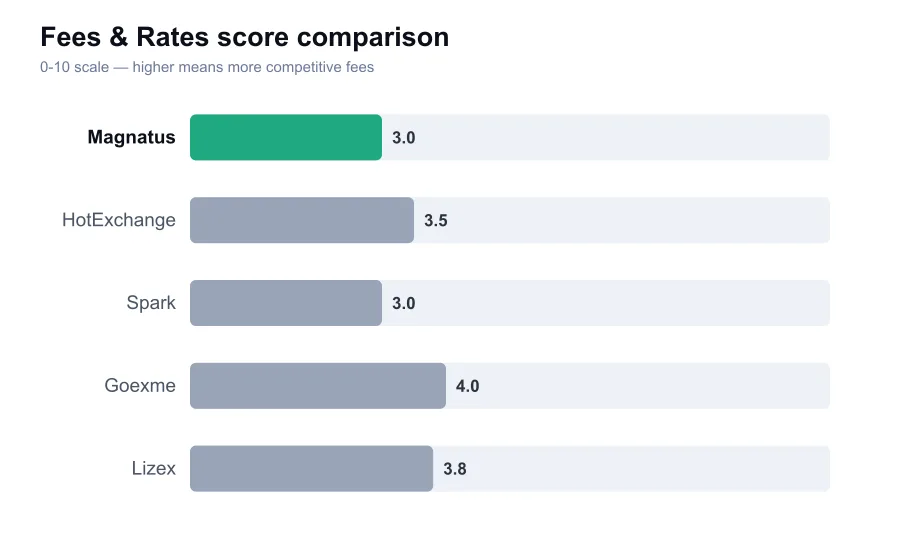
Fees are particularly hard to judge in that environment. I could not establish a reliable, current published maker and taker schedule, a clear flat swap fee, or a consistent explanation of how spreads are calculated. That is a poor starting point for any exchange review. A quoted conversion can look free while the effective cost is embedded in the rate, and without a transparent reference price users can't tell whether they paid 0.5 percent, 2 percent, or considerably more.
For small experimental trades, the sensible approach would be to compare the displayed Magnatus quote with a live quote from a recognizable alternative before approving anything. Include network costs, not just the number in the swap box. A platform that doesn't itemize its economics may still process a trade, but it asks customers to trust its pricing model blindly. I don't think that is an acceptable tradeoff for regular buying, selling, or treasury management.
Speed claims also deserve a reality check. Crypto settlement isn't simply a button-click experience. A swap can be fast internally but still wait for an inbound deposit, blockchain confirmations, liquidity sourcing, risk checks, and an outbound transaction. With no extensive body of credible, time-stamped user reports or service metrics to inspect, there is no sound basis for promising that Magnatus is faster than established instant-swap services or centralized exchanges.
Anyone who does test it should start with a low value transaction on a well supported network and document every step. Check whether the deposit address is generated correctly, whether a transaction ID is supplied on withdrawal, and whether the final amount matches the quoted or floating rate. Avoid sending an asset over a network that isn't explicitly named. This is basic discipline, but it becomes essential when the operator's processes haven't been tested publicly at scale.
Security is where the lack of disclosure becomes more serious. I could not verify public evidence of third party custody audits, proof of reserves, a named security leadership team, bug bounty coverage, cold storage policy, insurance arrangements, or a detailed incident response history. Exchanges don't become safe merely by displaying a lock icon or offering a login page. Customers need to know who controls keys, who can approve withdrawals, and what happens if an account or hot wallet is compromised.
The same uncertainty applies to identity checks. Magnatus does not present a widely documented KYC policy comparable with regulated exchanges. A light onboarding flow can be attractive to privacy minded users, but it can also change abruptly once an automated risk system flags a transfer. If documents are requested after funds arrive, a customer needs clear rules for review times, rejected verification, refunds, and appeals. I could not verify those safeguards to a standard I would recommend.
Reputation is not a popularity contest, but time and scrutiny matter in crypto. Coinbase has public financial reporting, Kraken has operated through multiple market cycles, and even many smaller exchanges have years of archived coverage, leadership interviews, and a substantial support record. Magnatus does not have that kind of independently traceable track record. The absence of a well documented public controversy is not the same thing as an earned security reputation.
That leaves support as another unknown rather than a strength. I found no persuasive basis to rate its response channels, coverage hours, escalation process, or ability to resolve a failed blockchain transaction. A help widget is not enough. During a deposit mismatch, a stuck withdrawal, or an address-tag error, customers need a reachable team that can identify the transaction, explain the issue, and give a realistic timetable rather than send scripted replies.
There is a broader issue here that people often miss. An exchange can be technically functional on its best day and still be unsuitable for money one cannot afford to lose. Thin liquidity may create bad pricing. A single compliance review can freeze a transfer. A poorly staffed team may not respond until after a network opportunity has passed. These are operational risks, and they tend to surface precisely when markets are moving fast.
I would not use Magnatus as a primary fiat gateway, a long term wallet, or a place to park a meaningful portfolio. There is no reason to take that level of counterparty risk when established exchanges and self-custody options exist. If it offers an asset pair you genuinely cannot access elsewhere, treat the interaction as a limited, single purpose transaction. Deposit only what is needed and withdraw promptly after completion.
The platform could improve this assessment quickly by publishing a legal entity and jurisdiction, a complete fee and spread methodology, security architecture details, supported network rules, named support commitments, and a clear KYC escalation policy. Independent audits and verifiable customer service performance would help far more than polished marketing. Until then, uncertainty is the defining feature of the product.
My view is blunt. Magnatus may be a service worth watching if it develops a verifiable operating record, but it has not earned the confidence required of a mainstream exchange. The potential convenience of a small platform is outweighed by the number of unanswered questions around price execution, custody, compliance, and recourse. For now, caution isn't pessimism. It's the only responsible position.
| Criterion | Score (0-10) | Notes |
|---|---|---|
| Fees & Rates | 3.0 | No reliably verifiable public fee or spread schedule. |
| Transaction Speed | 4.0 | Execution performance is not independently documented. |
| Security & KYC Policy | 2.5 | Limited verifiable custody, audit, and KYC information. |
| Reputation & Track Record | 2.5 | Very limited independently traceable track record. |
| Customer Support | 3.0 | Support quality and escalation process are unclear. |
| Pros | Cons |
|---|
I could not verify a dependable public schedule covering trading fees, spreads, and network charges. Compare the final quote with an established venue before sending funds.
I would not use it as a wallet or long term custody service. Public evidence of reserves, custody controls, insurance, and independent audits is too limited.
Confirm its current identity and compliance rules directly before depositing. Do not assume an initially light sign-up process means documents will never be requested.
| Alternative | Score |
|---|---|
| HotExchange Review | 3.1/10 |
| Spark Review | 2.9/10 |
| Goexme Review | 3.3/10 |
| Lizex Review | 3.6/10 |
| CoinDrop Review | 2.4/10 |
| Pegasusswap Review | 3.7/10 |