
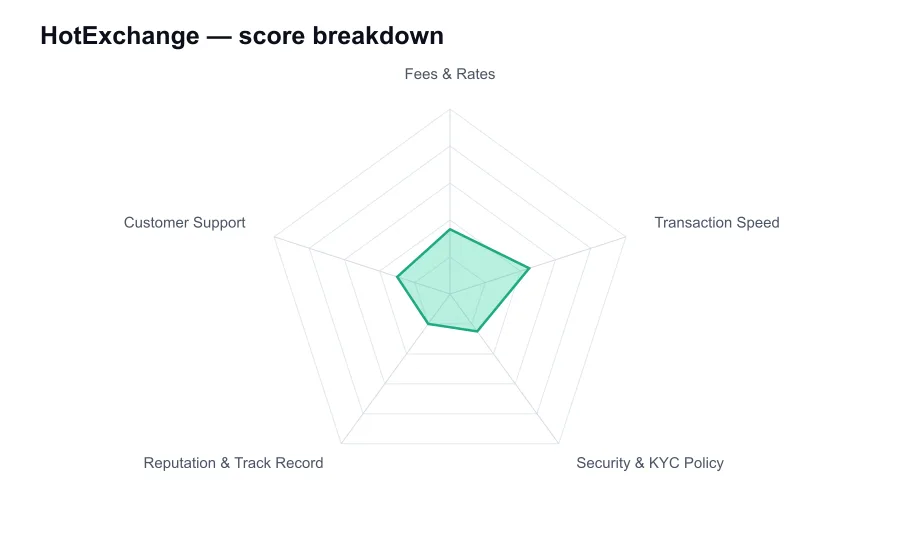
HotExchange scores 3.1/10 overall in our independent review, measured against every other provider we've compared, strongest on Transaction Speed (4.5/10) and weakest on Reputation & Track Record (2.0/10).
3.1/10 How we score →Editorial independence: our scores and rankings are produced using the fixed criteria above and are not influenced by advertisers. This is an independent ranking site and is not operated by, or affiliated with, any provider we list.
Affiliate disclosure: some links on this page may earn us a commission at no extra cost to you. This does not affect our rankings.
HotExchange appears to target the familiar market for smaller cryptocurrency trading and exchange services, where the pitch is usually quick access, a broad asset list, and fewer obstacles than a heavily regulated global platform. That market is crowded and unforgiving. A new or lightly documented venue has to earn trust with transparent operations, not just a collection of tokens and a functioning deposit address. On the evidence readily available to the public, HotExchange has not earned the same confidence as established exchanges.
The first issue is identity. A serious customer should be able to quickly establish the operating company, jurisdiction, registration details, governing terms, and compliance contact. Those are not glamorous features, but they tell you whether there is a real accountable entity behind the website. HotExchange does not have the broad, easily verifiable institutional profile of providers such as Coinbase, Kraken, Gemini, Bitstamp, or Australia-based Independent Reserve. That is a major consideration before any money is sent.
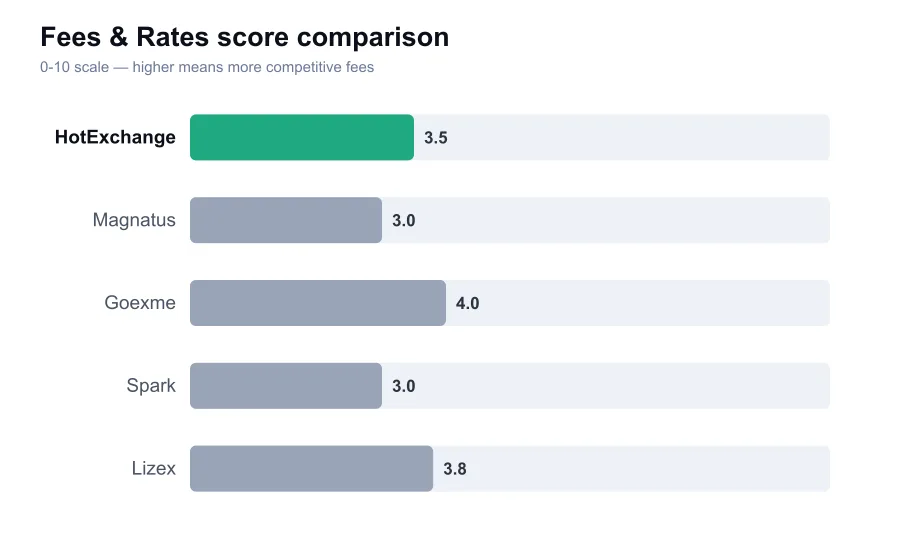
Small exchanges can offer good value, particularly if they use aggressive pricing to attract volume. But good value is impossible to judge without transparent numbers. HotExchange does not have a widely recognized public fee schedule with clear spot trading tiers, deposit rules, withdrawal charges, and a definition of how spreads are calculated. If a platform shows a seemingly free conversion, users should assume compensation may be reflected in the exchange rate until they have compared it with an external benchmark.
That comparison needs to happen at the confirmation screen, not after the transaction settles. Check the market price on a liquid venue, calculate how many units you should receive, then add the blockchain fee and any service charge. A difference that appears trivial on a $50 swap can be painful on a larger order. For active traders, an opaque quote is especially unattractive because it prevents reliable cost forecasting. Published maker and taker pricing is far preferable to guessing at a spread.
Withdrawal fees deserve equal scrutiny. Exchanges sometimes keep trading fees low but charge more than necessary to withdraw Bitcoin, Ethereum, stablecoins, or smaller assets. They may also pause a chain or set a minimum withdrawal threshold with little warning. HotExchange users should inspect the withdrawal page before depositing, not after. If the service does not clearly show the network, the fee, confirmation requirements, and expected processing status, assume there is operational uncertainty.
Speed claims need the same skepticism. A crypto transfer has several stages: the user sends funds, the chain confirms them, the provider credits the deposit, any screening checks are completed, the exchange executes, and the provider broadcasts a withdrawal. A platform can be fast at one stage and slow at another. No credible review should promise a fixed delivery time for HotExchange without consistent public data. Bitcoin can take from minutes to much longer, while a token transfer may be fast but still wait on internal review.
For market trading, liquidity is just as important as raw system speed. A screen can update quickly while the actual order book is thin. Thin liquidity means wider spreads, partial fills, and a bad price when the market moves. HotExchange does not have the widely cited volume, liquidity reports, or institutional market profile that would make me comfortable using it for sizeable spot orders. Serious traders will get more predictable execution from a venue with transparent order books and established volume.
Security is the central weakness in the case for lightly documented providers. HotExchange may employ standard web safeguards, but customers need more than basic transport encryption. They should be able to assess two-factor authentication options, address whitelisting, session controls, withdrawal delays, cold-wallet practices, key-management arrangements, bug-bounty activity, independent audits, and incident disclosures. Without credible public detail on those points, a user cannot sensibly assign a high level of trust.
KYC is another area where ambiguity is dangerous. Some services look permissive until a transaction triggers compliance checks, then request identification or source-of-funds documents after the crypto has already arrived. Compliance review is normal in modern financial services. The issue is whether the policy is clear, proportionate, and supported by an accountable team. Users should read HotExchange's terms before depositing and avoid any service that leaves them unsure about verification triggers, restricted countries, or withdrawal holds.
Reputation is not built by promotional claims. It is built over years by surviving volatile markets, responding to hacks or outages honestly, maintaining withdrawals during stress, and dealing with customers in public view. HotExchange does not have a well-established public record that provides this kind of reassurance. That does not prove misconduct, but it leaves a buyer with an evidence problem. In crypto, lack of evidence is itself a risk factor because there is rarely a simple chargeback process after a transfer.
Support can make that risk either manageable or unbearable. The test is not whether a chat bubble exists, but whether someone can explain a delayed deposit, a blocked account, or a missing withdrawal in specific terms. Before funding HotExchange, I would submit a basic question about fees, KYC, or withdrawal processing. A useful reply should identify the relevant policy and give a realistic response time. A vague answer, an anonymous social-media account, or a request to move the discussion off-platform would be a red flag.
There is a sensible way to approach an unknown exchange if you are determined to investigate it. Start with public records and independent discussion, verify the exact domain carefully, and do not follow links from unsolicited messages. Then make a small deposit and a small withdrawal on the same day. Test two-factor authentication and save transaction hashes. If the service creates any obstacle to withdrawal, do not add funds in the hope that a larger deposit will solve the problem.
HotExchange is a poor fit for newcomers because newcomers need a provider that explains the rules plainly and has a clear route for dispute resolution. It is also a poor fit for businesses, high-frequency traders, and long-term holders. The people most likely to tolerate its uncertainty are technically capable users who understand self-custody, recognize phishing attempts, and can afford to lose the small amount used for testing. Even for that audience, there are better-documented alternatives.
My judgment is that HotExchange has too much to prove. The potential appeal of easy access cannot compensate for uncertain fee transparency, an unproven public record, and limited independently verifiable security information. I would not keep funds there, and I would not make it my primary trading venue. Use an established exchange for the main transaction, then self-custody assets where appropriate. A platform handling irreversible money has to clear a high bar, and HotExchange has not supplied enough public evidence to clear it.
| Criterion | Score (0-10) | Notes |
|---|---|---|
| Fees & Rates | 3.5 | All-in pricing is not clearly benchmarkable |
| Transaction Speed | 4.5 | No strong public evidence of execution quality |
| Security & KYC Policy | 2.5 | Security and custody practices lack clear disclosure |
| Reputation & Track Record | 2.0 | Limited established public track record |
| Customer Support | 3.0 | Escalation quality is difficult to verify |
| Pros | Cons |
|---|
Not to the standard expected from a major exchange. Compare the final amount received with a liquid market price and check withdrawal charges before sending funds.
No. Given the limited public information on custody and operating history, keep any test balance minimal and withdraw to a wallet you control.
Confirm the correct website domain, enable available account protections, deposit a tiny amount, and complete a withdrawal before considering a larger transaction.
| Alternative | Score |
|---|---|
| Magnatus Review | 3.0/10 |
| Goexme Review | 3.3/10 |
| Spark Review | 2.9/10 |
| Lizex Review | 3.6/10 |
| Pegasusswap Review | 3.7/10 |
| CoinDrop Review | 2.4/10 |