
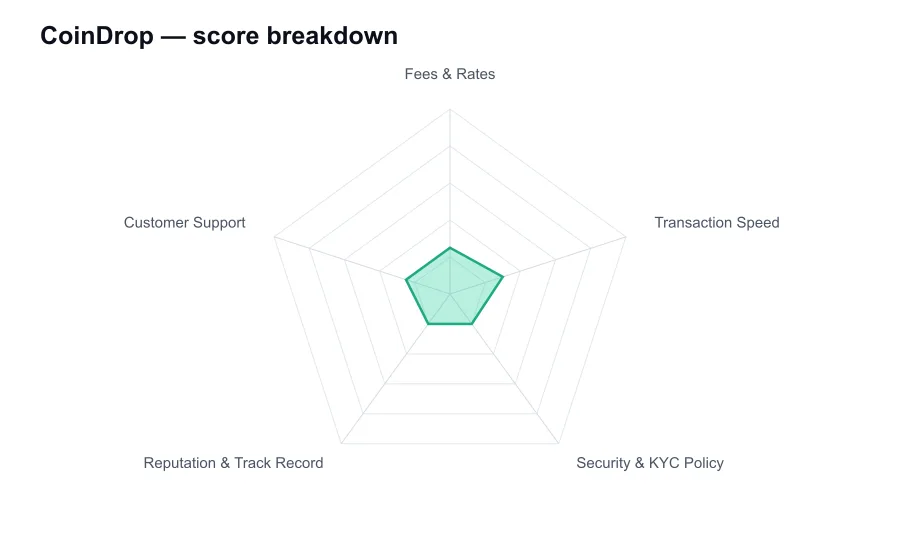
CoinDrop scores 2.4/10 overall in our independent review, measured against every other provider we've compared, strongest on Transaction Speed (3.0/10) and weakest on Reputation & Track Record (2.0/10).
2.4/10 How we score →Editorial independence: our scores and rankings are produced using the fixed criteria above and are not influenced by advertisers. This is an independent ranking site and is not operated by, or affiliated with, any provider we list.
Affiliate disclosure: some links on this page may earn us a commission at no extra cost to you. This does not affect our rankings.
CoinDrop is a difficult service to place confidently because the name has been used by multiple crypto projects, promotional campaigns, and small web services over the years. That matters more than it might sound. A financial provider should be easy to identify, easy to verify, and clear about which legal entity is taking custody of money or arranging a trade. CoinDrop does not have the market recognition, regulatory footprint, or long operating history of brands such as Kraken, Coinbase, Bitstamp, or Coinmotion.
The first problem for a prospective customer is basic due diligence. A trustworthy exchange normally publishes a company name, registered address, licence or registration details where applicable, detailed terms, supported jurisdictions, and a transparent fee schedule. With CoinDrop, public information has been inconsistent enough that I would not treat the name alone as evidence that a specific website or app is legitimate. Scammers frequently select generic crypto names precisely because they sound established.
That does not prove every service called CoinDrop is fraudulent. It does mean users should stop before depositing anything and independently verify the domain, company registration, and app publisher. A polished website is not verification. Neither are social media followers, Telegram messages, celebrity images, countdown timers, or testimonials displayed by the service itself. Those are cheap signals, and crypto has made a small industry out of manufacturing them.
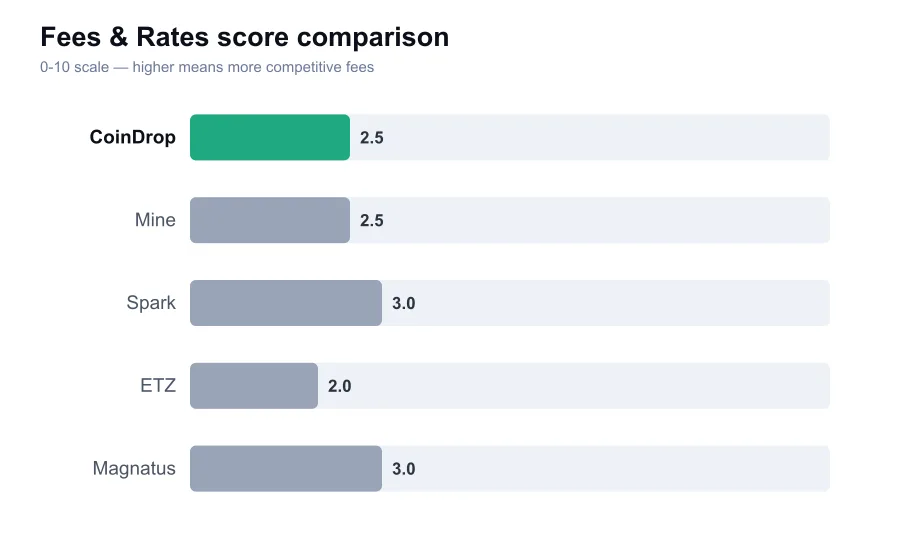
Pricing is impossible to score highly where the underlying commercial terms are not reliably published or independently established. If a CoinDrop service advertises a zero fee trade, a free withdrawal, or an unusually generous conversion rate, read the quoted execution price carefully. The cost may be embedded in the spread. That is common across instant swap products, but a reputable provider makes it possible to compare its quote with a market price before the customer commits.
A transparent platform separates trading fees, card processing charges, blockchain withdrawal fees, and conversion spreads. It also says whether its quote is fixed or floating. CoinDrop's public profile does not provide enough dependable detail to establish that standard. This isn't a minor documentation complaint. On a crypto purchase, a two or three percent hidden spread can cost far more than an exchange's stated maker and taker fee, especially on a modest retail order.
Speed claims should also be treated carefully. Crypto transfers can settle quickly on the right network, but the provider's own checks, wallet processing, liquidity, banking partner, and withdrawal controls determine the experience customers actually have. A site can say instant while leaving a withdrawal pending for hours or days. Without a demonstrated record of processing times and an accessible status page, CoinDrop cannot credibly be ranked alongside services with established operational data.
The safest approach is to assume that any first transaction may need manual review. Never send a large first deposit to a little known service. Test a small amount, confirm that the receiving address is correct, and try a withdrawal before treating the account as usable. If the platform asks for an additional tax, release fee, liquidity payment, or deposit to unlock a withdrawal, stop. Legitimate exchanges deduct valid charges from available balances or explain them through published procedures.
Security information is another weak point. I could not verify a mature public security programme attached to a clearly identified CoinDrop operator, such as cold storage practices, penetration testing, proof of reserves, insurance terms, bug bounty coverage, or audited financial reporting. Not every small provider can offer every one of those protections. Still, customers deserve more than a claim that funds are protected by bank grade security, a phrase that has become nearly meaningless.
KYC policy deserves the same scrutiny. Some users seek no KYC services for privacy, but anonymity does not remove the need for accountability. A provider handling fiat purchases generally needs identity checks, and one that says it can bypass every compliance rule should raise concern rather than admiration. Conversely, collecting passports and selfies without a clear privacy policy or known legal operator creates its own risk. CoinDrop offers too little verified context to make either route comfortable.
Reputation is where CoinDrop falls furthest behind. A short public history is not automatically disqualifying, yet a new or obscure financial service has to earn trust through transparent leadership, responsive support, verifiable legal status, and a consistent record of withdrawals. I do not see the independent coverage, established user community, or long record of accountable operations required to give the brand much benefit of the doubt.
Customer support can be the moment of truth with a crypto provider. Before using CoinDrop, test its support channel with direct questions about the company, fees, withdrawal limits, chain support, and identity verification. A real support agent should be able to answer without pushing you into private messaging apps or demanding a deposit. If the only meaningful contact route is Telegram, WhatsApp, or a generic web form, that is inadequate for an operation that may hold customer assets.
Be especially suspicious of unsolicited CoinDrop offers. Airdrop notices, recovery services, investment managers, and accounts that promise to multiply a deposit commonly use crypto language to create urgency. No support agent should ask for your seed phrase, private key, remote access to your computer, or a payment to release funds. Those requests are not a customer service inconvenience. They are a decisive reason to walk away.
For experienced users, the practical comparison is not CoinDrop against nothing. It is CoinDrop against established exchanges with published fee tiers, named executives or legal entities, long running security processes, and substantial public scrutiny. Even a more expensive regulated broker can be the cheaper choice if it reduces the chance of losing the entire balance to a questionable operator or a withdrawal dispute.
My view is blunt. CoinDrop may be a name attached to a legitimate small service somewhere, but the available, verifiable information is not strong enough to recommend it as a place to buy, sell, store, or trade crypto. Until a specific CoinDrop operator can be independently tied to clear ownership, transparent terms, credible security disclosures, and a meaningful track record, use a recognised provider and keep self custody of funds you are not actively trading.
| Criterion | Score (0-10) | Notes |
|---|---|---|
| Fees & Rates | 2.5 | No reliably verifiable public fee schedule |
| Transaction Speed | 3.0 | Processing record is not independently established |
| Security & KYC Policy | 2.0 | Security and operator details are unclear |
| Reputation & Track Record | 2.0 | Limited verifiable market track record |
| Customer Support | 2.5 | Test support before depositing any funds |
| Pros | Cons |
|---|
I could not verify a clear, broadly recognised regulatory registration tied to a specific CoinDrop operator. Check the exact legal entity and relevant regulator yourself before depositing.
No. Treat unsolicited airdrop and account activation messages as high risk. Never pay a deposit, tax, or release fee to unlock a crypto withdrawal.
Verify the domain and company first, then use only a tiny amount. Confirm a withdrawal works before considering another transaction. Never share a seed phrase or private key.
| Alternative | Score |
|---|---|
| Mine Review | 2.3/10 |
| Spark Review | 2.9/10 |
| ETZ Review | 1.8/10 |
| Magnatus Review | 3.0/10 |
| CryptoVortex Review | 1.7/10 |
| HotExchange Review | 3.1/10 |