
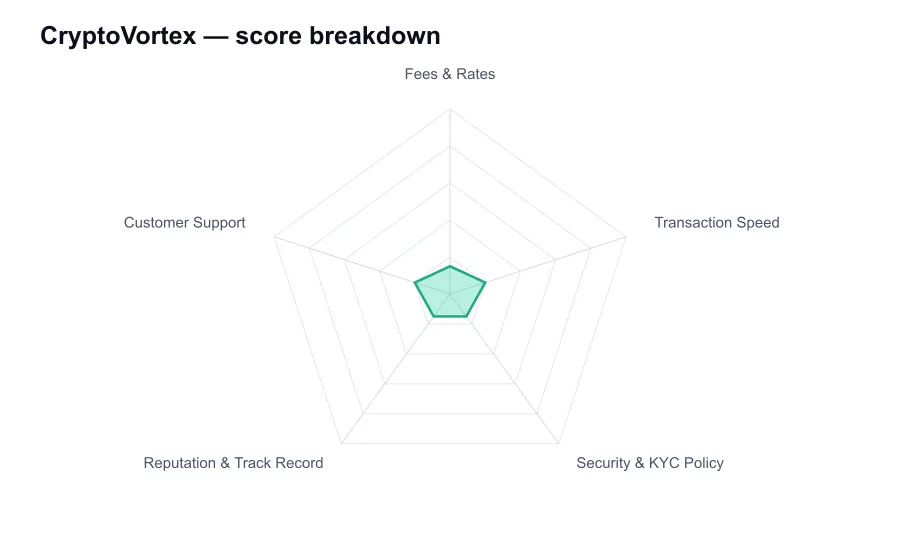
CryptoVortex scores 1.7/10 overall in our independent review, measured against every other provider we've compared, strongest on Transaction Speed (2.0/10) and weakest on Reputation & Track Record (1.5/10).
1.7/10 How we score →Editorial independence: our scores and rankings are produced using the fixed criteria above and are not influenced by advertisers. This is an independent ranking site and is not operated by, or affiliated with, any provider we list.
Affiliate disclosure: some links on this page may earn us a commission at no extra cost to you. This does not affect our rankings.
CryptoVortex is another name that demands caution before it deserves a place on anyone's exchange shortlist. It is not a recognisable, established provider in the way that major centralised exchanges, regulated brokers, or long running wallet companies are. Crypto is full of brands with dramatic names, glossy interfaces, and claims of automated profits. A name that sounds technical or exciting does not establish that a real, accountable financial business sits behind it.
The central issue is verification. Before opening an account with any service calling itself CryptoVortex, a user should identify the exact website domain, mobile app publisher, legal company name, country of registration, directors where public, and applicable licensing status. If those facts cannot be located independently, the investigation should end there. A crypto platform handling deposits should not require customers to play detective just to learn who has their money.
I could not establish a reliable, broadly documented operating record for CryptoVortex as a recognised exchange provider. That absence is important. It means I cannot responsibly validate quoted fees, custody arrangements, trading volume, supported assets, withdrawal performance, or security controls. A low score here is not a claim that every person using a site under that name has had a bad experience. It is a judgment about the lack of evidence required for trust.
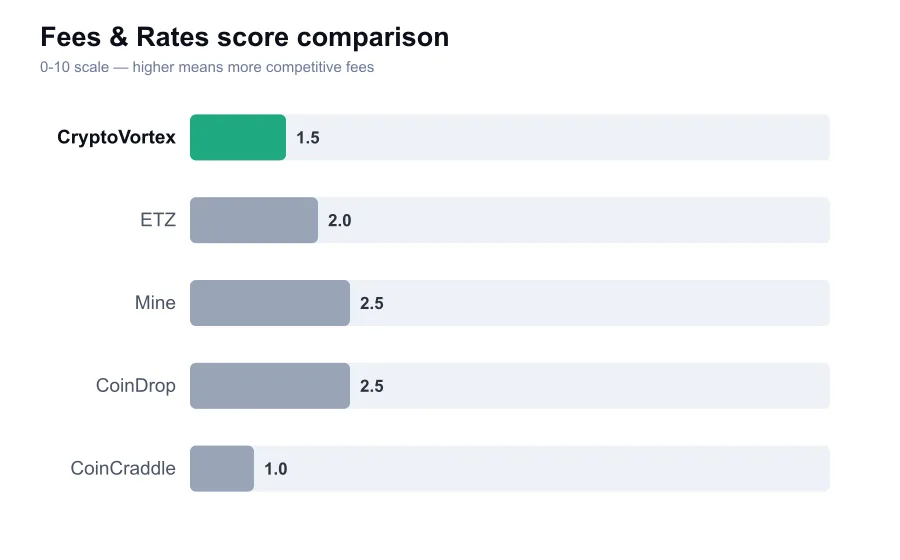
Fees are often where questionable providers hide the real cost. A platform may advertise commission free trades, tiny spreads, or a guaranteed daily return, then profit through poor pricing, withdrawal charges, forced account upgrades, or arbitrary conversion costs. Legitimate services disclose their fee schedule before a customer deposits. They explain the spread methodology, network withdrawal fees, payment method charges, minimum amounts, and conditions that could delay a payout.
CryptoVortex does not have a sufficiently verifiable public pricing framework for a meaningful positive score. If a representative gives you a fee quote in a private chat but the same terms do not appear in published documentation, treat it as nonbinding marketing. Do not assume a dashboard balance is a real, liquid account balance either. A screen can display any number. The relevant test is whether the customer can withdraw their own crypto to an address they control.
Speed promises require the same scepticism. Many dubious investment sites claim instant withdrawals until a customer attempts one, at which point they discover a verification charge, tax payment, anti money laundering deposit, or minimum turnover requirement. Real exchanges can delay withdrawals for security or compliance reasons, but they do not ask customers to send more money to unlock money they already own. That pattern is an unmistakable warning sign.
Never let a CryptoVortex agent create urgency around a transfer. Pressure to deposit today, copy trade a professional, recover a prior loss, or take a limited time arbitrage opportunity is designed to bypass judgement. Crypto markets are volatile, but there is no legitimate reason to send funds to an unknown provider without verifying ownership and withdrawal mechanics. Missing an opportunity is far better than funding a wallet you cannot recover from.
Security claims need evidence. Statements about military grade encryption, AI protection, insured funds, or institutional liquidity are easy to copy into a website footer. Stronger evidence includes a named legal operator, a published security architecture, enforceable insurance terms, independent audits, bug bounty activity, clear cold storage practices, transparent incident history, and a record of communicating openly when something goes wrong. I could not verify that level of disclosure for CryptoVortex.
A missing security record is especially concerning in a custodial setting. If CryptoVortex holds the private keys, a customer is exposed not only to hackers but also to internal misuse, insolvency, blocked withdrawals, and the possibility that the service was never operating a real exchange at all. Noncustodial wallets place different responsibilities on users, but at least the ownership model is clear. Unknown custodial platforms combine the worst parts of opacity and counterparty risk.
The KYC question is no safer. A no KYC promise is sometimes presented as an advantage, yet an unidentified operator collecting deposits outside ordinary controls offers little recourse if something fails. The opposite scenario is also dangerous, where a vague company collects passports, selfies, and proof of address without a credible privacy policy or legal responsibility. Do not hand over sensitive identity documents merely because a website says verification is required to release a withdrawal.
Reputation must be earned across time. Reliable providers have criticism too, but they leave a trail: serious press coverage, regulator records, known executives, app histories, technical discussion, user communities, and public responses to problems. A thin set of glowing reviews, particularly if they all use similar wording or steer people toward an account manager, is not a substitute. Search for independent reports, domain history, and complaints, not just the testimonials chosen by the platform.
Customer support is usually revealing. A legitimate exchange offers an official ticket process, documented escalation route, and support pages that do not ask customers to expose account secrets. Fraudulent or dubious services tend to shift communication into Telegram, WhatsApp, Discord, or direct calls. They may sound unusually attentive while pushing deposits, then vanish or become hostile when the customer asks to withdraw. Sales pressure is not customer care.
If you have already deposited with a CryptoVortex branded service, do not send additional funds to recover the first deposit. Save transaction hashes, wallet addresses, emails, screenshots, and chat logs. Contact your bank or card provider promptly if fiat was involved, report the relevant wallet addresses to the exchange that received or sent funds where possible, and consider a local fraud reporting channel. Be wary of recovery agents who approach you afterward, since they often run a second scam.
For traders, there is no compelling reason to accept this uncertainty. A recognised exchange may require more verification and may not make impossible return promises, but it publishes trading conditions and has something to lose from misconduct. Users who want privacy can use established noncustodial wallets and decentralised protocols after learning the risks. CryptoVortex does not offer enough verifiable substance to justify choosing it over either route.
My recommendation is simple: avoid CryptoVortex unless the exact service can be independently shown to be a legally identified, securely operated provider with transparent pricing and a proven withdrawal record. At present, it fails the basic confidence test expected of a financial platform. Do not confuse a professional looking dashboard with evidence of custody, liquidity, or safety. Keep control of your funds and use a provider whose history can be checked without relying on its own promises.
| Criterion | Score (0-10) | Notes |
|---|---|---|
| Fees & Rates | 1.5 | No dependable, independently verifiable fee data |
| Transaction Speed | 2.0 | Withdrawal performance is not credibly documented |
| Security & KYC Policy | 1.5 | No verified custody or security programme |
| Reputation & Track Record | 1.5 | Insufficient established public track record |
| Customer Support | 2.0 | Do not rely on private chat based support |
| Pros | Cons |
|---|
I could not verify enough reliable public information about a specific CryptoVortex operator to recommend it. Confirm the legal entity, domain, and regulatory status independently before any deposit.
Do not pay. Requests for taxes, activation deposits, liquidity fees, or verification payments to unlock funds are a major scam warning sign. Preserve evidence and seek fraud advice.
Do not trust an account manager simply because they are responsive or claim professional expertise. Never share a seed phrase, install remote access software, or send funds under pressure.
| Alternative | Score |
|---|---|
| ETZ Review | 1.8/10 |
| Mine Review | 2.3/10 |
| CoinDrop Review | 2.4/10 |
| CoinCraddle Review | 0.8/10 |
| Spark Review | 2.9/10 |
| Magnatus Review | 3.0/10 |