
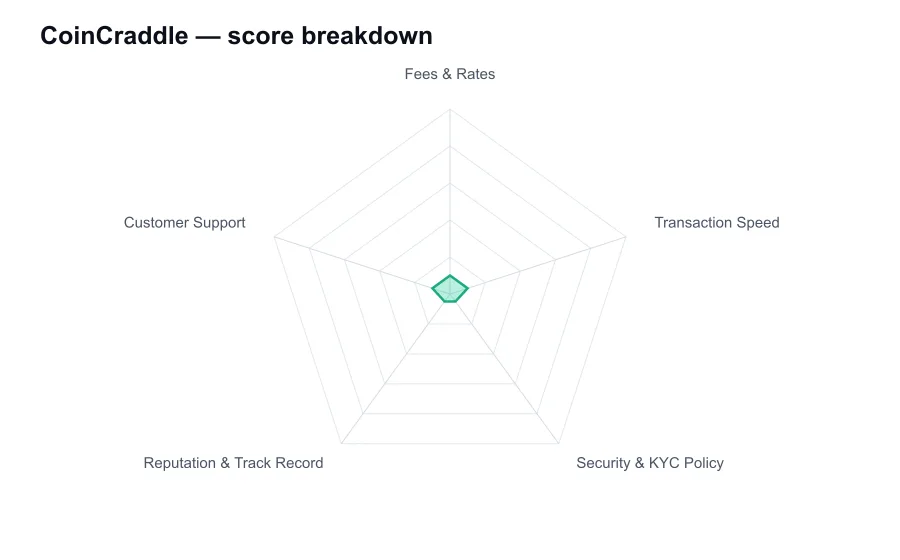
CoinCraddle scores 0.8/10 overall in our independent review, measured against every other provider we've compared, strongest on Fees & Rates (1.0/10) and weakest on Reputation & Track Record (0.5/10).
0.8/10 How we score →Editorial independence: our scores and rankings are produced using the fixed criteria above and are not influenced by advertisers. This is an independent ranking site and is not operated by, or affiliated with, any provider we list.
Affiliate disclosure: some links on this page may earn us a commission at no extra cost to you. This does not affect our rankings.
CoinCraddle is a name that raises a basic editorial problem before fees, features, or chart layouts even enter the discussion. I could not establish a reliable official website, a clearly attributable operating company, a credible regulatory footprint, or a durable public record that would support treating it as a known crypto exchange provider. In an industry full of cloned brands and short-lived domains, that lack of verifiable identity is not a minor gap. It is the central fact.
A legitimate exchange does not need to be famous to be usable, but users should be able to verify who operates it, where it is incorporated, what services it offers, how customers can contact it, and which terms govern their funds. CoinCraddle does not present enough independently confirmable information to clear that basic standard. A polished advert, Telegram group, social account, or referral page would not fix the problem. Those are cheap to create and routinely used to manufacture credibility.
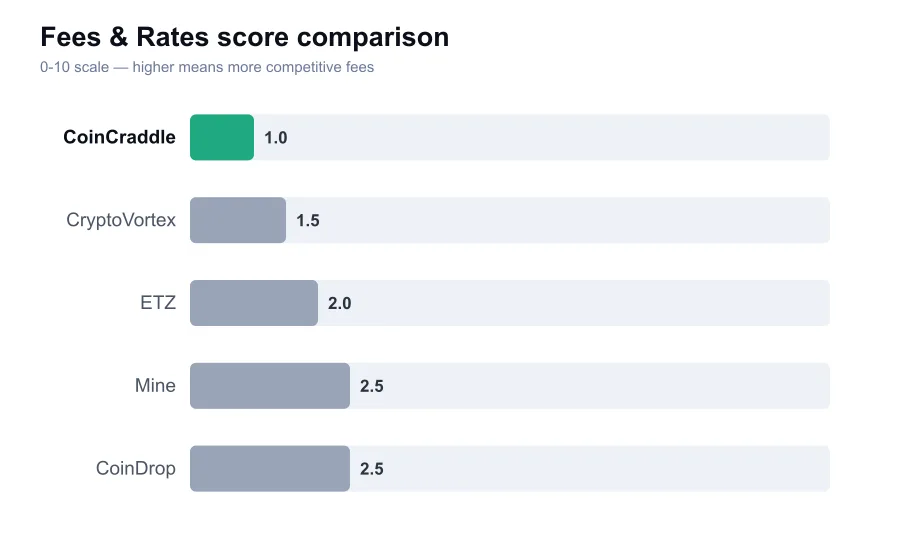
Because the service cannot be reliably identified, there is no responsible way to quote a trading fee, spread, deposit charge, withdrawal charge, or staking yield as fact. Any figure circulated in an affiliate post or direct message should be treated as unverified. Crypto scams commonly advertise unusually low trading fees or zero-fee withdrawals, then recover money through inflated purchase prices, withdrawal locks, fabricated taxes, or demands for a further deposit to release funds.
That puts CoinCraddle at the bottom of the fees rubric, not because a high published fee is proven, but because the costs are unknowable. Transparent fees are not merely a convenience. They let a customer calculate whether a platform is viable and expose misleading marketing. If you cannot find a stable, official fee schedule tied to a legal entity and live service, you cannot calculate the true cost of using it. The right price is not always the lowest one, but it must be knowable.
Speed claims deserve the same skepticism. An unknown site can show an instant account balance, label an internal transfer complete, or promise a withdrawal in minutes. None of that proves it will broadcast a transaction on-chain or honor a fiat payout. The only meaningful withdrawal test is an independently verifiable transaction or a completed bank settlement, initiated by a customer who has not been pressured to pay extra charges first. Publicly verifiable evidence is what is missing here.
This is where newcomers get trapped. They see a dashboard update and assume they own a tradable balance. On a real exchange, a user can usually inspect transaction IDs, destination addresses, network confirmations, and withdrawal policies. On a questionable platform, the numbers may only exist inside its own interface. A displayed profit, bonus, or locked balance has no value if the operator controls every route out and refuses or delays withdrawals.
Security cannot be assessed from generic claims about SSL, encryption, cold storage, artificial intelligence, or military-grade protection. Every decent web service uses encryption in transit. That says little about private-key management, segregation of customer assets, access controls, internal governance, incident response, insurance, or whether the business exists in a form that can be held accountable. CoinCraddle provides no trustworthy basis to assess those areas, so a high security score would be fiction.
The KYC question is also a warning sign rather than a selling point. Unknown services sometimes market no-KYC access aggressively, then request identity documents only after a user has deposited money and attempts to withdraw. That combination is dangerous. It exposes users to both financial loss and identity theft. Conversely, if the service claims to be regulated yet lacks a verifiable legal entity, regulator listing, privacy policy, and compliance contact, its supposed KYC process offers no comfort.
Never upload a passport, driver's license, bank statement, selfie, recovery phrase, or remote-device access code to an unverified crypto brand. A legitimate provider may request identity documents under a clear policy, but that does not mean every request is safe. Confirm the exact domain, check the company behind it, and make sure support contact details match official records. If a recruiter, romantic contact, or investment mentor sent the link, assume the risk level is substantially higher.
Reputation is where CoinCraddle fails most decisively. I found no dependable track record comparable to established exchanges that have years of public scrutiny, documented outages, security disclosures, customer complaints, licensing information, and recognizable leadership. A lack of complaints alone would not be positive evidence, because a tiny or newly created platform may simply have little real customer use. In crypto, silence around an obscure brand is not the same as trust.
Support is impossible to rate generously when the operator cannot be independently pinned down. A chat bubble, email address, or messaging account is not meaningful customer support if there is no accountable company behind it. Worse, scam operations can be very responsive while they are encouraging deposits. The quality test begins after a customer asks for a withdrawal, challenges an unexplained charge, or reports a compromised account. There is no reliable evidence that CoinCraddle can meet that test.
A prudent reader should compare this uncertainty with a known provider. At Coinbase, Kraken, Bitstamp, or a properly licensed local exchange, users can still encounter fees, verification delays, and frustrating support. The difference is that their legal entities, public history, published terms, and operating model can be checked. That does not eliminate risk, but it gives a user a foundation for due diligence. CoinCraddle does not currently offer that foundation.
If someone already deposited funds, the priority is not to send more money in pursuit of a release. Do not pay a supposed tax, account-upgrade charge, verification fee, liquidity deposit, or anti-money-laundering bond to unlock a balance. Save screenshots, wallet addresses, transaction hashes, emails, and chat logs. Contact the bank, card issuer, or exchange used to send funds promptly, and report the case to the relevant fraud authority. Recovery is difficult, but further payment nearly always deepens the loss.
My recommendation is blunt: avoid CoinCraddle until there is independently verifiable evidence of who operates it, what regulatory and legal framework applies, what its real official domain is, and whether customers can withdraw normally. There are far too many established alternatives to justify gambling on anonymity. This is not a case where a tempting bonus compensates for limited information. The missing information is itself the risk, and it overwhelms any claimed feature or price advantage.
| Criterion | Score (0-10) | Notes |
|---|---|---|
| Fees & Rates | 1.0 | No reliably verifiable public fee schedule was identified. |
| Transaction Speed | 1.0 | No dependable evidence of normal, completed withdrawals. |
| Security & KYC Policy | 0.5 | Operator, custody controls, and KYC handling cannot be verified. |
| Reputation & Track Record | 0.5 | No established, independently verifiable operating record. |
| Customer Support | 1.0 | No accountable support organization could be confirmed. |
| Pros | Cons |
|---|
I could not verify an official operating entity, authoritative domain, regulatory status, or established exchange track record. Treat it as unverified.
No. Do not send additional funds for taxes, verification, upgrades, or withdrawal release. Preserve evidence and contact your payment provider or exchange.
No. An unknown service can request KYC later or misuse submitted documents. Lack of identity checks is not proof of legitimacy.
| Alternative | Score |
|---|---|
| CryptoVortex Review | 1.7/10 |
| ETZ Review | 1.8/10 |
| Mine Review | 2.3/10 |
| CoinDrop Review | 2.4/10 |
| Spark Review | 2.9/10 |
| Magnatus Review | 3.0/10 |