
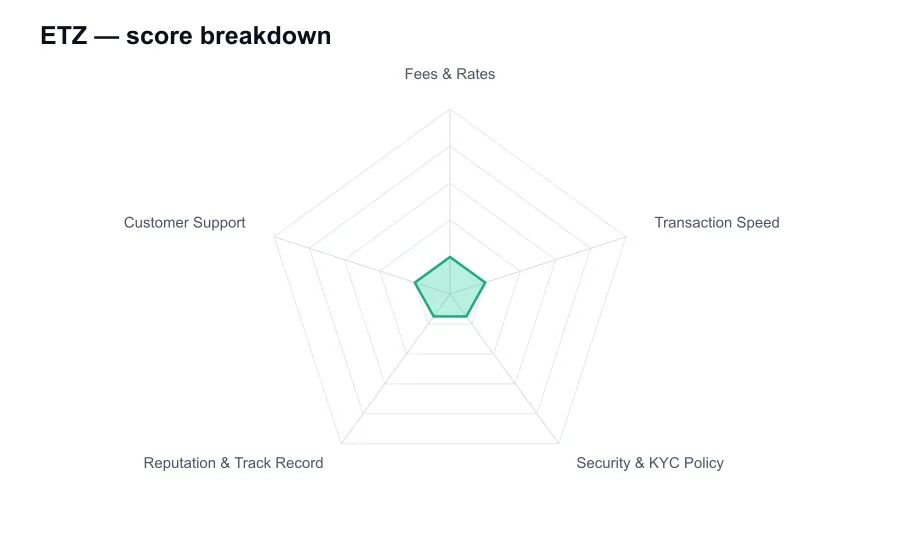
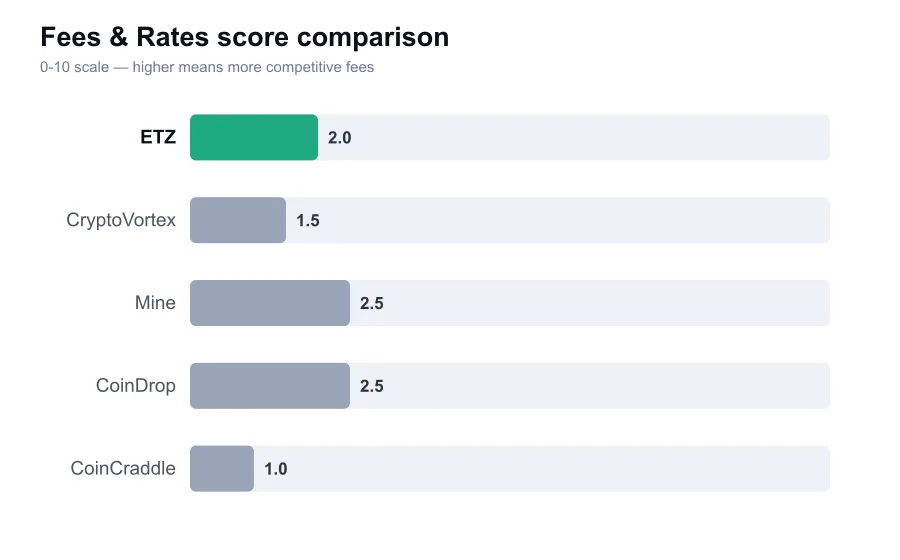
ETZ scores 1.8/10 overall in our independent review, measured against every other provider we've compared, strongest on Fees & Rates (2.0/10) and weakest on Reputation & Track Record (1.5/10).
1.8/10 How we score →Editorial independence: our scores and rankings are produced using the fixed criteria above and are not influenced by advertisers. This is an independent ranking site and is not operated by, or affiliated with, any provider we list.
Affiliate disclosure: some links on this page may earn us a commission at no extra cost to you. This does not affect our rankings.
ETZ is the most difficult name in this group to review responsibly because the label does not identify a widely established crypto exchange with a clear, verifiable public operating history. In crypto, that is not a minor research inconvenience. It is a warning sign. Names are reused by tokens, wallet projects, offshore websites, and short lived trading brands, so a reviewer should not attach confidence to the wrong entity simply because a familiar acronym appears in a search result.
I have therefore not assigned an official website URL here. A real exchange should make its legal identity, domain, terms, supported jurisdictions, customer contact route, and security information easy to verify from its own official presence. If a prospective user cannot independently establish those basics, depositing crypto is premature. A polished interface or social media account does not solve the identity problem.
This makes fee analysis largely impossible in the normal sense. I cannot responsibly confirm a published maker and taker schedule, an instant swap markup, a withdrawal charge table, or the way ETZ handles network fees. Any site using the ETZ name may display rates, but a displayed rate is not enough without reliable terms and a clear operator behind it. Unknown fees are often worse than merely high fees.
The practical risk is that users may focus on an attractive quote and ignore the exit route. A provider can advertise zero trading fees while recovering revenue through a wide spread, restrictive withdrawal conditions, token conversion rules, or unexplained minimums. With an unverified exchange, the relevant question is not whether the fee is 0.1% or 1%. It is whether the customer can reliably withdraw the asset after depositing it.
Speed cannot be scored strongly either. There is no sufficiently established public record to support claims about average processing times, blockchain confirmation policy, liquidity sourcing, fiat settlement, or withdrawal performance. A website can show an instant status indicator while a manual review queue is processing deposits behind the scenes. Until a platform has sustained, independently visible operational evidence, speed claims should be treated as marketing.
A transaction may appear quick on the way in because blockchain deposits are simple to receive. The real test is the conversion, withdrawal, and support response when something does not match the expected flow. This is where unknown providers often fail users. Established exchanges have their own frustrations, but they at least leave a substantial trail of documented policies, regulatory disclosures, and user experiences that can be checked.
Security is where ETZ's lack of clear verification becomes most serious. I cannot confirm whether there is cold storage policy, proof of reserves, mandatory two factor authentication, withdrawal address whitelisting, third party penetration testing, a bug bounty, insurance, or meaningful segregation of customer assets. A provider should not receive credit for security measures that are only claimed vaguely or cannot be independently evaluated.
The KYC position is equally unclear. Some obscure crypto services market no KYC access, but then reserve the right to request documents after a deposit is made. Others collect personal data through an onboarding form without clearly explaining the legal entity handling it. Both scenarios are poor from a user protection perspective. Privacy requires more than skipping an ID upload, it requires clear data practices and predictable transaction rules.
It is tempting to assume that no KYC is automatically better. It is not. A legitimate noncustodial protocol can operate without KYC because it does not take custody in the same way as a broker. An unidentified centralized service with no KYC may simply mean users have fewer protections, no clear complaints process, and no credible way to recover funds if access is restricted. The business model and custody flow matter far more than the slogan.
Reputation has to be earned through time, transparency, reliable withdrawals, and credible accountability. ETZ does not have the recognizable industry track record of Kraken, Coinbase, Bitstamp, Binance, Curve, or even established instant swap brands such as EasyBit. I could not substantiate a long, consistent public history sufficient to treat the ETZ name as a trusted exchange provider. That does not prove fraud, but it does make a positive recommendation unjustified.
The absence of a clear independent reputation is especially important because crypto reviews can be manipulated. Testimonials on a provider's own site, generic five star comments, referral campaigns, and anonymous social posts are weak evidence. Look for a coherent record across official filings where relevant, named leadership, transparent terms, longstanding technical documentation, credible security disclosures, and complaints that receive verifiable responses. If that record is missing, move on.
Customer support also cannot be rated as a dependable service merely because a chat bubble exists. A legitimate support operation should have identifiable contact channels, documented response expectations, a support center, and a way to escalate disputes. It should never ask for a seed phrase, private key, remote device access, or an extra crypto payment to release a withdrawal. Those are classic scam indicators, not normal support procedures.
Anyone who is still considering a service branded ETZ should perform basic checks before sending even a small amount. Confirm the precise domain through independent sources, inspect the terms for the legal company name and jurisdiction, search regulator warnings, verify the age and ownership signals of the domain, and read the withdrawal rules. Then test only with an amount you are fully prepared to lose. Never use borrowed money or send a life changing balance to establish whether a site works.
A small test withdrawal is more useful than a deposit test. Deposit only after you know the exact network and address format required, complete the intended trade if one is involved, and withdraw to a wallet you control. Record transaction hashes and screenshots. If the platform imposes a surprise tax, unlock fee, security deposit, or demand for more funds before withdrawal, stop. Do not send additional money to recover money already sent.
For ordinary users, there is no good reason to accept this level of uncertainty. Regulated exchanges offer clearer recourse and established DeFi protocols offer more transparent on chain execution, even though both have risks. An unknown provider has to demonstrate a compelling, verifiable advantage before it deserves consideration. A vague name and unsupported claims are not an advantage.
My final view is blunt. ETZ cannot be recommended on the evidence available under that name. The lack of a confidently identified official operator prevents meaningful praise for its pricing, speed, security, or support, and that uncertainty should pull its scores down rather than invite optimistic assumptions. Use a provider with a verifiable identity and history instead. If ETZ can document those fundamentals clearly, it should be reassessed on that evidence, not on promises.
| Criterion | Score (0-10) | Notes |
|---|---|---|
| Fees & Rates | 2.0 | No reliably verified public fee schedule |
| Transaction Speed | 2.0 | No dependable evidence of settlement performance |
| Security & KYC Policy | 1.5 | Security and KYC practices cannot be verified |
| Reputation & Track Record | 1.5 | No established exchange track record confirmed |
| Customer Support | 2.0 | No independently dependable support record found |
| Pros | Cons |
|---|
I could not confirm a widely established exchange operator, official domain, or public track record for a provider identified simply as ETZ. Verify the exact entity before sending funds.
A reliable public fee schedule could not be confirmed. Do not rely on a quoted trading fee alone, because spread, withdrawal conditions, and hidden charges may be more important.
The safer choice is to use a verified provider instead. If you proceed despite the uncertainty, use only an amount you can lose and test a withdrawal to your own wallet.
| Alternative | Score |
|---|---|
| CryptoVortex Review | 1.7/10 |
| Mine Review | 2.3/10 |
| CoinDrop Review | 2.4/10 |
| CoinCraddle Review | 0.8/10 |
| Spark Review | 2.9/10 |
| Magnatus Review | 3.0/10 |