
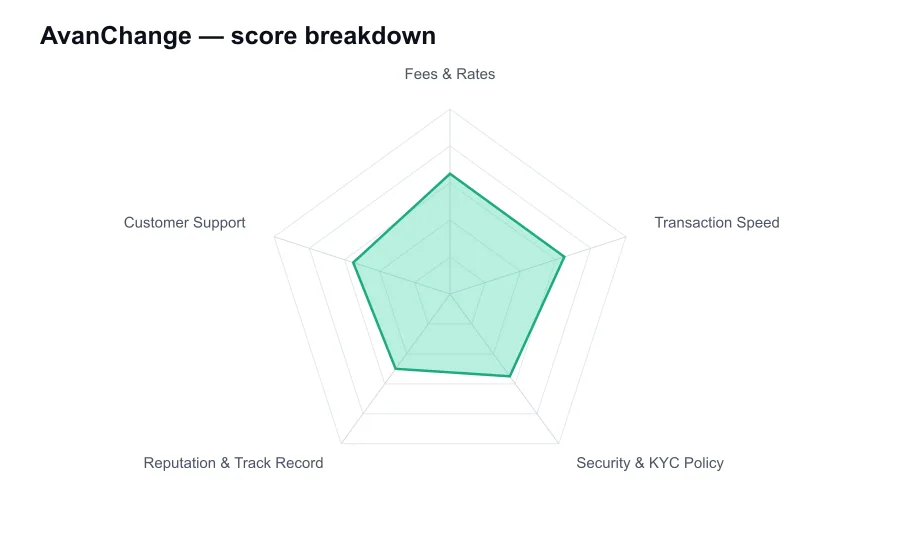
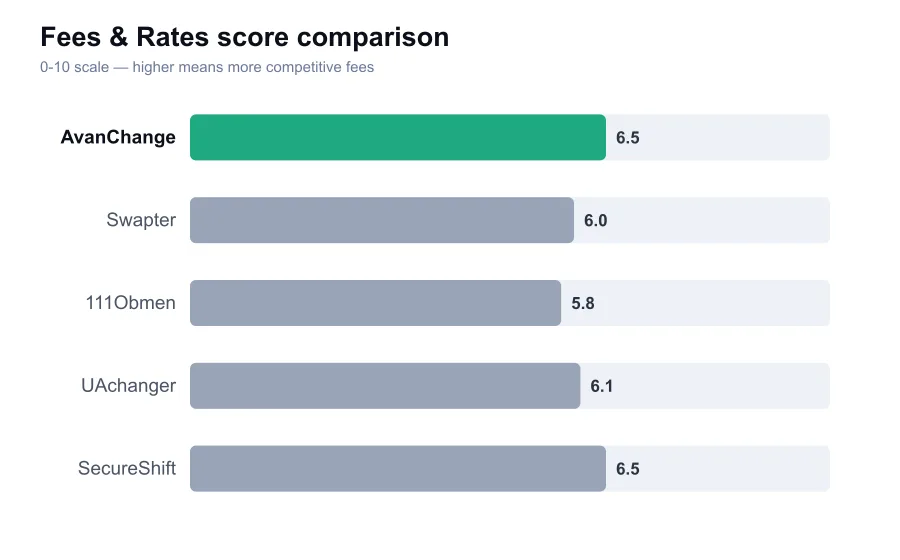
AvanChange scores 5.9/10 overall in our independent review, measured against every other provider we've compared, strongest on Fees & Rates (6.5/10) and weakest on Reputation & Track Record (5.0/10).
5.9/10 How we score →Editorial independence: our scores and rankings are produced using the fixed criteria above and are not influenced by advertisers. This is an independent ranking site and is not operated by, or affiliated with, any provider we list.
Affiliate disclosure: some links on this page may earn us a commission at no extra cost to you. This does not affect our rankings.
AvanChange is a small cryptocurrency exchange service built around straightforward swaps rather than a full trading terminal. It sits in the crowded market of instant and semi-manual exchangers, where users arrive with one coin, choose another, and expect a completed transaction without opening a conventional exchange account. That can be useful, especially for someone who doesn't need charts, margin products, or a custodial wallet. It also means the service has to earn trust through its rate quotes, operational consistency, and responsiveness, because it doesn't have the institutional profile of Coinbase, Kraken, or Bitstamp.
The first thing I would tell a prospective user is to distinguish convenience from proof. AvanChange presents the kind of simple flow many exchange monitors favor: choose a pair, enter a receiving address, pay, and wait for settlement. There is nothing inherently wrong with that model. In fact, a lean exchange desk can solve a one-off conversion faster than registration at a large venue. But the model gives the operator considerable discretion over pricing, liquidity, compliance checks, and exception handling. Those are precisely the details that deserve scrutiny.
Fees are not usually presented as a clean, standalone trading commission in the way they are on a major spot exchange. The cost is primarily embedded in the quoted exchange rate, with network charges and provider spreads effectively folded into the offer. That is normal for an exchanger, but it makes comparisons essential. A rate that looks attractive against another small swap service can still be materially worse than buying on a liquid exchange and withdrawing the asset yourself. Don't compare only the amount sent. Compare the exact amount you will receive after every charge.
For common pairs such as Bitcoin, Ethereum, USDT, and Litecoin, the headline quote can be competitive during calm markets. The problem is that these rates are not a promise of deep liquidity. A thinly capitalized exchanger may advertise a good number, then need to revise, delay, or manually process a large order. I would use AvanChange for a modest conversion only after checking its live quote against Changelly, FixedFloat, SimpleSwap, and an exchange order book. For a large transfer, a few tenths of a percent saved on screen is not enough compensation for counterparty risk.
The distinction between fixed and floating rates matters here. A floating quote leaves the final amount exposed to market movement between the time you create an order and the time the service receives enough blockchain confirmations. That risk becomes very real during a sharp Bitcoin move or when Ethereum gas conditions are unsettled. If AvanChange offers a fixed-rate option for a particular route, read the expiry window and payment instructions carefully. Sending late, using the wrong network, or underpaying by a small amount can turn a supposedly automatic order into a support case.
Speed is decent in the situations these services are designed for, namely ordinary-sized transfers through liquid networks with no compliance review. The blockchain itself is often the limiting factor. Bitcoin deposits need confirmations, Ethereum and token transfers can be delayed by congestion, and a destination network may have its own finality rules. A realistic expectation is minutes for some token swaps and substantially longer for Bitcoin or manually handled orders. Anyone promising that every conversion is instant is selling a fantasy.
AvanChange is less reassuring once something goes wrong. The normal path can be quick because there is little human intervention, but exceptions are where small exchangers reveal their maturity. An incorrect memo, a delayed deposit, a chain swap, or an order that triggers a risk review can leave the customer dependent on a support queue. A major exchange has formal ticket systems, published incident practices, and more staff. A smaller provider may eventually solve the issue, but the user has fewer practical levers if communication stops.
Its KYC posture should not be confused with a blanket guarantee of anonymity. Many swap services advertise a low-friction process because they do not require account creation for ordinary orders. Yet providers can still request identification, source-of-funds information, or wallet explanations where automated screening flags a transaction. That isn't unreasonable in itself. The concern is whether the conditions, document process, retention policy, and refund procedure are clearly explained before money is sent. If those policies are vague, the user bears too much uncertainty.
Security starts with the fact that AvanChange is a counterparty, not just software routing coins between wallets. You transfer funds to an address controlled by the service and rely on it to send the output. That is fundamentally different from a noncustodial decentralized swap. The safest habit is to use a self-custody wallet as both the sending and receiving endpoint, confirm the destination address independently, and never leave an exchange balance sitting with the operator. There is no reason to treat a swap desk as a long-term wallet.
Public reputation is adequate only if approached with the caution appropriate to a lesser-known brand. Listings on exchange monitoring sites, review aggregators, and forums can establish that a service is operating, but they do not provide the same assurance as a long regulatory history or audited financial disclosures. Positive comments are useful signals about routine orders. They are weak evidence about how a provider behaves during disputed transactions, market stress, or compliance holds. I put far more weight on a clear, documented resolution record than on a large pile of one-line praise.
The site experience is geared to completing a transaction, not educating a first-time buyer. That keeps it uncluttered, but it also puts responsibility on the customer to understand networks, minimums, destination tags, and confirmation timing. A newcomer moving USDT can easily make an expensive mistake by confusing TRC20, ERC20, and another supported network. The service should make those distinctions impossible to miss. If an interface merely displays a network label in small text, that is not enough for a product handling irreversible transfers.
Customer support appears to be one of the more important practical tests for AvanChange. Before placing a meaningful order, I would send a specific pre-sales question about a pair, network, or rate type and see whether the reply is prompt and precise. A generic answer is a bad sign. Good exchanger support should be able to explain confirmation requirements, reserve limitations, the handling of underpayments, and the timeline for a refund without improvising.
There is also a basic risk-management point that gets ignored by users hunting for the best quote. Never make your first transaction with a new exchanger the largest transaction of the month. Send a small test amount, verify the receiving address and final payout, then decide whether the saved spread justifies using the service again. That approach is not paranoia. It is the rational response to irreversible settlement and the limited recourse available with smaller crypto businesses.
My view is that AvanChange can be a workable tool for experienced users who understand wallet operations and are willing to compare live quotes. It is not the provider I would choose for a first crypto purchase, a time-critical large conversion, or funds whose loss would cause real harm. The basic swap model is convenient, and routine orders may be uneventful. Still, the limited public footprint, quote-based pricing, and dependence on support during exceptions keep it firmly in the specialist, use-with-care category.
| Criterion | Score (0-10) | Notes |
|---|---|---|
| Fees & Rates | 6.5 | Quote-based pricing can be competitive, but the spread needs checking. |
| Transaction Speed | 6.5 | Routine swaps can be quick, exceptions may require manual handling. |
| Security & KYC Policy | 5.5 | Low-friction swaps, but limited public assurance and counterparty risk. |
| Reputation & Track Record | 5.0 | A smaller exchange-service footprint than established global venues. |
| Customer Support | 5.5 | Support matters heavily for delayed or flagged orders. |
| Pros | Cons |
|---|
The practical cost is generally reflected in the quoted exchange rate, alongside network costs. Compare the final receive amount with several services before paying.
A low-friction order flow does not guarantee no verification. A transaction can still trigger compliance checks or a request for information.
Timing depends on the asset, network confirmations, liquidity, and whether the order needs manual review. Bitcoin transfers often take longer than token swaps.
| Alternative | Score |
|---|---|
| Swapter Review | 6.0/10 |
| 111Obmen Review | 5.7/10 |
| UAchanger Review | 5.7/10 |
| SecureShift Review | 5.6/10 |
| ClickPay Review | 6.3/10 |
| Nexchange Review | 6.3/10 |