
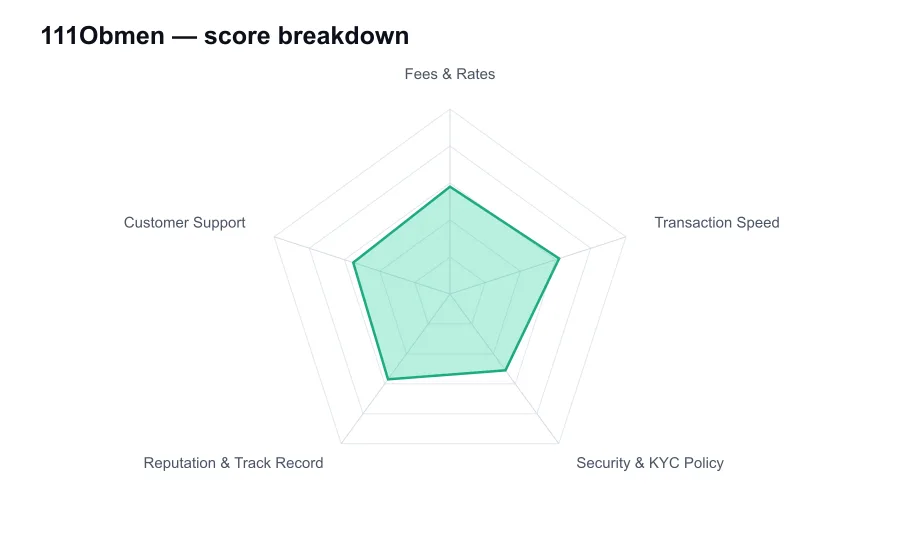
111Obmen scores 5.7/10 overall in our independent review, measured against every other provider we've compared, strongest on Transaction Speed (6.2/10) and weakest on Security & KYC Policy (5.1/10).
5.7/10 How we score →Editorial independence: our scores and rankings are produced using the fixed criteria above and are not influenced by advertisers. This is an independent ranking site and is not operated by, or affiliated with, any provider we list.
Affiliate disclosure: some links on this page may earn us a commission at no extra cost to you. This does not affect our rankings.
111Obmen is a small online currency exchanger aimed at people who want to move between crypto, bank cards, electronic money systems, and occasional cash or transfer routes without opening a full trading account. It belongs to the familiar Eastern European exchanger model rather than the global exchange model. You select a direction, enter details, send funds, and wait for an operator or automated reserve system to complete the other side. That can be convenient, but it is a very different proposition from using Binance, Kraken, or a self-custodial swap.
The service appears most relevant through exchange-monitoring sites, where its available directions, reserve levels, and user feedback can be compared against competing exchangers. That visibility is useful, though it should not be mistaken for the sort of public financial reporting or regulatory disclosure expected from a major exchange. 111Obmen is a service to assess transaction by transaction. The listed rate, reserve, payment rail, and review history for that particular route matter more than a broad brand promise.
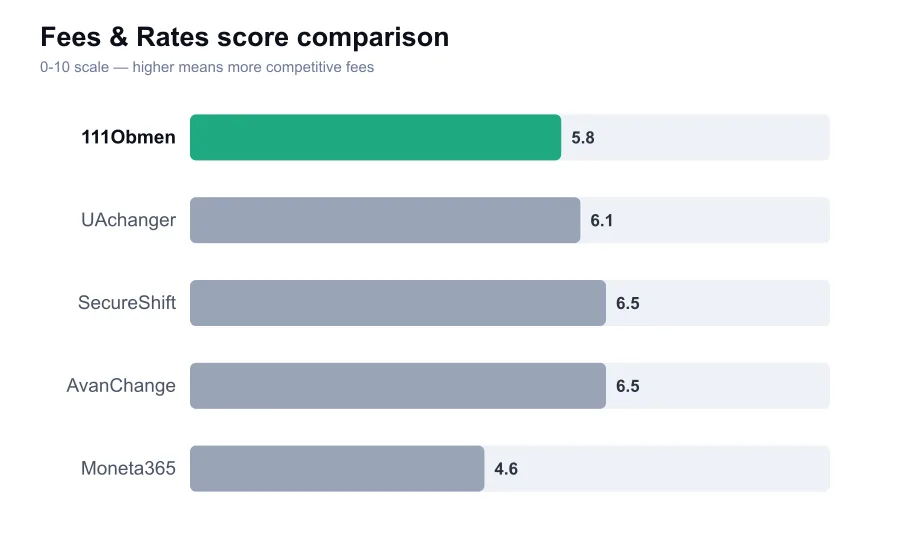
Its pricing is neither especially transparent nor necessarily excessive. With this kind of exchanger, the stated rate normally contains the service margin, payment processing cost, and the provider's market risk. A customer may see no separate trading-fee line, yet still pay materially more than the mid-market price. That is standard practice, but it means the headline can look friendlier than the actual economics. Compare the final payout, not just the rate field or a claim about low commission.
For common crypto-to-crypto swaps, the spread may be tolerable if 111Obmen has a good reserve and the transaction is small. For card purchases, bank transfers, and directions involving less liquid payment systems, the all-in cost can widen quickly. That is where a conventional exchange will often win for users who can complete verification and fund an account. 111Obmen's value lies in route convenience, not in being a dependable low-cost venue for regular trading.
The calculator should be treated as a quote request, not as a guarantee that every input will produce exactly the displayed result. Network fees, insufficient reserve, a payment arriving late, or a rate movement can affect execution. Fixed-rate directions deserve extra attention because the conditions matter. If the service only fixes a rate after receipt, the customer carries price risk while the blockchain transaction confirms. During a quiet market that barely matters. During a sharp Bitcoin or USDT move, it can matter a lot.
Speed depends heavily on the pair. A straightforward crypto transaction can be processed after the required network confirmations, and that may mean minutes rather than hours if the operator is online and reserve is ready. Bank card and transfer directions are less predictable. Manual checks, banking cutoffs, recipient-bank delays, and fraud controls can turn a supposedly quick exchange into a same-day or next-business-day matter. Anyone needing an exact deadline should not rely on the optimistic time shown beside an order form.
I would also be careful with unusually large orders. Smaller exchangers can handle routine amounts well, but their published reserve does not guarantee instant capacity across every payment channel. A large payout may need confirmation from an operator or be split into stages. Test the process with a modest amount first, particularly for a new bank beneficiary or a less common token. Sending a full treasury transfer to discover that a route requires manual review is an avoidable mistake.
111Obmen's security model is mostly operational rather than institutional. It is not a self-custody tool, so users temporarily trust the service with incoming funds and personal payment details. Check the exact domain, use a bookmarked link, and inspect the recipient wallet address carefully. Exchanger impersonation is common, and a cloned payment page can look convincing. No amount of good service history protects someone who sends money to a fraudulent copycat.
The service's limited-account approach can appeal to privacy-minded users, but no-KYC marketing should never be read as a promise of anonymity in every circumstance. A transaction can be paused if automated controls identify unusual behavior, a mismatched sender name, sanctions risk, or a compliance concern. Card and bank routes are particularly likely to produce questions. Users should be prepared to document the source of funds if an operator asks, even if the initial order flow seems light on verification.
That ambiguity is the main security weakness. Large regulated exchanges publish policies, licensing information, proof-of-reserves efforts, and security programs that can be independently scrutinized, even if they have their own flaws. A small exchanger offers less institutional visibility. The practical safeguard is restraint: use unique contact details where possible, save the order page and transaction hash, do not send from third-party accounts unless the rules explicitly allow it, and avoid storing money on the service.
Reputation should be judged from recent, detailed feedback rather than a raw score alone. Reviews that mention a specific direction, date, amount range, and resolution process carry more weight than generic praise. Pay special attention to complaints involving delayed payouts, rate changes, or requests for documents after funds were sent. A single angry review proves little, but repeated reports of the same operational problem are a reason to walk away.
Support is likely adequate for a conventional exchange order, but it is not the kind of global, staffed support operation available at Coinbase or Kraken. The important test is whether an operator gives a clear answer about an active order and explains what evidence is required if something goes wrong. Before sending a large amount, ask a practical question through the listed support channel. A slow or vague reply before payment is useful information, not bad luck.
There are situations where 111Obmen makes sense. A user who has found a competitive quote for a familiar route, checked current monitoring-site feedback, and only needs a one-off exchange may appreciate the straightforward flow. It can also be useful where a mainstream exchange does not support the local payment method. That is a narrower endorsement than calling it a primary crypto platform, because it simply is not designed to be one.
My view is cautious but not dismissive. 111Obmen can be a workable transactional exchanger if the live quote is good and the order is modest, yet it asks the customer to do more due diligence than a large exchange. Its lack of deep public transparency and its variable route economics prevent a strong recommendation for large or recurring transfers. Use it as a tool for a specific route, verify every detail, and keep an established regulated platform for savings, trading, and anything you cannot afford to have delayed.
| Criterion | Score (0-10) | Notes |
|---|---|---|
| Fees & Rates | 5.8 | Rate includes the margin, compare final payout carefully |
| Transaction Speed | 6.2 | Crypto routes can be quick, bank routes vary |
| Security & KYC Policy | 5.1 | Limited public security disclosure and conditional checks |
| Reputation & Track Record | 5.7 | Monitor recent route-specific feedback |
| Customer Support | 5.5 | Practical operator support, limited institutional depth |
| Pros | Cons |
|---|
The effective charge is commonly built into the exchange rate. Compare the exact final payout against competing services and the market rate before paying.
Crypto orders can complete after blockchain confirmations, while bank and card directions may take longer because of manual checks and payment-provider delays.
It can. Even services with a light initial flow may request documents or source-of-funds information for suspicious or higher-risk transactions.
| Alternative | Score |
|---|---|
| UAchanger Review | 5.7/10 |
| SecureShift Review | 5.6/10 |
| AvanChange Review | 5.9/10 |
| Tiendacrypto Review | 5.5/10 |
| Moneta365 Review | 5.5/10 |
| Swapter Review | 6.0/10 |