
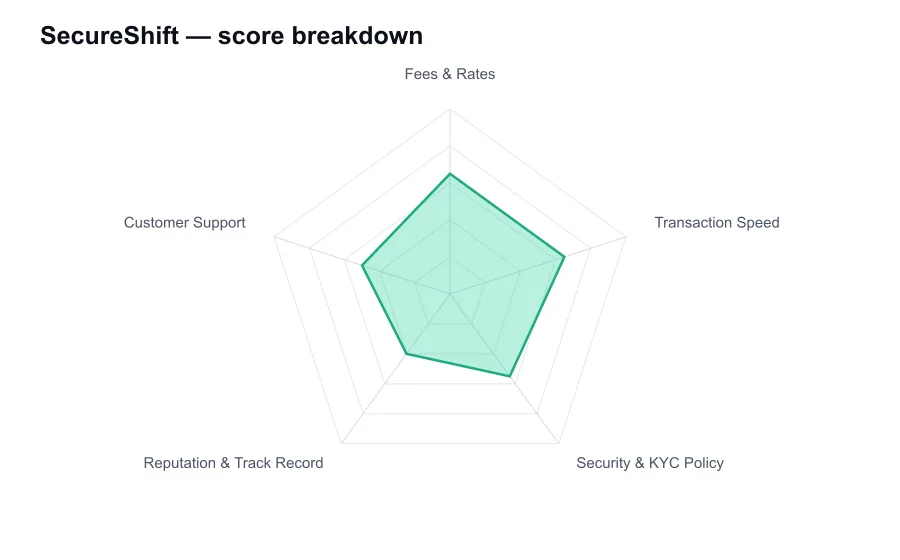
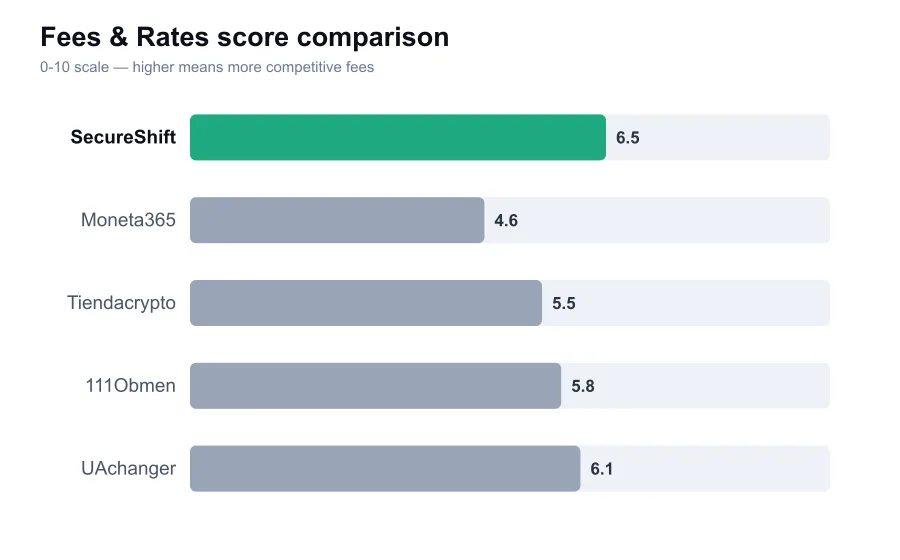
SecureShift scores 5.6/10 overall in our independent review, measured against every other provider we've compared, strongest on Fees & Rates (6.5/10) and weakest on Reputation & Track Record (4.0/10).
5.6/10 How we score →Editorial independence: our scores and rankings are produced using the fixed criteria above and are not influenced by advertisers. This is an independent ranking site and is not operated by, or affiliated with, any provider we list.
Affiliate disclosure: some links on this page may earn us a commission at no extra cost to you. This does not affect our rankings.
SecureShift sits in the instant exchange category, a corner of crypto built for people who want to swap one asset for another without opening a traditional trading account. The model is simple: choose a pair, send funds to a quoted address, and receive the destination asset in your own wallet. It is closer to an exchange aggregator than to Coinbase, and it should be judged by that standard.
This format has obvious appeal. There is usually no order book to learn, no custody balance to maintain, and no long registration flow before a small conversion. It can be useful for a wallet user who holds one coin and needs another for a specific network, payment, or portfolio adjustment. The convenience disappears quickly if the transaction goes wrong, which is why provider quality matters more here than glossy design.
SecureShift advertises competitive rates and a straightforward exchange flow, but users should understand how instant exchanges price trades. The platform may not display a separate trading commission. That does not mean there is no cost. Its compensation can be embedded in the rate, alongside liquidity-provider spreads and blockchain fees. The final amount received is the number that matters, not a claim of zero commission.
For modest, common swaps, the quotes can be perfectly reasonable. For large Bitcoin, Ethereum, or stablecoin conversions, I would compare the same pair at least twice, once with SecureShift and once with a larger instant provider such as ChangeNOW, SimpleSwap, or StealthEX. Also compare against a major exchange if you already have an account. A gap of one or two percent is easy to miss in a fast quote and expensive on a large order.
Fixed-rate and floating-rate mechanics deserve attention. A floating quote can improve if the market moves in your favor, but it can also settle worse than expected by the time confirmations arrive. A fixed quote offers more certainty but may carry a wider spread or a narrow payment window. SecureShift users should read the exchange screen instead of treating every route as identical. This is not a place for blind clicking.
Speed is reasonable, though the word instant is always a little optimistic in crypto. The service can create an order quickly, but block confirmations, network congestion, liquidity sourcing, and risk checks dictate the actual completion time. Swaps involving fast chains may finish in minutes. Bitcoin or a busy Ethereum transaction can take substantially longer. A service cannot settle before it has enough confirmation confidence to safely proceed.
The more awkward cases are partial deposits, underpayments, wrong-network transfers, and transactions that trigger compliance review. These situations are where instant exchanges reveal whether they have competent operations. SecureShift provides order tracking, but a tracker does not solve an exception by itself. Keep the order ID, transaction hash, and screenshots of the original quote until funds arrive.
SecureShift is non-custodial in the usual instant-exchange sense. It does not ask customers to leave a standing trading balance on the platform, and the output is sent to a wallet address specified by the customer. That reduces the risk of a long-term exchange bankruptcy affecting deposited funds. It does not eliminate the temporary custody and execution risk that exists from the moment you send assets to the order address.
Routine KYC is not presented as the core user experience, which will appeal to privacy-conscious users. But no-KYC marketing should never be read as a guarantee that identity questions can never arise. Like nearly all serious instant exchange operators, SecureShift can review transactions under anti-money-laundering procedures or at the request of a liquidity partner. If a transaction is flagged, the fast and anonymous experience can stop abruptly.
This is where SecureShift's limited public track record becomes a concern. It does not have the same volume of independent industry coverage, lengthy operational history, or broad user-review footprint as established exchanges and larger swap aggregators. That does not prove misconduct. It does mean the burden of caution is higher. I would test it with a small transaction before trusting it with an amount that would hurt to have delayed.
Security information is also less reassuring when compared with a large regulated exchange or a battle-tested DeFi protocol. The relevant questions are not just whether the website uses encryption. Users need confidence in order routing, wallet handling, liquidity partners, refund procedures, and response to suspicious activity. Publicly available claims provide only part of that picture. An unknown provider should earn trust through repeated small successes, not receive it upfront.
Customer support appears to rely on online channels and ticket-style contact. That is standard for this type of service, but it is not the same as having a dedicated account manager or a regulated complaints process. A good support team can resolve an address mistake only in limited circumstances, and it cannot reverse a completed blockchain transfer. Expect support to be most useful for delayed orders and verification questions, not miracles.
There is a sensible use case for SecureShift. It can be a convenient tool for a small, straightforward wallet-to-wallet conversion where its final quote beats alternatives. It is not the exchange I would choose for high-value trades, first-time crypto buyers, or anyone requiring strong legal recourse. The service has to compete in a crowded category, and at present its thin reputation is its biggest handicap.
My view is blunt: SecureShift may work, but it has not earned the same level of confidence as the better-known instant exchanges. Its non-custodial flow is attractive and its lack of a routine account barrier is useful. Yet lower friction should lead to smaller initial trades, not greater trust. Verify the address, compare the quote, save every record, and do not make your first order your largest one.
| Criterion | Score (0-10) | Notes |
|---|---|---|
| Fees & Rates | 6.5 | Quotes can compete, but the effective spread needs comparison |
| Transaction Speed | 6.5 | Fast order creation, but settlement depends on chain and liquidity |
| Security & KYC Policy | 5.5 | Non-custodial flow, but limited public security track record |
| Reputation & Track Record | 4.0 | Much less established than leading instant exchange brands |
| Customer Support | 5.0 | Online support is available, with limited public evidence on recovery |
| Pros | Cons |
|---|
Routine swaps are marketed without a conventional account process, but transactions can still be reviewed under anti-money-laundering procedures or liquidity-provider compliance rules.
Instant exchange costs are commonly included in the quoted rate, alongside liquidity spreads and network fees. Compare the amount you will receive, not just the fee label.
Timing depends on the source chain, required confirmations, destination network, available liquidity, and any review. Fast-chain swaps may take minutes, while Bitcoin can take longer.
| Alternative | Score |
|---|---|
| Tiendacrypto Review | 5.5/10 |
| Moneta365 Review | 5.5/10 |
| 111Obmen Review | 5.7/10 |
| UAchanger Review | 5.7/10 |
| Acechange Review | 5.4/10 |
| Changee Review | 5.3/10 |