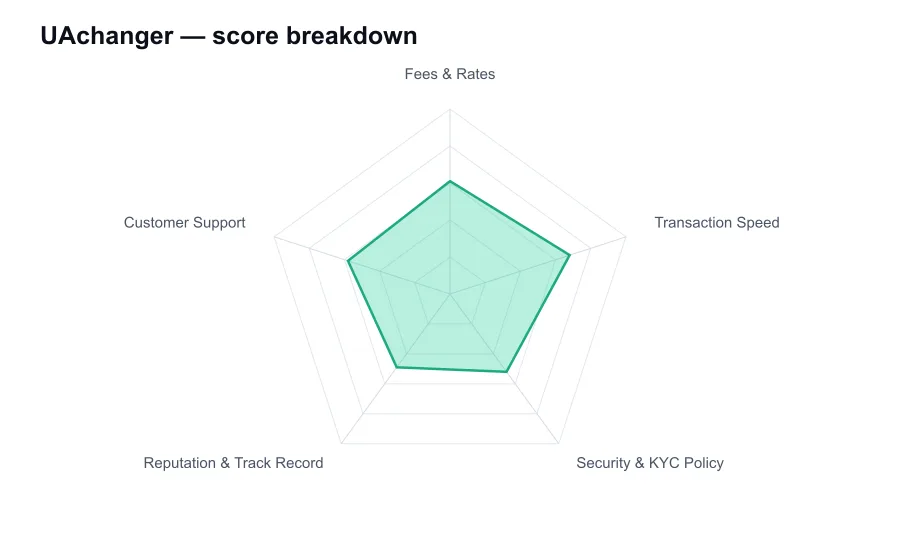
UAchanger scores 5.7/10 overall in our independent review, measured against every other provider we've compared, strongest on Transaction Speed (6.8/10) and weakest on Reputation & Track Record (4.9/10).
5.7/10 How we score →Editorial independence: our scores and rankings are produced using the fixed criteria above and are not influenced by advertisers. This is an independent ranking site and is not operated by, or affiliated with, any provider we list.
Affiliate disclosure: some links on this page may earn us a commission at no extra cost to you. This does not affect our rankings.
UAchanger sits in the small, practical end of the exchange market: an online swap service aimed at people who want to move between crypto, bank cards, and electronic-payment balances without learning a trading terminal. It isn't trying to be Binance, WhiteBIT, or Kraken. The appeal is convenience and a relatively direct order form, especially for users accustomed to Ukrainian and Eastern European payment routes. That narrow focus can be useful, but it also means buyers should judge it as an exchanger, not as a full custodial crypto platform.
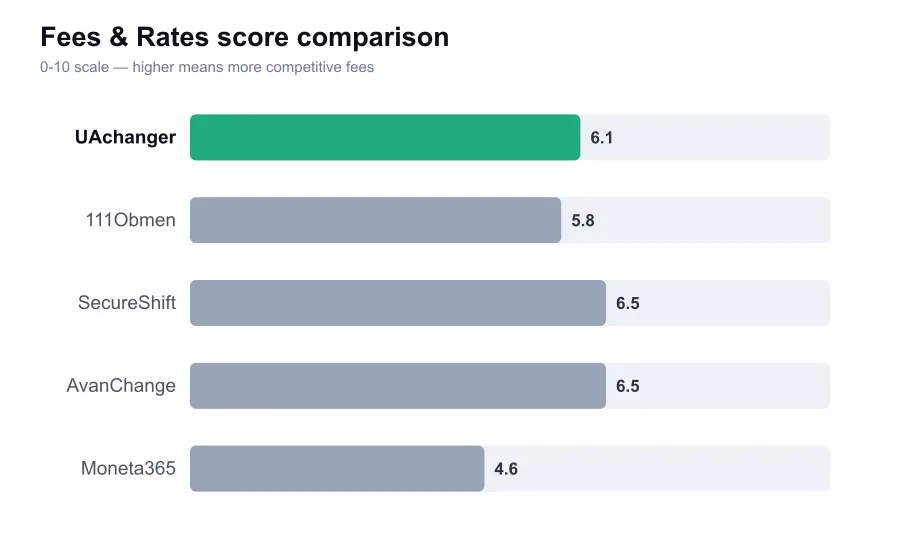
The first thing I look for with a service like this is whether the quoted rate is honestly the rate a customer receives. UAchanger generally presents the exchange amount before an order is created, but the practical cost is not always a clean standalone percentage. It is embedded in the rate, and network fees, bank-side charges, or payment-provider spreads can change the final value. That's normal for an instant exchanger, yet it makes price comparison essential.
On liquid pairs, the service can be competitive enough for a small conversion. It may beat a bank card purchase at a large exchange once card processing costs are added. It is less compelling for a sizeable BTC, ETH, USDT, or fiat trade, where a proper exchange's order book and transparent maker-taker schedule usually produce a better result. The convenience premium is real, and pretending otherwise is how people overpay.
There is also a difference between the rate shown on a normal market day and the rate that survives a fast move. Crypto exchangers have to manage volatility, but their responses vary. UAchanger's quoted terms and reserve limits need to be read carefully before payment. If the rate is floating, a sharp market move can alter the payout. If it is fixed, make sure the payment window and required amount are clear, because sending late or sending the wrong amount can turn a simple order into a support case.
Speed is one of the better arguments for using a specialized exchanger. A straightforward crypto-to-crypto order can be processed after the incoming transaction receives the required confirmations, and that may mean minutes rather than hours. Transfers involving cards, bank rails, or manual review are another matter. They can take substantially longer, particularly outside banking hours or where a provider must verify a payment.
Don't treat the word automatic as a guarantee of instant settlement. Blockchain congestion, an incorrectly chosen network, a missing memo, or a payment arriving from a third party can stop an order. Small services generally have less redundancy than a major exchange. That doesn't make UAchanger uniquely bad, but it does mean that time-sensitive transfers deserve a test transaction first.
The KYC question needs a more careful answer than the marketing shorthand used by many exchangers. Services in this category often permit many ordinary orders without an account-level identity check, but they still reserve the right to request documents under AML rules or when a transaction is flagged. That can include identity evidence, proof of card ownership, or source-of-funds information. Anyone who needs a guaranteed no-document route should not assume one exists simply because registration is light.
This conditional approach creates a real tradeoff. It is convenient for a routine, low-risk swap, but it can feel abrupt if an order is paused after funds have already been sent. A mature compliance process explains what triggered the review, what documents are needed, and what happens if they cannot be supplied. Before placing a larger order, I would read the AML policy, refund rules, and country restrictions rather than relying on a homepage claim.
UAchanger does not have the public corporate footprint, audited reserve disclosures, institutional custody framework, or deep licensing record of established global exchanges. That is not an automatic verdict of wrongdoing. Plenty of small exchangers operate honestly for years. It does, however, limit the amount of independently verifiable reassurance available to a user who is considering a four-figure or five-figure transfer.
Reputation research around smaller exchangers is messy. Review sites can contain genuine accounts, affiliate-driven praise, competitors, and frustrated users who made an address or network mistake. The useful signals are consistency over time, clear resolution of disputed cases, presence on relevant monitoring services, and whether the operator answers complaints with order-specific evidence. A page full of five-star snippets is much less meaningful than a transparent history of resolving difficult cases.
The service's support experience matters more here than it does at a conventional exchange because an exchanger handles each order as a discrete event. A useful support desk should be able to locate an order quickly, identify the blockchain transaction, explain confirmation requirements, and tell a customer exactly what information is missing. UAchanger's available contact channels can be adequate for routine questions, but I would not expect the round-the-clock staffing depth or formal escalation path offered by a large venue.
Before paying, save the order ID, the quoted rate, the receiving address, and screenshots of the instructions. That isn't paranoia. It is simply good operational hygiene with any service that mediates an irreversible blockchain payment. Never send a larger amount than the order specifies in the hope that the system will calculate the difference for you, and never reuse an old destination address from a prior order.
For a first use, I would send a small amount on a common network, then check that the payout reaches the intended wallet or payment method before scaling up. This also exposes whether the displayed reserve, payment instructions, and settlement estimate are realistic. Avoid using an exchanger to make a rushed payment to a third party, especially if somebody else has chosen the service and wallet address for you. That pattern is common in scams, regardless of which exchanger is involved.
UAchanger makes the most sense for users who value a simple conversion more than exchange-grade pricing and who understand the basics of wallet addresses, confirmations, and payment references. It is not my first choice for active trading, long-term storage, or a substantial transaction that needs a heavily documented compliance and support structure. The service can do a useful, narrow job, but the lack of broad public transparency means the sensible approach is modest order sizes and careful verification.
My view is that UAchanger belongs in the functional-but-cautious category. The order flow can be attractive for a quick swap and the low-friction model has a legitimate audience. Yet the price spread, conditional AML checks, and thinner public track record are meaningful costs, even if they don't appear as a line-item fee. Use it deliberately, compare the quote, and keep your main holdings somewhere with stronger safeguards.
| Criterion | Score (0-10) | Notes |
|---|---|---|
| Fees & Rates | 6.1 | Rates can be competitive, but the spread needs comparison. |
| Transaction Speed | 6.8 | Simple crypto orders can clear quickly after confirmations. |
| Security & KYC Policy | 5.2 | AML checks may apply, with limited public security detail. |
| Reputation & Track Record | 4.9 | A smaller public footprint than major exchanges. |
| Customer Support | 5.8 | Order support is important, but escalation depth is unclear. |
| Pros | Cons |
|---|
Not necessarily for every order, but an exchanger can request identity, payment ownership, or source-of-funds documents under AML controls. Read the current policy before sending funds.
A routine order can complete after the incoming transaction gets the required confirmations. Bank, card, manual-review, and congested-network orders can take much longer.
The effective cost is commonly reflected in the exchange rate rather than one universal published percentage. Compare the final payout against other providers.
| Alternative | Score |
|---|---|
| 111Obmen Review | 5.7/10 |
| SecureShift Review | 5.6/10 |
| AvanChange Review | 5.9/10 |
| Tiendacrypto Review | 5.5/10 |
| Moneta365 Review | 5.5/10 |
| Swapter Review | 6.0/10 |