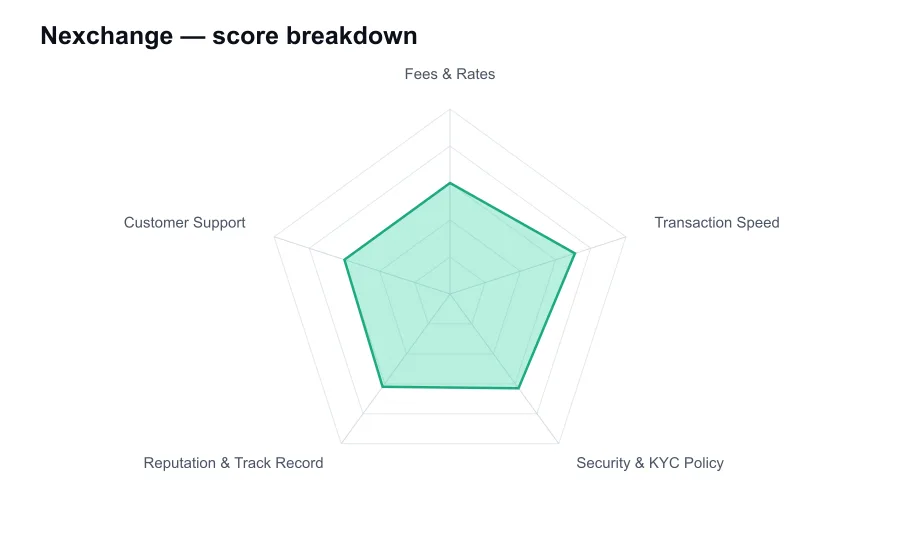
Nexchange scores 6.3/10 overall in our independent review, measured against every other provider we've compared, strongest on Transaction Speed (7.1/10) and weakest on Customer Support (6.0/10).
6.3/10 How we score →Editorial independence: our scores and rankings are produced using the fixed criteria above and are not influenced by advertisers. This is an independent ranking site and is not operated by, or affiliated with, any provider we list.
Affiliate disclosure: some links on this page may earn us a commission at no extra cost to you. This does not affect our rankings.
Nexchange was built around a familiar promise: make a cryptocurrency conversion without forcing the user into a full exchange account. It offered an instant-exchange style flow and was also associated with an API-oriented approach, which made it more interesting than a simple consumer swap widget. The service belonged to the middle ground between centralized exchanges and fully decentralized protocols, where convenience is high but counterparty trust remains unavoidable.
For a retail user, the process was simple. Select the asset being sent, choose the asset to receive, provide a destination address, and fund the deposit. There was no need to learn order-book terminology or manage an active trading interface. For a developer or business, the more relevant proposition was the ability to integrate exchange functionality through an API rather than source liquidity independently.
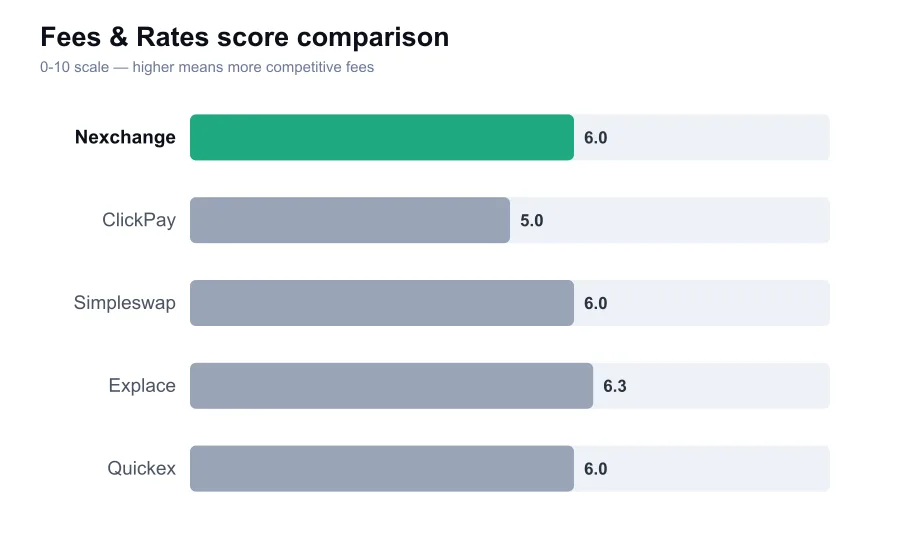
That convenience should be priced honestly. Instant exchanges do not generally offer the raw market price visible on Binance, Kraken Pro, or Coinbase Advanced. They aggregate or source liquidity, take execution risk, and present an all-in quote. The sensible question is not whether Nexchange has a low headline fee. It is whether the final amount received beats the alternatives after spread, network fees, and any volatility adjustment.
Nexchange's pricing model could be attractive for users who value a clear quote and do not want to place orders manually. It was less attractive for frequent traders. Small transactions can be disproportionately expensive because blockchain fees are fixed in coin terms while the trade amount is not. For larger trades, even a modest percentage spread can cost more than the time needed to use a liquid exchange with a limit order.
A good test is simple. Open identical quotes at Nexchange and two established competitors, then compare the exact destination amount, not the rate in isolation. Repeat the exercise at a quiet market time and during volatility. If the gap is tiny, convenience may be worth it. If the gap is several percent, the instant experience is a luxury purchase rather than a trading solution.
Speed was generally constrained by deposit confirmation rules and the chain selected by the user. A transaction on a fast network could progress quickly once Nexchange detected it. Bitcoin deposits needed more patience, and Ethereum congestion could turn an apparently simple swap into a longer wait. A fixed-rate or rate-locked flow may also have a limited funding window, so users need to send promptly and accurately.
The service could feel fast because it removed account onboarding, but that is different from guaranteeing rapid settlement. A liquidity issue, a wallet maintenance event, or a compliance review can interrupt any centralized instant-exchange pipeline. The absence of an order book does not remove operational dependencies. It merely hides them behind a cleaner interface.
Security begins with the custody model. Nexchange-style swaps are often described as non-custodial because the user does not maintain an account balance on the platform. That description is useful but incomplete. The provider still receives the deposited asset during the conversion and is responsible for sending the output. Users are reducing persistent exchange custody, not eliminating counterparty exposure.
The KYC picture requires similar care. Low-friction services may not ask every ordinary user to create an account or upload documents before a small transaction. That does not mean compliance checks cannot occur. Providers can screen transactions, flag risk indicators, and request information before releasing funds. A user who needs an assured compliance process should choose a regulated exchange with explicit policies rather than infer rules from a quick interface.
Nexchange had a more visible technical identity than many anonymous swap sites, particularly because of its business and API orientation. That is a positive sign. A product that serves integrators has to think about uptime, status, documentation, and repeatable transaction handling. Yet it did not have the consumer scale or long public record of the largest exchanges. For significant transfers, that difference still matters.
Reputation should be separated into product reliability and financial resilience. An API can work well and ordinary swaps can complete reliably without proving that a provider has the controls, liquidity, and customer remediation standards of a major regulated venue. The safest approach is to build trust incrementally. Make a small test transaction, confirm the destination asset arrives, and only then consider a larger amount.
Customer support is essential in this category because transaction mistakes are unusually stressful. A strong instant-exchange operator should let users trace an order, identify a deposit, and provide a support route with transaction details. Nexchange's technical orientation was helpful for users who could read status information. It was less reassuring for a beginner who wanted a phone conversation after sending funds to the wrong chain.
Developers need to evaluate a different set of risks. API documentation and easy integration are only the start. They should examine rate limits, webhook reliability, supported asset maintenance, quote expiry, error handling, and what happens when a partner's transaction is held. An embedded swap product inherits its provider's outages and compliance friction, so a business should never present it to customers as guaranteed instant settlement.
Nexchange was strongest as a convenience and integration tool. It was not the best destination for day traders, large treasury conversions, or anyone who needs institutional-grade assurances. The user who benefits most is someone making a modest conversion and willing to pay a little for simplicity, or a developer who understands that an exchange API is operational infrastructure rather than a magic liquidity button.
My final view is moderately positive, but conditional. Nexchange's product logic was sound and its technical emphasis gave it more substance than a generic swap page. Still, instant-exchange economics and counterparty risk do not disappear because the interface is efficient. Compare live quotes, test before scaling, and use a transparent order-book exchange whenever price precision or large size is the priority.
| Criterion | Score (0-10) | Notes |
|---|---|---|
| Fees & Rates | 6.0 | Convenient quotes, but spreads can beat trading fees. |
| Transaction Speed | 7.1 | Quick after deposit detection, confirmation rules still matter. |
| Security & KYC Policy | 6.3 | No standing balance, but deposits retain counterparty risk. |
| Reputation & Track Record | 6.2 | Technical credibility, less proven than major exchanges. |
| Customer Support | 6.0 | Order tracing helps, escalation depth is less clear. |
| Pros | Cons |
|---|
Not necessarily. It may be cheaper in time and setup effort, but the final quote can include spread and network costs that exceed low spot-trading fees on a liquid order-book exchange.
It depends mainly on the deposit network, required confirmations, liquidity, and any review. Fast networks may complete quickly, while Bitcoin or congested Ethereum transactions can take longer.
It reduces the need to keep an ongoing exchange balance, but the provider still handles the deposited asset during the conversion. Treat it as reduced custody exposure, not zero counterparty risk.
| Alternative | Score |
|---|---|
| ClickPay Review | 6.3/10 |
| Simpleswap Review | 6.3/10 |
| Explace Review | 6.4/10 |
| Quickex Review | 6.4/10 |
| Kingex Review | 6.5/10 |
| Ripio Review | 6.5/10 |