
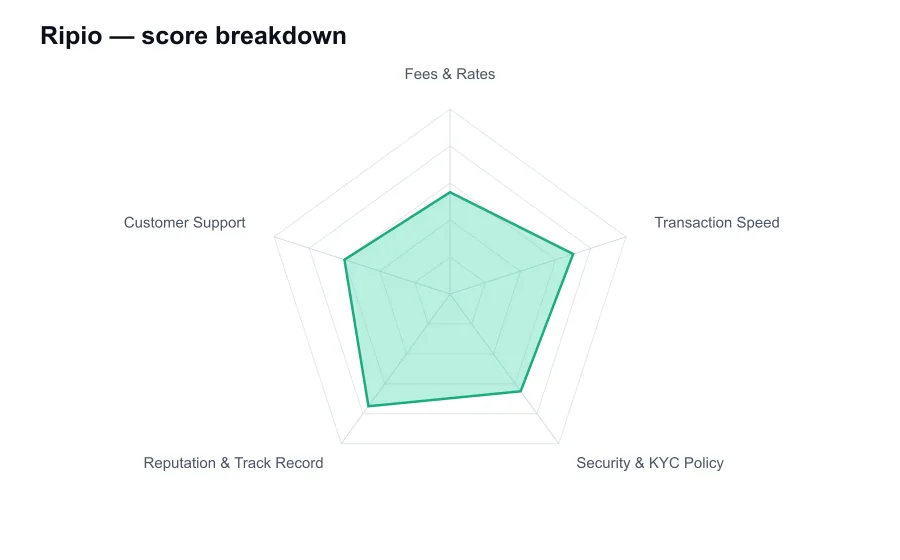
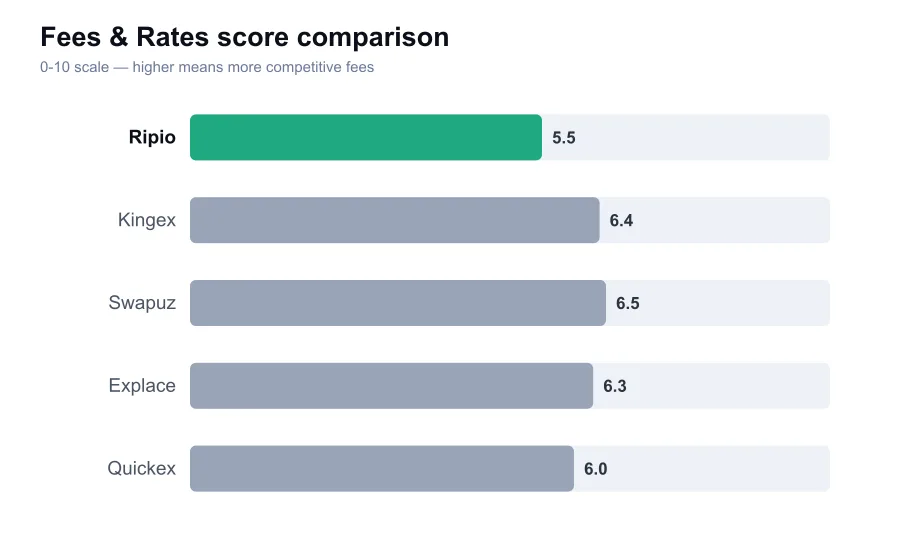
Ripio scores 6.5/10 overall in our independent review, measured against every other provider we've compared, strongest on Reputation & Track Record (7.5/10) and weakest on Fees & Rates (5.5/10).
6.5/10 How we score →Editorial independence: our scores and rankings are produced using the fixed criteria above and are not influenced by advertisers. This is an independent ranking site and is not operated by, or affiliated with, any provider we list.
Affiliate disclosure: some links on this page may earn us a commission at no extra cost to you. This does not affect our rankings.
Ripio is one of Latin America's older and more recognizable crypto brands. Founded in Argentina in 2013, it has evolved from a bitcoin focused startup into a regional platform offering crypto purchases, sales, wallet services, stablecoin access and related products across several Latin American markets. That history gives Ripio an advantage in a region where local currency rails, inflation and regulation matter as much as a slick global trading interface. It is not trying to be Binance for everyone. It is trying to be useful in places where global exchanges do not always fit daily financial life.
The company has a meaningful track record. It began under the name BitPagos and later became Ripio, building visibility in Argentina, Brazil, Uruguay, Colombia and other markets over time. It has attracted venture backing and has remained active through several boom and bust cycles. For Latin American users, that longevity matters. Many local exchanges disappear after a market downturn or a banking disruption. Ripio has not been immune to product changes, but it has demonstrated more staying power than the average regional crypto app.
The core app is aimed at retail customers, not professional traders. Buying bitcoin, ether, stablecoins and selected other assets is straightforward, and local fiat methods are central to the experience. In Argentina especially, access to dollar linked stablecoins and easy local currency movement can matter more than whether a platform offers sophisticated derivatives. Ripio understands that demand. Its product can be a practical bridge between a bank account or local payment method and onchain assets, which is a far more useful role than it may appear from a global exchange comparison chart.
Fees are where the convenience premium shows up. Ripio's pricing varies by country, payment method and product, and the all in cost is not always as transparent as a professional exchange maker and taker schedule. Users may encounter a quoted buy or sell price that includes spread, while fiat deposit and withdrawal terms can also vary. That is common among retail first regional apps. It is still a weakness. A user buying stablecoins regularly should calculate the difference between the quote and a reference market price, not assume a zero commission message means zero cost.
For small local purchases, that pricing can be acceptable. Saving a few basis points is not always worth managing an offshore exchange, foreign currency transfers and additional account risk. For larger purchases, it becomes important quickly. Ripio may not be the cheapest route to bitcoin or USDC, particularly for users with access to a high liquidity international venue. The best approach is to use Ripio for local on and off ramps and compare rates before making substantial trades. It is a practical financial utility, not a bargain hunting trader's first choice.
Transaction speed is largely determined by which rail is involved. Internal app movements and completed trades are normally immediate. Local fiat deposits can be fast where instant payment systems are integrated, though bank processing windows and verification checks still matter. Crypto withdrawals require blockchain settlement and Ripio's own approval process. A transfer on a low cost fast network can arrive quickly, while Bitcoin or Ethereum withdrawals may take longer. The app experience is generally responsive, but users should never schedule a time critical payment around a crypto withdrawal estimate.
Ripio's regional focus is its biggest strength and its biggest limitation. An Argentinian or Brazilian customer may find familiar payment methods, local language support and a service designed around regional banking realities. A user in the United States, Europe or Asia has little reason to choose it over larger domestic options. Even within Latin America, available assets, fiat methods and product features can differ by country. Before opening an account, users should verify the exact offering in their jurisdiction rather than relying on broad regional marketing.
Identity verification is a standard part of using Ripio. This is a custodial, regulated facing financial platform, not a privacy preserving wallet. Customers should expect to provide personal information, identification and potentially additional documents depending on limits and transaction activity. That is a reasonable trade for users who want local fiat access, but it rules out the platform for no KYC users. Compliance checks can also affect deposit and withdrawal timing, particularly when transaction values rise above ordinary retail use.
Security tools include the usual account protections such as passwords, verification procedures and device or transaction checks, but the central fact remains custody. Ripio controls customer assets held in the app. That means the user has exposure to operational risk, account access restrictions and the company's handling of hot and cold wallet security. Ripio's long operating history is reassuring relative to a new exchange, but it is not a reason to hold every savings asset there. The sensible rule remains the same: use an exchange for access and movement, then self custody long term holdings if you can manage the responsibility.
The company has pursued initiatives beyond basic buying and selling, including wallet services, educational efforts and blockchain projects associated with the Latin American ecosystem. That ambition is interesting, but I am more impressed by its mundane usefulness. Ripio earns its place by helping users navigate volatile local currencies and access crypto without needing to become exchange specialists. Fancy ecosystem plans do not matter much if deposits, withdrawals and support fail. On that practical standard, Ripio has generally built a credible regional service, even if the product is not always the most technically advanced.
Customer support is mixed, as it is with many retail financial apps serving a large region. Spanish and Portuguese language availability is a genuine advantage for its target audience. Basic questions about verification, deposits and app navigation can often be handled through the help center and support channels. More complicated cases involving account access, bank transfer reconciliation or compliance checks can take time. Users should not expect a dedicated relationship manager on a standard account, and they should keep records of every transfer reference and blockchain hash.
Ripio's reputation benefits from familiarity. In markets where scam apps and short lived exchanges are common, a company that has operated for more than a decade has real value. It has also had to operate amid difficult economic and regulatory environments, particularly in Argentina. That does not make it untouchable or guarantee flawless service. Public complaints about delays and support are part of the picture. But Ripio is plainly a more established proposition than a newly launched local exchange with no history, and it has a clearer regional identity than many global platforms.
The biggest criticism is that Ripio can feel expensive and limited for sophisticated users. Asset selection, liquidity, trading tools and price transparency do not match the standards of the world's biggest exchanges. Users who want perpetual futures, extensive API tools, deep altcoin books or low maker fees will outgrow it quickly. That is not a failure of its intended product. It is a reminder to choose a platform based on the actual task. A good local ramp and a professional trading venue can serve different purposes in the same portfolio.
I would recommend Ripio most readily to Latin American users who need a known local gateway to major cryptocurrencies and stablecoins, particularly those making modest purchases or converting local funds. It is less attractive as a long term vault or high volume trading desk. The company has earned credibility through duration and regional execution, but the pricing needs scrutiny and custody should be managed conservatively. Ripio is useful because it understands its home markets. Just do not confuse regional convenience with the lowest cost or the highest level of self sovereignty.
| Criterion | Score (0-10) | Notes |
|---|---|---|
| Fees & Rates | 5.5 | Convenient local access, but spreads and country-specific costs need checking |
| Transaction Speed | 7.0 | Responsive app and local rails, subject to bank and blockchain timing |
| Security & KYC Policy | 6.5 | KYC based custodial service with established regional operations |
| Reputation & Track Record | 7.5 | Founded in 2013 and one of Latin America's better known brands |
| Customer Support | 6.0 | Regional language support, with slower handling of complex cases |
| Pros | Cons |
|---|
Ripio's main focus is Latin America, and available services vary by country. Check the app or Ripio's local site for eligibility, supported fiat methods and asset availability in your jurisdiction.
Yes. Ripio is a custodial platform with KYC procedures. Users should expect identity verification and may be asked for more information depending on limits or transaction activity.
Costs vary by country and may be reflected in quoted buy and sell prices rather than a simple trading commission. Compare the final quote with a market reference before larger transactions.
| Alternative | Score |
|---|---|
| Kingex Review | 6.5/10 |
| Swapuz Review | 6.6/10 |
| Explace Review | 6.4/10 |
| Quickex Review | 6.4/10 |
| ClickPay Review | 6.3/10 |
| Nexchange Review | 6.3/10 |