
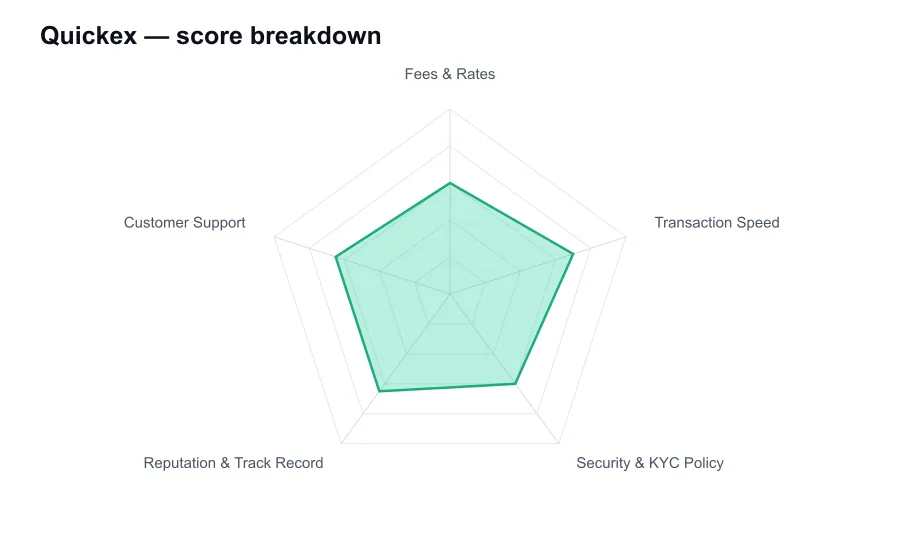
Quickex scores 6.4/10 overall in our independent review, measured against every other provider we've compared, strongest on Transaction Speed (7.0/10) and weakest on Security & KYC Policy (6.0/10).
6.4/10 How we score →Editorial independence: our scores and rankings are produced using the fixed criteria above and are not influenced by advertisers. This is an independent ranking site and is not operated by, or affiliated with, any provider we list.
Affiliate disclosure: some links on this page may earn us a commission at no extra cost to you. This does not affect our rankings.
Quickex is an instant crypto exchange rather than a conventional trading platform. It is designed for the person who already has coins in a wallet and wants to convert them without dealing with order books, trading pairs or a full account setup. That makes it closer to ChangeNOW, SimpleSwap and LetsExchange than to Coinbase or Kraken. The service has operated since 2018, which gives it a more substantial history than many anonymous swap sites, though it still should not be treated like a regulated brokerage.
The central attraction is convenience. A user chooses the coin being sent, chooses the asset to receive, supplies a destination address and sends funds to Quickex's deposit address. There is usually no need to deposit into an ongoing custodial balance. For a simple BTC to ETH or USDT to LTC conversion, that workflow can be much less intimidating than opening an exchange account. It also avoids the common problem of forgetting to withdraw coins from a trading platform after making a trade.
Quickex supports both floating and fixed rate swaps. Floating rate transactions use the market price available during processing, which can work well in calm conditions but leaves the final received amount exposed to price movement. Fixed rate swaps attempt to lock a quote for a limited period, usually with strict timing and amount requirements. Fixed rates are often more expensive because the provider is taking market risk. For someone converting a modest amount, that premium may be acceptable. For a large trade, compare the received amount with a liquid exchange before deciding.
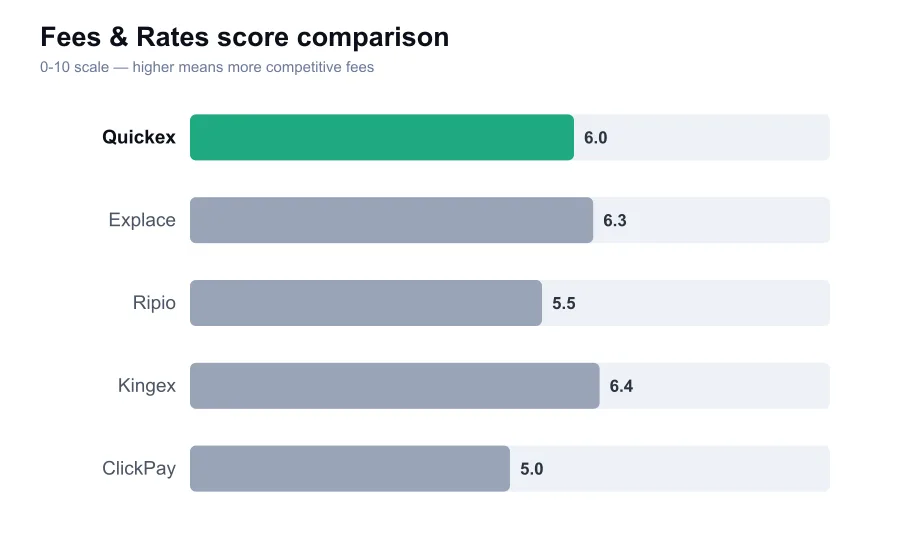
Fee disclosure is adequate for a convenience service but not as clean as an order book venue. Quickex generally includes its service fee and liquidity costs in the displayed rate, rather than presenting a simple universal commission for every pair. The website has described rates and fees as being built into the exchange calculation, and network charges can also affect the result. The right question is not whether the fee is called zero. It is how much of the destination asset reaches your wallet compared with the market midpoint and competing live quotes.
That approach can produce surprisingly good results on liquid pairs, especially when Quickex has a favorable liquidity route. It can also be expensive for illiquid tokens or fast moving markets. Users should be particularly careful with stablecoin conversions, where a quote that looks close can still hide a noticeable percentage cost. If you are swapping $50 for convenience, the difference may be trivial. If you are swapping $5,000, even a one percent weak quote is a $50 decision. Instant exchange pricing rewards comparison shopping.
Quickex is usually quick in the practical sense, but the name should not be read as a settlement guarantee. The provider needs to see incoming blockchain confirmations, source the receiving coin and send it onward. On networks such as Litecoin, Tron or XRP, a straightforward transaction can arrive in a matter of minutes. Bitcoin and Ethereum can take longer, and congestion or a low fee on the user's deposit transaction can add substantial waiting time. A quoted processing estimate is an estimate, not a deadline.
The interface gives users a transaction page that can be used to follow progress. This matters more than it seems. Instant exchanges create anxiety because the customer has already sent funds while the service has not yet paid out. A visible transaction status, reference ID and support contact reduce some of that uncertainty. Still, the status display is only as useful as the provider's operations. A transaction placed into review, sent with an incorrect memo, or involving a wallet screening flag may need manual intervention.
Quickex is commonly described as no registration for ordinary swaps. That does not make it anonymous in the absolute sense. The company states that it follows anti money laundering requirements and can request KYC documentation where a transaction is flagged. This is standard for centralized instant exchangers. A user who has sent coins cannot safely assume that refusing verification will lead to an immediate refund. Read the terms before sending, particularly if the transaction is large, connected to privacy tools or likely to trigger chain analytics scrutiny.
On security, Quickex's non-account model has a genuine benefit. There is less reason to leave a long term balance on the platform, so the risk of an account takeover affecting parked funds is reduced. But every exchange still involves temporary custody. During processing, Quickex or its liquidity partners control the incoming assets. The user must also protect against phishing, fake support accounts and copycat domains. Always verify the domain, check the receiving address displayed by the actual site and never send coins based on a social media message.
Quickex does not offer the type of institutional transparency one would expect from a major regulated exchange. There is no reason to assume that its operational arrangements, reserves or counterparties are visible to ordinary users in the way a public company might disclose them. This is a limitation shared by much of the instant exchange sector. The difference is that Quickex has a longer operating record than many small alternatives and a recognizable customer base. That history is useful, but it is not a substitute for self custody or comprehensive financial disclosure.
Support has a reasonably good reputation for transaction status questions, particularly through live chat and email channels. The real test, as always, is an exception. Missing tags, underpayments, compliance holds and failed payout routes are where support quality matters. Quickex provides a transaction ID and support process, which is better than a faceless swap form, but users should save every detail before contacting the team. Screenshots of the quote, deposit hash, destination address and transaction ID make a major difference when a case needs escalation.
The asset selection is broad enough for ordinary swaps, including major coins, stablecoins and a rotating selection of tokens. Broad support should not be mistaken for equal quality across all networks. Be precise about USDT and USDC network variants. Check whether the destination wallet accepts the particular chain. Verify XRP destination tags, Stellar memos and similar requirements. These errors are not always recoverable, and recovery can take days or require help from a receiving wallet provider that has no relationship with Quickex.
Quickex works best as a utility, not a home base for crypto activity. I can see the appeal for a wallet user who needs a one time conversion and does not want to open a trading account for it. I would not use it for frequent trading, because repeated embedded spreads add up and there are no advanced order types. I would also avoid using it for large transfers where execution certainty matters. A deep order book exchange is simply a better tool for that job.
My recommendation is moderately positive, with boundaries. Quickex is an established enough instant exchanger to consider for small to medium routine swaps, and its fixed rate option can be useful when a user needs a known payout. Its pricing is quote based, so it earns no prize for transparency, and compliance reviews remain a possible interruption. Compare each quote, test with a small amount if it is your first use, and keep your own records. Used that way, Quickex is convenient rather than exceptional, which is often exactly what an instant exchanger needs to be.
| Criterion | Score (0-10) | Notes |
|---|---|---|
| Fees & Rates | 6.0 | Rates include service and liquidity costs, so compare the final payout |
| Transaction Speed | 7.0 | Usually prompt after confirmations, but blockchain delays still apply |
| Security & KYC Policy | 6.0 | No parked balance helps, but swaps involve temporary third party custody |
| Reputation & Track Record | 6.5 | Operating since 2018, with less transparency than major exchanges |
| Customer Support | 6.5 | Transaction tracking and chat help are useful for routine issues |
| Pros | Cons |
|---|
Many ordinary swaps can be started without creating a conventional account. Quickex can still request identity documents if its compliance systems flag a transaction.
Quickex offers floating rate and fixed rate transactions. Floating rates can change during processing. Fixed rate swaps seek to lock the quote for a limited funding period and may cost more.
It depends on the deposit blockchain, required confirmations and destination network. Many uncomplicated swaps finish within minutes, while Bitcoin, Ethereum congestion or reviews can take longer.
| Alternative | Score |
|---|---|
| Explace Review | 6.4/10 |
| Kingex Review | 6.5/10 |
| Ripio Review | 6.5/10 |
| ClickPay Review | 6.3/10 |
| Nexchange Review | 6.3/10 |
| Simpleswap Review | 6.3/10 |