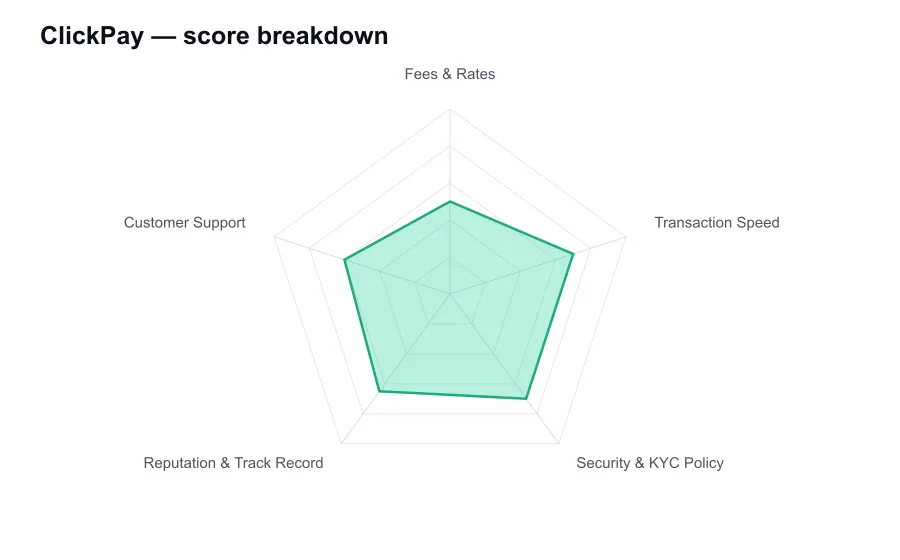
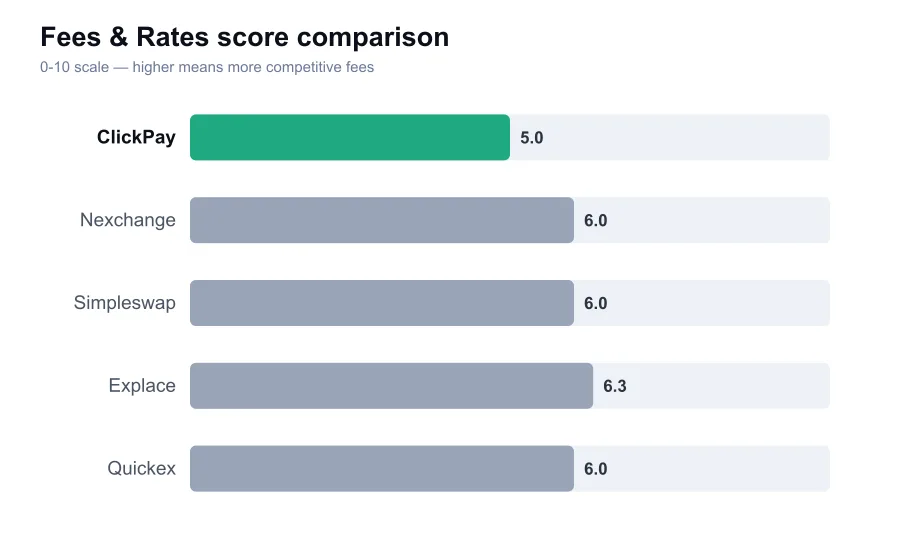
ClickPay scores 6.3/10 overall in our independent review, measured against every other provider we've compared, strongest on Transaction Speed (7.0/10) and weakest on Fees & Rates (5.0/10).
6.3/10 How we score →Editorial independence: our scores and rankings are produced using the fixed criteria above and are not influenced by advertisers. This is an independent ranking site and is not operated by, or affiliated with, any provider we list.
Affiliate disclosure: some links on this page may earn us a commission at no extra cost to you. This does not affect our rankings.
ClickPay sits in the payments business, not in the same lane as Binance, Kraken, Coinbase, or a typical instant-swap service. Its public identity is that of a merchant payment platform, particularly visible in Middle Eastern markets, where businesses use it to accept cards and local payment methods online. That distinction matters. Calling it a crypto exchange creates expectations around token custody, trading pairs, blockchain withdrawals, and quoted spreads that ClickPay does not publicly present as its core product.
For a merchant already looking for a regional checkout provider, the proposition is easy to understand. ClickPay is built around collecting payments on websites, apps, invoices, and payment links. Its audience is businesses that need an acquiring and checkout layer, not retail traders trying to move BTC into USDT before a price swing. The platform may be adjacent to crypto commerce in a broad sense, but it should not be treated as a place to buy, store, or speculate on digital assets.
That makes fee comparisons unusually awkward. A trader can inspect an exchange's maker and taker schedule, compare a 0.10 percent spot fee against another venue, and calculate the cost of a market order. ClickPay works through merchant pricing, payment-method costs, country coverage, transaction volume, and commercial agreements. Public material does not provide a universal crypto conversion fee or a retail trading fee table, because there is no conventional retail exchange service to price.
Businesses should be especially wary of anyone pitching ClickPay as a cheap route to acquire cryptocurrency. A card payment processor's merchant service charges are not the same thing as an on-chain purchase fee. There can be card scheme costs, local acquiring charges, chargeback exposure, foreign exchange conversion, settlement terms, and contract-specific pricing. Without a written quote and a merchant agreement, claims that it is cheaper than a specialist crypto processor are simply sales talk.
For ordinary online payments, checkout speed is a more relevant measure than blockchain execution. A well-integrated card checkout can authorize in seconds, assuming the customer passes the issuing bank's checks. That is useful for shops, service providers, and subscription businesses. It tells a prospective customer nothing about how quickly a crypto withdrawal would arrive, because ClickPay does not publicly operate a wallet and blockchain withdrawal workflow comparable to an exchange.
Settlement is another point people often muddle. A customer can see a successful card transaction almost immediately, while the merchant receives funds later under the settlement cycle in its agreement. Weekends, bank cutoffs, currencies, reserve requirements, and risk reviews can all affect the timeline. Anyone who needs real-time access to proceeds for trading or treasury activity should ask ClickPay for the exact settlement calendar rather than relying on the speed of the checkout screen.
On security, ClickPay's role as a payments company is more reassuring than an unknown crypto storefront, but it still requires practical due diligence. A merchant should verify the legal entity serving its market, the applicable payment-services permissions, PCI-related controls, fraud tooling, data processing terms, and the support path for a disputed payment. These are the questions that matter here. Buzzwords about encryption do not replace a clear contract and accountable regulated counterparties.
KYC and business verification are not optional details in this category. Payment providers commonly need to identify merchants, beneficial owners, business activity, bank accounts, and expected transaction flows. That may feel more intrusive than opening a basic charting account, but it is normal for a payment acquirer. A merchant selling products connected to crypto should be prepared for additional scrutiny, since high-risk or restricted categories can fall outside a processor's acceptable-use policy.
That policy issue is central. ClickPay should not be assumed to support cryptocurrency merchants, token sales, exchange services, or wallet-related activity merely because it provides digital payments. Many processors restrict such sectors, impose enhanced underwriting, or approve them only under narrow conditions. The responsible approach is to obtain written confirmation before integrating. Building a checkout around an unapproved business model is a quick way to face frozen settlements or a terminated account.
Reputation is strongest where ClickPay is evaluated as a mainstream regional payment provider. It has a recognizable commercial presence, product documentation, and merchant-oriented infrastructure, all of which put it well ahead of anonymous sites that appear overnight with a crypto logo. Still, it lacks the long public record of exchange safeguards, proof-of-reserves debates, asset listings, and trading-market operations that crypto users usually examine. Those are not failings in its intended category, but they are real limits.
Customer support also follows the merchant-services model. Integration questions, gateway configuration, declined transactions, refunds, and settlement issues are the likely subjects of a support ticket. That can work well for a business with an account manager or a properly documented deployment. It is a poor fit for a retail user who expects live help tracing a missing token transfer or explaining a delayed network confirmation, because those events are outside the core service.
Developers should inspect the documentation before making a judgment. A sensible test covers sandbox behavior, webhook reliability, refunds, payment-link controls, tokenization, retry handling, and reconciliation exports. The attractive front-end checkout is only one piece of the job. A payment platform earns its keep when finance teams can match successful authorizations, captured payments, refunds, fees, and bank settlements without manual guesswork.
The competitive set is also different from what crypto readers may expect. A merchant may compare ClickPay with Checkout.com, Adyen, Stripe where available, PayTabs, HyperPay, or a bank's own gateway. A business genuinely seeking to accept crypto should compare specialist processors such as BitPay or Coinbase Commerce, then confirm local availability and compliance support. Trying to force ClickPay into that role without explicit approval is not clever cost-saving, it is operational risk.
My view is straightforward. ClickPay can be a credible payment-gateway candidate for businesses operating in its supported markets, provided the commercial terms and permitted business activity fit. It is not a cryptocurrency exchange, not a self-custody wallet, and not a substitute for a regulated trading venue. The scores reflect a reasonably established payments operation with unclear relevance for crypto transactions. If your need is card acceptance, investigate it. If your need is to trade or hold digital assets, look elsewhere.
| Criterion | Score (0-10) | Notes |
|---|---|---|
| Fees & Rates | 5.0 | Merchant pricing is quote-based, not a public crypto fee schedule. |
| Transaction Speed | 7.0 | Card authorization is fast, while settlement depends on the merchant agreement. |
| Security & KYC Policy | 7.0 | Built for merchant payments, but not a crypto custody service. |
| Reputation & Track Record | 6.5 | Recognizable payment brand, with limited relevance as a crypto provider. |
| Customer Support | 6.0 | Merchant integration support is the focus. |
| Pros | Cons |
|---|
No. ClickPay publicly presents itself as a merchant payment platform rather than a retail crypto exchange or wallet provider.
No public retail crypto trading schedule is available because trading is not its core advertised service. Merchant payment charges are typically commercial and payment-method dependent.
Do not assume so. Crypto-related activity can be restricted or require enhanced approval. Ask ClickPay for written confirmation before onboarding or integrating.
| Alternative | Score |
|---|---|
| Nexchange Review | 6.3/10 |
| Simpleswap Review | 6.3/10 |
| Explace Review | 6.4/10 |
| Quickex Review | 6.4/10 |
| Kingex Review | 6.5/10 |
| Ripio Review | 6.5/10 |