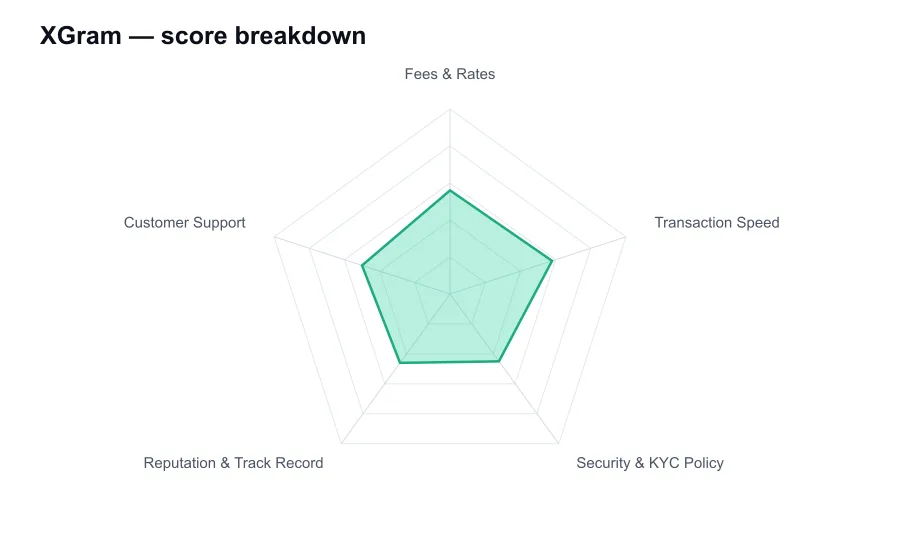
XGram scores 5.1/10 overall in our independent review, measured against every other provider we've compared, strongest on Transaction Speed (5.8/10) and weakest on Security & KYC Policy (4.5/10).
5.1/10 How we score →Editorial independence: our scores and rankings are produced using the fixed criteria above and are not influenced by advertisers. This is an independent ranking site and is not operated by, or affiliated with, any provider we list.
Affiliate disclosure: some links on this page may earn us a commission at no extra cost to you. This does not affect our rankings.
XGram appears positioned as a compact exchange service for users who value a direct conversion path over the machinery of a conventional centralized exchange. That places it in a useful but demanding niche. Instant exchangers can save time for someone who already holds crypto in self-custody and simply wants a different asset or network. They are less compelling for people who need transparent market depth, detailed reporting, recurring purchases, or the legal protections attached to a well established licensed platform.
The first thing I would say about XGram is that its practical appeal is easy to understand. A single-purpose exchange flow can be less intimidating than a large trading dashboard full of charts, staking offers, leverage products, and dozens of account settings. You enter the source asset, select the destination, submit a receiving address, and pay. For a user who knows exactly what they are doing, that can be pleasantly efficient. It also leaves very little room for vague assumptions about how the service works.
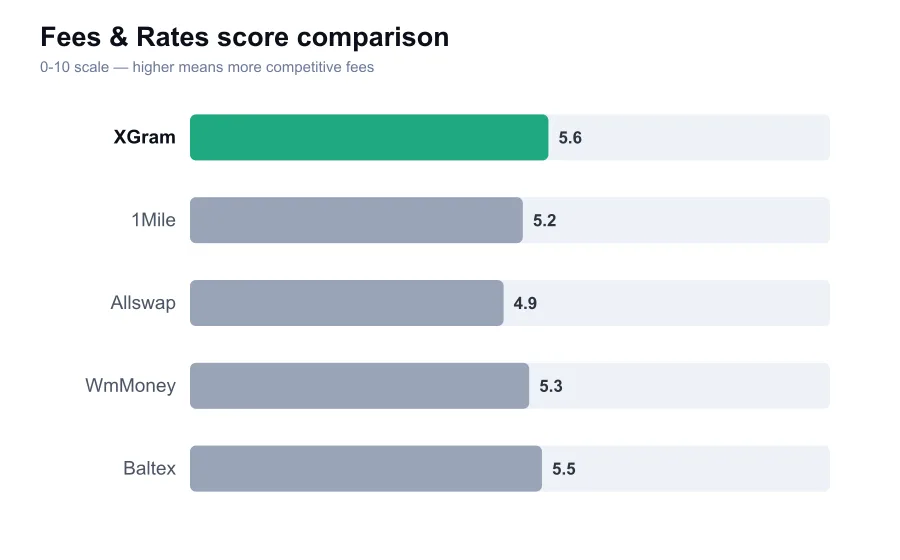
Rates deserve close attention. XGram should be judged by the net amount it promises to deliver, not by whether its interface uses the word commission. Instant exchange providers frequently source liquidity from other venues and add a spread. That spread can be reasonable, especially on a small or inconvenient route, but it can also be the most expensive part of the transaction. A customer should compare the XGram quote with at least two alternatives and with the mid-market price before deciding the convenience is worth it.
A fair comparison must include the details that marketing pages leave out. Check whether the payout estimate includes the blockchain withdrawal cost, whether the amount changes with market movement, whether there is a minimum, and whether the service treats an underpayment as a refund, a delayed manual case, or a partial conversion. If a provider cannot make those points clear at the order stage, I consider that a fee and support warning. Money is often lost in the gaps between a headline rate and the actual settlement rules.
XGram has a better chance of being useful on uncomplicated crypto-to-crypto exchanges than on complex fiat routes. Crypto transfers have visible transaction hashes, known confirmation requirements, and fewer human intermediaries. Fiat payments add bank schedules, payer-name rules, card processor scrutiny, and potential chargeback concerns. Anyone using XGram for a fiat-related conversion should read the payment instructions twice and avoid sending from a third party account. A mismatch can transform a routine order into an avoidable support case.
Speed is best viewed through that same lens. If the incoming transfer reaches the specified address quickly and the selected chain is functioning normally, a simple conversion can be completed in a fairly short window. Bitcoin confirmations, Ethereum gas conditions, liquidity availability, and manual checks can interrupt that tidy picture. The service should not be measured against the theoretical speed of a blockchain. It should be measured by the entire path from payment made to usable funds arriving in the customer's wallet.
I could not verify a comprehensive public dataset showing XGram's normal processing time, support backlog, or rate of delayed orders. This does not mean orders are slow. It means a reviewer cannot responsibly award a top speed score based on a promise alone. There is a big difference between an exchange that occasionally completes a swap in ten minutes and one that can demonstrate predictable service across market volatility. For a deadline-sensitive payment, hold the destination asset in advance.
The security profile needs restraint. I was unable to confirm extensive public information about XGram's corporate identity, security governance, wallet architecture, or independent audits. Any user evaluating the service should recognize that the normal risks of a non-custodial-looking exchanger do not disappear just because it does not ask them to open an account. You still send funds to an address controlled during the exchange process. Until the payout lands in your wallet, counterparty risk exists.
There is also a persistent misunderstanding around no-registration flows. Not creating a username and password can reduce friction, but it does not make a service anonymous in every circumstance or eliminate the possibility of compliance intervention. Blockchain tracing, payment-provider review, and internal anti-fraud procedures can all prompt questions. XGram should state its current verification rules clearly in its terms. If the policy is unclear, users should assume documents may be requested and should not send funds they cannot afford to have delayed.
For safe use, I recommend the same discipline I use with any lesser-known exchanger. Reach the site independently, not from a social media advertisement. Confirm the asset ticker and network, because USDT on different networks is not interchangeable. Send a small test amount first. Keep the transaction ID, destination address, order number, and screenshots of the quoted payout. These are not signs of paranoia. They are the minimum records needed if the transaction is delayed or the support team needs to identify it.
XGram's reputation remains the limiting factor. It does not have the years of independently documented operating history, recognizable leadership, and broad public scrutiny that give a major exchange some earned credibility. Small providers can build a good name gradually, but that requires a visible pattern of transparent terms, clear complaint handling, and reliable resolution of awkward cases rather than only smooth ones. A handful of positive comments cannot answer the hard question of what happens when a transaction fails.
Support should be tested before money is committed. Ask a question with a factual answer, perhaps whether a particular network is available or what happens after a late payment. Strong support will answer directly and point to the relevant policy. Weak support will issue stock phrases, avoid the specifics, or vanish until there is an order number. I would also avoid relying on informal messaging channels as the sole route for a dispute. A ticket trail or recorded correspondence is much safer.
XGram is most defensible as a tactical choice for someone who has done this before, sees a favorable rate, and is moving an amount they can comfortably test. It does not earn a place as a core exchange account or a large-value settlement provider. The service's lean approach is its advantage, but it is also its weakness. There is less bureaucracy, yet less visible evidence that difficult cases are handled with the processes customers should expect from a financial intermediary.
My take is moderately cautious. XGram may deliver the quick wallet-to-wallet conversion its interface promises, and that can be enough for a small, routine transaction. But transparent pricing, independently verifiable security information, and a long public track record are not areas where it currently inspires the highest confidence. Use it only if its exact quote is meaningfully better than stronger alternatives, and keep the first transfer small. In crypto, convenience should never outrun verification.
| Criterion | Score (0-10) | Notes |
|---|---|---|
| Fees & Rates | 5.6 | Potentially workable quotes, but spread must be checked. |
| Transaction Speed | 5.8 | Routine crypto routes can be efficient, without audited metrics. |
| Security & KYC Policy | 4.5 | No extensive public evidence of institutional controls. |
| Reputation & Track Record | 4.6 | Developing public footprint, not a proven major brand. |
| Customer Support | 5.0 | Ask a precise question before placing an order. |
| Pros | Cons |
|---|
During an exchange, funds are sent to an address used for processing before the destination asset is paid out. Do not treat a direct exchange flow as risk-free custody, and avoid sending more than the order requires.
Check the exact amount you will receive against two instant-exchange alternatives and a liquid exchange conversion after withdrawal costs. Include the network fee and the rate type in the comparison.
Keep the order ID, sending transaction hash, amount, network, and screenshots of the quote. Contact support through its documented channel and avoid sending a second payment unless instructed clearly.
| Alternative | Score |
|---|---|
| 1Mile Review | 5.1/10 |
| Allswap Review | 5.0/10 |
| WmMoney Review | 5.0/10 |
| BTC2Pay Review | 5.2/10 |
| Baltex Review | 5.2/10 |
| CCECash Review | 4.9/10 |