
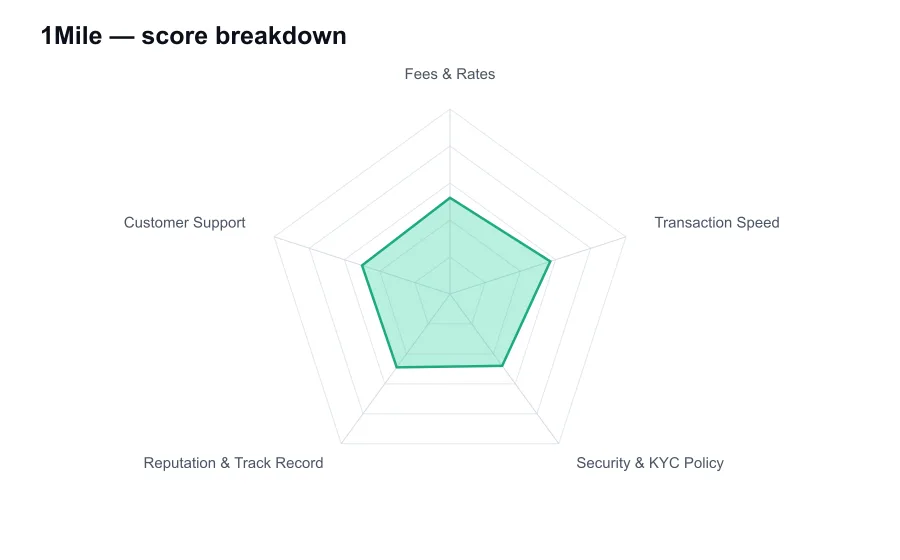
1Mile scores 5.1/10 overall in our independent review, measured against every other provider we've compared, strongest on Transaction Speed (5.7/10) and weakest on Security & KYC Policy (4.8/10).
5.1/10 How we score →Editorial independence: our scores and rankings are produced using the fixed criteria above and are not influenced by advertisers. This is an independent ranking site and is not operated by, or affiliated with, any provider we list.
Affiliate disclosure: some links on this page may earn us a commission at no extra cost to you. This does not affect our rankings.
1Mile is presented in the style of a compact online exchanger rather than a full-scale cryptocurrency marketplace. That puts it in a crowded category where the useful question is not whether the website can create an order, because most can, but whether the provider can execute that order at the quoted rate, communicate clearly during a problem, and handle compliance fairly. Small exchangers can be perfectly functional. They also require more active caution from the customer than recognizable global platforms do.
The service is most likely to appeal to users who have a specific payment direction in mind and want a direct conversion instead of charting, order books, custody accounts, or long identity onboarding. A visitor may find a route involving crypto and a regional bank, card, or electronic payment method that larger exchanges do not support cleanly. That convenience is its commercial reason to exist. It should not be confused with an advantage in trading depth, custody protection, or regulatory accountability.
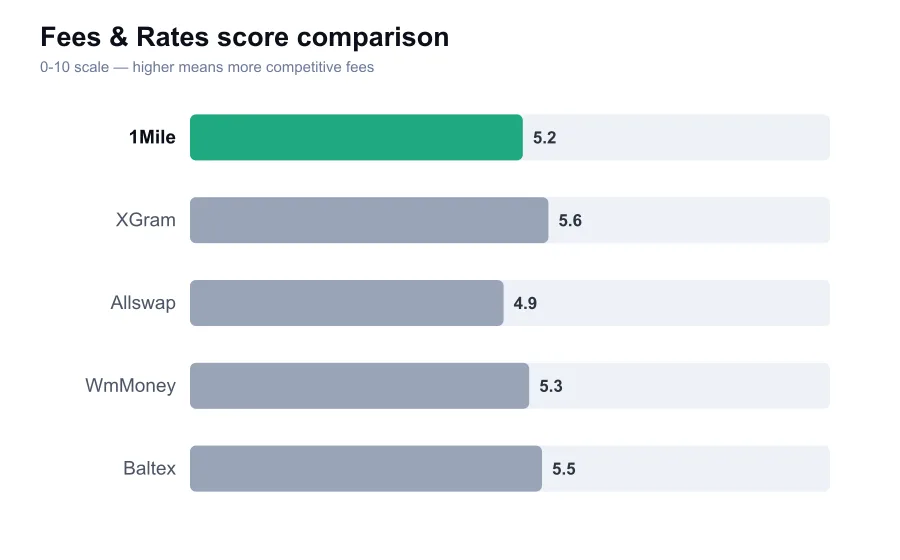
Fee disclosure is the first area where prospective users should slow down. Exchanger sites often advertise a rate rather than a separate commission, so the cost is embedded in the amount received. The right comparison is simple: enter the same amount across several reputable exchangers and compare the confirmed payout after every visible network fee. If 1Mile's result is lower by a noticeable margin, a sleek order page is not enough reason to choose it.
The spread can be reasonable on a well-supplied, ordinary route, particularly if the service is trying to remain competitive on monitoring platforms. It can become expensive in directions involving cards, local banking rails, lower-liquidity coins, or a volatile asset. Card chargeback risk and payment processing are not free, and smaller providers pass that risk into rates. Users looking to buy Bitcoin or USDT regularly will usually obtain better long-term pricing through an exchange with transparent maker and taker fees.
Rate language matters as much as the number. A floating exchange rate can change between the time an order is created and the time the provider receives enough confirmations. A fixed-rate option, if offered for a route, has conditions around payment window, exact amount, and network confirmations. Sending an incorrect amount can force manual handling and change the result. Read those rules before pressing send, not while asking support why a payout differs from an initial calculator estimate.
Transaction speed is similarly route dependent. A simple onchain payout can be sent quickly once the incoming payment is visible and the destination has passed basic checks. The customer then waits for blockchain confirmation on the receiving side. Bank routes can be constrained by business hours, correspondent banks, holidays, or recipient-side screening. A provider saying an order is processed quickly does not mean the beneficiary's bank will credit it quickly. Those are separate stages.
The operational risk rises if a route requires an operator to verify a transfer manually. That does not automatically signal a bad service, since fraud prevention is necessary, but it does make exact delivery times difficult to promise. Do not use a small exchanger for rent, payroll, a time-sensitive OTC settlement, or a token sale deadline. A delay of a few hours may be merely irritating for a personal swap. It can be expensive in a trade or business payment.
Security begins with checking the site identity and order details. Use an independently found official link, not an advertisement or a link sent in a private message. Check that the recipient wallet and bank instructions shown after order creation match the order page. Take screenshots of the quote, order ID, and payment proof. These habits are boring, but they are more useful than vague claims about military-grade security on a site that holds customer funds temporarily.
A limited or no-account process does not mean the provider will never request identification. Financial crime controls can lead an exchanger to pause an order, ask about source of funds, or reject a third-party payment. This is particularly common when names do not match, transaction patterns look unusual, or a blockchain analytics flag is triggered. Anyone unwilling to provide documents under any circumstances should not send funds first and hope that the transaction remains outside compliance review.
What 1Mile lacks, compared with a larger licensed exchange, is a deep public trail of audited controls, corporate disclosures, insurance arrangements, or a mature incident-response record. That is not a claim of misconduct. It is a limitation on what an outsider can verify. The safer response is proportionality. Keep the first order small, avoid leaving a balance, and do not consolidate a large transfer through an unfamiliar provider merely because the initial quote beats the market by a fraction.
Reputation research should be current and granular. Look for feedback attached to actual payment directions and seek evidence that disputed orders were resolved with transaction IDs or meaningful explanations. Generic five-star comments are weak evidence, especially in the exchange-monitoring world. I would give more weight to a long run of recent, detailed reviews than to a high aggregate score whose underlying comments are sparse. Public complaints deserve the same context: look for patterns rather than one dramatic account.
Support quality is often decisive with small exchangers because there is no branch, phone-based fraud department, or formal account manager to fall back on. Before funding a meaningful order, test the listed channel with a specific question about limits, rate fixation, or whether a sender name must match. A competent answer should be direct and consistent with the rules. If the response is evasive before payment, it is unlikely to become better after your funds are in transit.
1Mile can make sense for a narrow use case, a modest one-time conversion on a route where it has a clearly superior final payout and sufficient recent feedback. It does not make sense as a place to build a trading routine or to hold a working crypto balance. The difference between a transactional exchanger and a financial platform is not cosmetic. One is designed to complete a conversion, while the other is expected to provide durable account controls, reporting, and established escalation paths.
My recommendation is conservative. Use 1Mile only after comparing its final quote, reading its active-order terms, and proving the process with an amount small enough to tolerate a delay. Its potential strength is route convenience, not a compelling record of fee transparency or institutional trust. People who value predictable pricing, advanced security controls, and a robust support structure should pay the modest extra friction of using a recognized regulated exchange. For occasional, informed users, it may be serviceable, but it has not earned blind trust.
| Criterion | Score (0-10) | Notes |
|---|---|---|
| Fees & Rates | 5.2 | Embedded spread needs quote-by-quote comparison |
| Transaction Speed | 5.7 | Straightforward crypto routes are faster than bank rails |
| Security & KYC Policy | 4.8 | Limited independently verifiable control disclosures |
| Reputation & Track Record | 4.9 | Assess current detailed feedback, not headline ratings |
| Customer Support | 5.0 | Test response quality before sending meaningful funds |
| Pros | Cons |
|---|
Compare the final displayed payout for the exact same amount and payment method with several alternatives. Include blockchain withdrawal fees and any card costs.
Do not assume that. An exchanger may request identification or payment evidence if an order triggers fraud or compliance checks.
No. Test a new exchanger with a modest amount first, then assess the payout, communication, and actual processing time.
| Alternative | Score |
|---|---|
| XGram Review | 5.1/10 |
| Allswap Review | 5.0/10 |
| WmMoney Review | 5.0/10 |
| BTC2Pay Review | 5.2/10 |
| Baltex Review | 5.2/10 |
| CCECash Review | 4.9/10 |