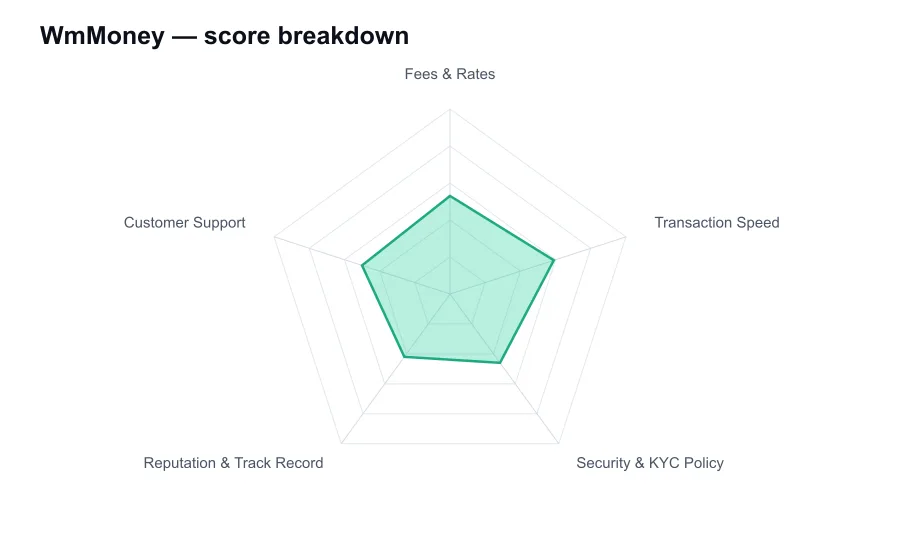
WmMoney scores 5.0/10 overall in our independent review, measured against every other provider we've compared, strongest on Transaction Speed (5.9/10) and weakest on Reputation & Track Record (4.2/10).
5.0/10 How we score →Editorial independence: our scores and rankings are produced using the fixed criteria above and are not influenced by advertisers. This is an independent ranking site and is not operated by, or affiliated with, any provider we list.
Affiliate disclosure: some links on this page may earn us a commission at no extra cost to you. This does not affect our rankings.
WmMoney appears to belong to the compact online-exchanger category, serving users who want a direct conversion between digital assets, electronic money, and available payment methods rather than a full trading account. Services like this survive because they can be useful in awkward corners of the market. A major exchange may offer better prices, but it may not support the exact payout route, small regional bank connection, or electronic-currency balance a customer wants to use.
That usefulness should not be confused with the protections of a major exchange. WmMoney is not the place to study charts, place sophisticated orders, or keep a diversified portfolio. Its transaction flow is fundamentally a request for one conversion at one quoted rate. The customer needs to get the amount, network, wallet details, payment reference, and timing right. If any of those are wrong, the safety net is much thinner than users expect.
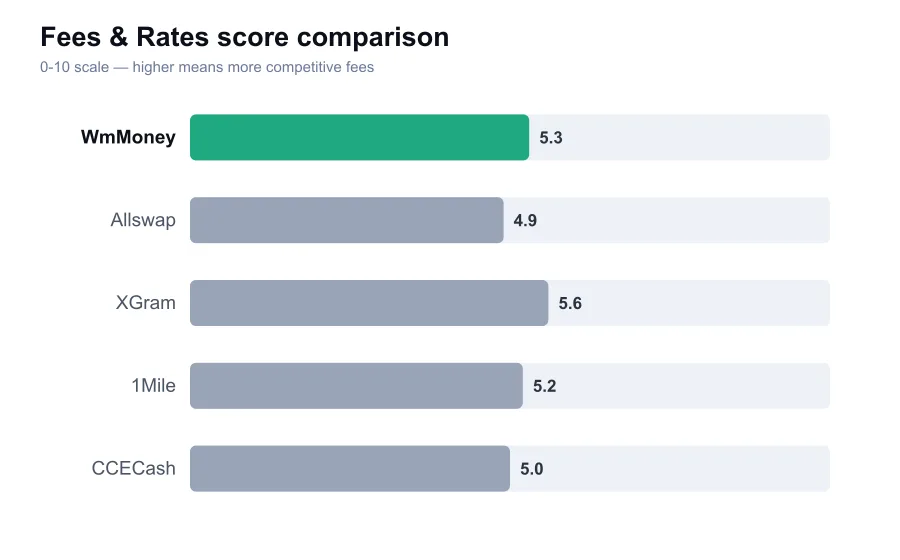
Fees are the first area where small exchangers can disappoint. WmMoney-style services often build compensation into the quote rather than publishing one simple trading commission. That makes the service easy to use but hard to compare. A displayed rate may include the operator's margin, liquidity cost, payment-provider charge, and a buffer for price movement. None of those is inherently improper, but the combined cost can be substantial compared with a spot trade.
The sensible method is to compare the actual receive amount, not the percentage someone advertises in a banner. Check at least two alternatives at the same moment, account for blockchain withdrawal fees, and use the same payout method in each comparison. An exchange with a low trading fee can still be worse after an expensive withdrawal. Conversely, an exchanger that looks costly may be reasonable if it removes several steps and reaches a payment rail your regular platform cannot.
WmMoney can be quick on a routine order. If it has adequate reserve, the incoming funds arrive correctly, and the asset is on a normal network, an automated or semi-automated exchange may complete shortly after required confirmations. That is the service at its best. The user sends a familiar asset, receives the target balance, and never needs to place a trade manually.
The problem is variability. Fiat settlement may depend on a bank or payment partner. Cryptocurrency settlement may depend on memos, network congestion, or wallet-risk checks. Some order directions may require operator involvement or be available only during defined processing hours. A site can call itself automatic and still have a manual exception queue. Don't use WmMoney for a deadline-sensitive obligation unless you have already tested that exact direction successfully.
Security deserves a practical rather than promotional discussion. The biggest technical risk in an exchanger transaction is often user error: phishing pages, copied addresses, wrong network selection, incorrect payment references, or impostors posing as support. Visit the service through a trusted saved address, inspect the domain carefully, and don't follow payment instructions sent through unsolicited social-media messages. A real exchanger will never need your wallet seed phrase.
There is also the platform-risk question. Smaller operators generally disclose less about custody, reserve segregation, penetration testing, insurance, governance, and incident response than major exchanges. That makes it difficult to assess how client funds are handled between receipt and payout. For a fast exchange this may be acceptable at a modest size, but it is not a reason to leave funds pending or treat the service as a wallet.
KYC is frequently misunderstood in this part of the market. A service may let a customer begin an order without creating a lengthy profile, but it can still freeze completion and ask for documents if its monitoring flags the transaction. WmMoney users should assume that AML and sanctions screening exist or may be applied, especially for larger amounts, questionable payment sources, third-party payments, and addresses with problematic transaction history.
The critical issue is transparency before money is sent. A fair service tells people that verification can be requested, identifies prohibited activity, explains refund conditions, and provides a realistic process for cases where documents cannot be accepted. If the terms are unclear, the customer bears too much uncertainty. I would not use any small exchanger for funds whose origin I cannot document or for money that must be available without delay.
WmMoney's public reputation is difficult to assess with the confidence one can apply to long-running, highly visible exchanges. Small brands can accumulate feedback without building a broad independent record. That does not prove poor conduct. It means review research must be more demanding. Look beyond aggregate star scores, seek dated comments with meaningful transaction details, and watch for patterns involving withheld orders, rate disputes, or support silence.
An operator's response to criticism is revealing. A useful response identifies the issue, respects customer privacy, and offers a route to resolution. A defensive reply that merely blames the user tells you little. Equally, an angry complaint without a transaction hash or order context should not be treated as conclusive proof. The right conclusion is not blind faith or blanket suspicion. It is to limit exposure until direct experience justifies more trust.
Support can make or break WmMoney because every exception becomes a human problem. A customer needs an answer that distinguishes an unconfirmed crypto deposit from a payment-provider hold, a reserve shortage, or a compliance review. Generic messages such as "wait" are poor service if they do not explain what the customer is waiting for. Before using the platform, check whether its listed support channels are current and whether its FAQ addresses refunds and mistaken payments.
Keep complete records from the start. Save the exchange direction, amount, quoted payout, order identifier, transaction hash, and payment receipt. For card or bank-based payments, use an account in your own name whenever the terms require it. Do not send extra money to "unlock" a transaction, and do not accept support instructions that shift the conversation to an unverified account. Those are common danger signals across the entire exchange sector.
WmMoney may suit an experienced customer making a small, carefully checked conversion that is poorly served by bigger platforms. It is not a good first stop for newcomers, large transfers, or people who need guaranteed same-day access to cash. The low-friction experience is attractive only as long as the order stays routine. Once a payment is questioned or delayed, the limited public transparency of a small exchanger becomes much more important.
My judgment is cautious rather than hostile. WmMoney can be a practical specialist service if its live rate and supported direction solve a real problem. It does not offer enough public assurance to justify treating it like a primary financial provider. Compare the final payout, begin with a test, and move on to a larger regulated exchange whenever that platform can accomplish the same task at a clearer cost.
| Criterion | Score (0-10) | Notes |
|---|---|---|
| Fees & Rates | 5.3 | Final payout matters, since costs are mainly rate-based. |
| Transaction Speed | 5.9 | Routine orders may be quick, exceptions can take time. |
| Security & KYC Policy | 4.6 | Possible AML controls, but limited public safeguards detail. |
| Reputation & Track Record | 4.2 | Public track record is harder to verify independently. |
| Customer Support | 5.0 | Support quality matters greatly for delayed orders. |
| Pros | Cons |
|---|
That depends on the specific order terms and exchange direction. Read the quote conditions before paying, since floating-rate orders can change with market movement.
Yes. Even services with light registration can apply AML checks and request identity, payment ownership, or source-of-funds evidence for flagged transactions.
Keep the order ID, transaction hash, payment proof, and screenshots of the terms. Contact only the official listed support channel and never disclose a seed phrase.
| Alternative | Score |
|---|---|
| Allswap Review | 5.0/10 |
| XGram Review | 5.1/10 |
| 1Mile Review | 5.1/10 |
| CCECash Review | 4.9/10 |
| BTC2Pay Review | 5.2/10 |
| Baltex Review | 5.2/10 |