
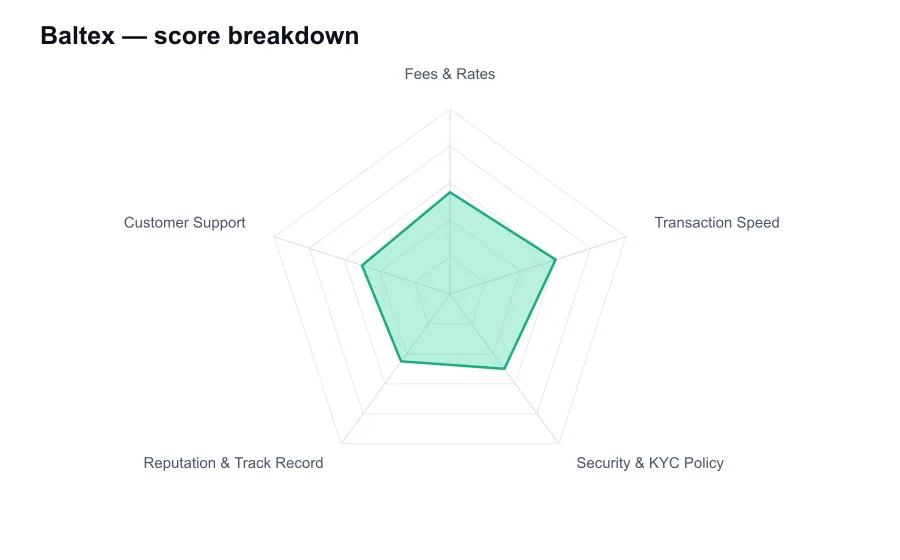
Baltex scores 5.2/10 overall in our independent review, measured against every other provider we've compared, strongest on Transaction Speed (6.0/10) and weakest on Reputation & Track Record (4.5/10).
5.2/10 How we score →Editorial independence: our scores and rankings are produced using the fixed criteria above and are not influenced by advertisers. This is an independent ranking site and is not operated by, or affiliated with, any provider we list.
Affiliate disclosure: some links on this page may earn us a commission at no extra cost to you. This does not affect our rankings.
Baltex belongs to the smaller end of the crypto exchange-service market, where the emphasis is on converting one digital asset to another rather than building a broad retail trading ecosystem. That distinction shapes the review. A large exchange can be judged by its licensing, custody architecture, order-book depth, and years of operational disclosures. A compact exchanger is judged more personally: does it quote honestly, process ordinary orders reliably, explain its rules, and communicate when something has gone wrong? Baltex has to clear that higher trust bar without the brand recognition of the market leaders.
The appeal is obvious for users who dislike conventional exchanges. You do not necessarily need to learn advanced order types, maintain a custodial account, or navigate a screen designed for active traders. Pick a sending asset, select a receiving asset, supply an address, and follow the payment instructions. For a person already holding crypto in a wallet, that can be less intimidating than depositing to Binance or Kraken. It is also a model where users can underestimate how much discretion they are handing to the provider.
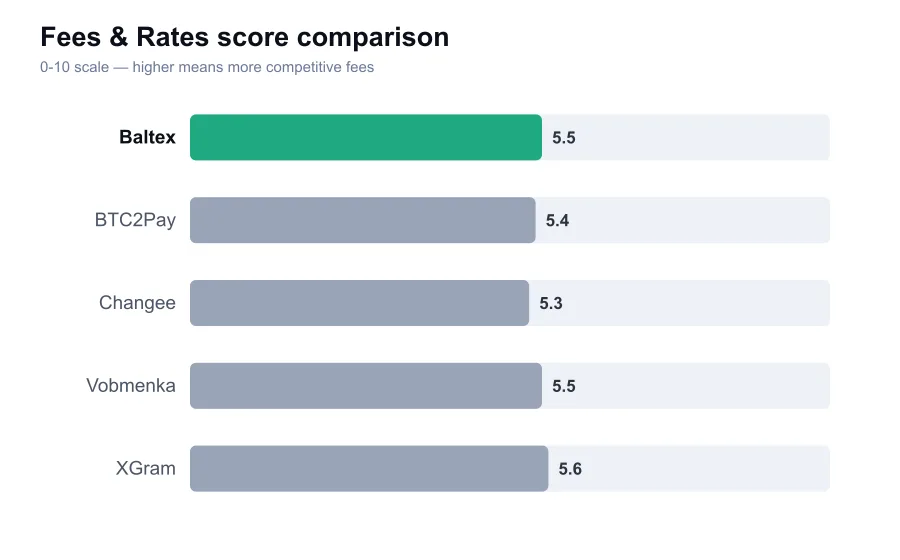
Fees are the first area where plain language matters. Baltex-style services tend to present an all-in conversion quote instead of breaking out a maker fee, taker fee, withdrawal fee, and spread. That is convenient, but it is not necessarily cheap. The difference between the market price and the amount offered to the customer is the real charge, whatever the site calls it. Network fees may also affect the payout. If the service does not provide a transparent calculation, the only sensible response is to compare the final receive amount elsewhere.
For a small swap, a slightly wider spread may be a fair price for avoiding account setup. For a larger one, it adds up rapidly. A two percent difference on a few hundred dollars is annoying. On a five-figure conversion, it can be more expensive than using a liquid exchange, paying a trading fee, and withdrawing to a private wallet. I would never accept a Baltex quote on the basis of an advertised percentage alone. Check the final amount against a major exchange's executable price, then include withdrawal costs and the time required to complete each route.
Rate type can change the outcome as much as the spread. A floating rate means the settlement amount may shift while the deposit reaches the service and is confirmed. That might be harmless during a quiet market, but crypto markets have a talent for moving precisely when a user is waiting for confirmations. A fixed rate can be preferable if Baltex clearly specifies the payment window and the exact conditions that void the quote. Read the payment page, not just the first quote screen. Those details govern a dispute.
Transaction speed should be described realistically. No exchange service can make the Bitcoin network confirm faster, and no provider controls congestion on Ethereum or other chains. A normal liquid route may settle within minutes after a deposit is recognized, while Bitcoin, large transfers, and manual reviews can take longer. The important question is not whether a service uses the word instant. It is whether it publishes a usable order status, recognizes incoming payments promptly, and tells the customer what stage is causing a delay.
Baltex is best suited to routine transactions, not operationally complex ones. A regular BTC to USDT or LTC to BTC exchange is much easier for a service to automate than a request involving an unusual token, a destination tag, a recently upgraded network, or a large amount that exceeds readily available reserve. If your transfer needs to arrive before a deadline, use an established venue and leave yourself time. Crypto settlement is unforgiving, and a smaller operator cannot always absorb an unexpected liquidity or wallet issue.
KYC is another subject users should approach without wishful thinking. A service may allow an order to begin without a full account profile, yet still reserve the right to screen wallet activity and request documents. That is increasingly common across the industry. The fair standard is not whether Baltex claims to be private. The fair standard is whether a customer can understand in advance what could trigger verification, what happens to funds under review, and how a refund is handled if verification is not completed.
From a security perspective, users should keep the service's role narrow. Send from a wallet you control, receive to a wallet you control, and do not regard the exchanger as a place to store funds. Verify every character of the destination address, especially for copied addresses and token networks. Use a hardware wallet for meaningful balances where practical. These habits matter even with famous platforms. They matter more with a provider whose public security reporting, corporate disclosures, and reserve practices are not as extensive as those of a large regulated exchange.
Reputation is neither created nor disproved by a handful of review-site comments. A small exchanger can collect many positive reports because routine orders are easy. The revealing cases are delayed transactions, incorrect sends, compliance flags, and refunds. Before using Baltex for more than a test amount, look for detailed recent reports that explain the asset, timeline, and resolution. Ignore both anonymous cheerleading and vague accusations that offer no transaction context. A pattern of unresolved complaints is more meaningful than a perfect-looking star average.
The limited public profile affects how I score the service. It does not automatically mean Baltex is unsafe, and pretending that only household names can process crypto would be silly. But it does mean customers have less independent information to assess solvency, team accountability, insurance, cold-storage controls, and legal recourse. A polished conversion page is not evidence of those things. Users should price that uncertainty into their decision rather than assuming a favorable rate eliminates it.
Support is the practical safety net. A good exchanger should answer clear questions before payment and provide a reference number, order status, and reachable channel afterward. The support team should not need days to identify a deposit or explain a missing payout. I would test Baltex with a specific question about a network and minimum amount before funding an order. If the reply is direct and competent, that is a modest positive signal. If it is evasive or generic, walk away before your funds make the decision for you.
There are sensible ways to use Baltex without pretending it carries no risk. Start with a small transaction. Take screenshots of the quoted rate, order identifier, and payment instructions. Confirm the correct chain before sending stablecoins. Avoid sending a balance that you cannot afford to have delayed. These are boring precautions, but they turn a potentially stressful event into a manageable one and are far more valuable than chasing the last decimal place in a rate.
Baltex can serve an experienced crypto user who wants a quick wallet-to-wallet conversion and is prepared to perform basic due diligence. I don't see enough reason to recommend it as a default platform for large conversions, long-term holding, or first-time users. The friction savings are real, but so are the transparency tradeoffs. Use it for what it is, a narrow exchange utility, rather than treating it as a substitute for a well-established trading and custody platform.
| Criterion | Score (0-10) | Notes |
|---|---|---|
| Fees & Rates | 5.5 | All-in quotes are convenient, but spreads need independent comparison. |
| Transaction Speed | 6.0 | Ordinary liquid routes can settle promptly after confirmations. |
| Security & KYC Policy | 5.0 | Use self-custody and expect transaction screening where required. |
| Reputation & Track Record | 4.5 | A modest public footprint offers limited independent assurance. |
| Customer Support | 5.0 | Pre-sale responsiveness is worth testing before funding an order. |
| Pros | Cons |
|---|
Compare the exact receive amount, including any network impact, against competing exchangers and a liquid exchange route. The headline rate alone is insufficient.
It is safer to test a small order first. For significant sums, deeper liquidity, published fees, and stronger institutional disclosure are preferable.
Blockchain confirmations, network congestion, liquidity limits, incorrect payment details, and compliance reviews can all delay settlement.
| Alternative | Score |
|---|---|
| BTC2Pay Review | 5.2/10 |
| Changee Review | 5.3/10 |
| Vobmenka Review | 5.3/10 |
| XGram Review | 5.1/10 |
| 1Mile Review | 5.1/10 |
| Acechange Review | 5.4/10 |