
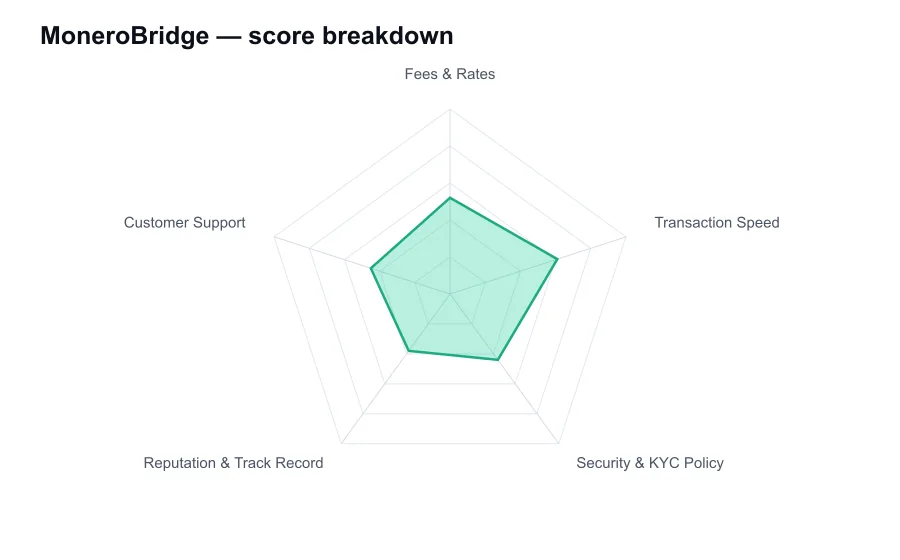
MoneroBridge scores 4.8/10 overall in our independent review, measured against every other provider we've compared, strongest on Transaction Speed (6.1/10) and weakest on Reputation & Track Record (3.8/10).
4.8/10 How we score →Editorial independence: our scores and rankings are produced using the fixed criteria above and are not influenced by advertisers. This is an independent ranking site and is not operated by, or affiliated with, any provider we list.
Affiliate disclosure: some links on this page may earn us a commission at no extra cost to you. This does not affect our rankings.
MoneroBridge occupied a very particular corner of the instant exchange market: users who wanted to move into or out of Monero without opening a conventional trading account. Its appeal was obvious. The service presented itself as a simple conversion tool rather than a full exchange, with a sparse interface, few distractions, and a strong privacy-minded audience. That niche also made trust more important than it would be at a large regulated venue.
The basic process was familiar to anyone who has used a non-custodial swap service. Pick an input coin, choose XMR or another supported asset as the output, enter a receiving address, and send funds to the quoted deposit address. MoneroBridge did not offer order books, margin, staking, or a wallet ecosystem. It was a transaction service, and judging it as a Binance substitute misses the point.
That narrow focus could be refreshing. There was less account friction, no elaborate dashboard, and no reason to leave a working balance on the site. For a person making an occasional privacy-oriented conversion, that is a better design than an exchange that asks for a passport before showing a rate. It also means the user carries more responsibility for addresses, network choice, and transaction records.
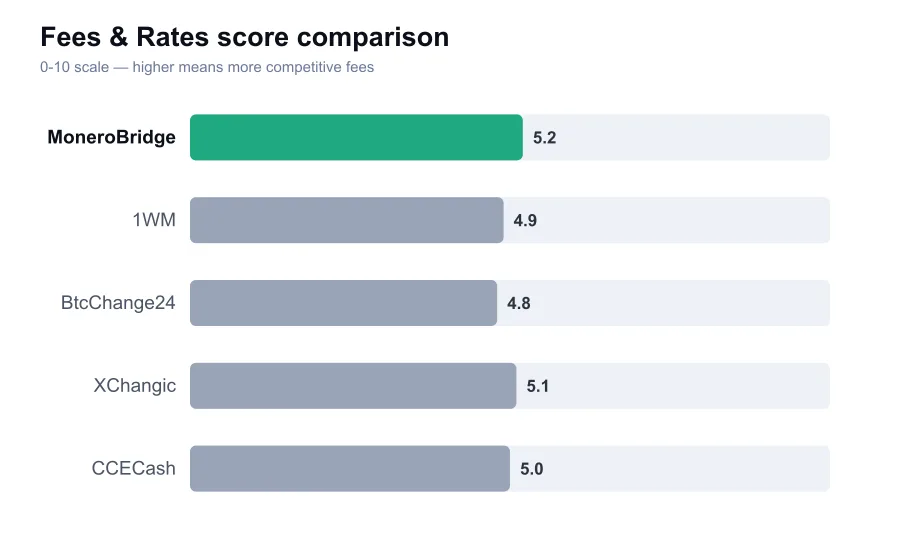
Fee transparency was never MoneroBridge's strongest feature. The quote shown before a swap mattered more than any headline claim because the effective cost could include a service spread, liquidity costs, and the underlying network fee. That is normal for instant conversion services, but it makes comparisons difficult. A rate that looks cheap against a visible percentage fee can still be weaker than a competitor's all-in quote.
Small swaps were the least attractive use case. Fixed network costs can eat a noticeable share of a modest Bitcoin or Ethereum conversion, while thin XMR liquidity can widen the spread during busy periods. Users should compare the final expected output against ChangeNOW, FixedFloat, SimpleSwap, and an exchange order book, not just accept the first quote. MoneroBridge was convenient, but it was rarely demonstrably the lowest-cost route.
The speed story depended heavily on the asset being sent. Once the deposit had the required confirmations, an ordinary swap could move along reasonably quickly. Fast networks could complete in minutes. Bitcoin, Ethereum during congestion, and any transaction requiring extra compliance review could take much longer. A service can process promptly while the blockchain still dictates the practical timetable.
Monero transactions add their own expectations. A user waiting for a privacy coin payout often wants certainty, not merely a transaction ID. MoneroBridge's limited public-facing operational detail made that certainty harder to get. There was no deep public status infrastructure, no substantial API documentation for retail users, and little of the transparency one sees from established platforms that publish incident reports and reserve information.
The no-account style was central to its attraction, but it should not be confused with an unconditional guarantee of anonymity. Instant swap providers can apply risk controls, request information, delay a transfer, or refuse to process funds associated with sanctions or theft investigations. Anyone who assumes that no sign-up means no compliance checks is setting themselves up for a painful surprise.
Security is also broader than KYC. A non-custodial flow reduces the danger of leaving a long-term balance on an exchange, which is a genuine benefit. Yet users still temporarily trust the operator with a deposit and trust the website not to be impersonated. With smaller services, phishing domains and copied interfaces are a serious threat. Bookmark the legitimate site and verify every destination address before sending.
MoneroBridge did not have the lengthy, easily auditable operating history that gives bigger names a margin of safety. That is the main weakness. A service can execute ordinary swaps perfectly well for a period and still offer little recourse if a large transfer is delayed or disputed. The lack of a prominent corporate identity, detailed licensing disclosures, and broad independent coverage leaves prospective customers with more uncertainty than they should accept for high-value transactions.
Reputation in privacy-coin circles is often built through forum anecdotes and social posts. Those can reveal recurring patterns, but they are not equivalent to a tested track record. Positive reports of completed swaps are useful, particularly for ordinary-sized transactions. They do not prove that a provider has the liquidity, controls, or support capacity to handle a six-figure conversion when markets are moving fast.
Support appeared to be functional rather than robust. A transaction ID and a concise explanation were likely the best way to get help, but there was no reason to expect the kind of around-the-clock, multi-channel support offered by a major exchange. That matters most when a deposit is late, a memo was missed, or a rate has expired. In those moments, an anonymous-looking operator can feel much less convenient.
I would not use MoneroBridge as a place to experiment with a large or time-sensitive amount. Test it with an amount you can afford to have delayed, save the quote and transaction hashes, and do not send a second deposit to an old address. If the quoted output is not clearly competitive, there is little reason to take the extra counterparty risk merely for a cleaner interface.
MoneroBridge made sense only for users who valued a simple, low-friction XMR conversion above institutional reassurance. Its model was appealing, but the public evidence supporting long-term reliability was too thin for confidence beyond modest transfers. Privacy is useful, yet a lack of operational transparency is not the same thing as privacy. For serious size, I would choose a better documented venue or split the trade into smaller, independently verified steps.
| Criterion | Score (0-10) | Notes |
|---|---|---|
| Fees & Rates | 5.2 | The effective spread matters more than any headline fee. |
| Transaction Speed | 6.1 | Often quick after confirmations, but chain delays apply. |
| Security & KYC Policy | 4.4 | No-account convenience, limited public operational detail. |
| Reputation & Track Record | 3.8 | A thin public track record for larger transfers. |
| Customer Support | 4.5 | Transaction support is less proven than major exchanges. |
| Pros | Cons |
|---|
Its model was associated with low-friction swaps rather than routine account onboarding, but no-account access does not guarantee that a transaction cannot be reviewed or delayed for compliance reasons.
Timing depended on the deposit network and required confirmations. Fast-chain deposits could finish quickly, while Bitcoin, Ethereum congestion, or a review could extend the wait considerably.
I would not treat it as a high-confidence venue for large size. Its public transparency and independently documented track record were weaker than those of larger alternatives.
| Alternative | Score |
|---|---|
| 1WM Review | 4.8/10 |
| BtcChange24 Review | 4.7/10 |
| XChangic Review | 4.7/10 |
| CCECash Review | 4.9/10 |
| Allswap Review | 5.0/10 |
| WmMoney Review | 5.0/10 |