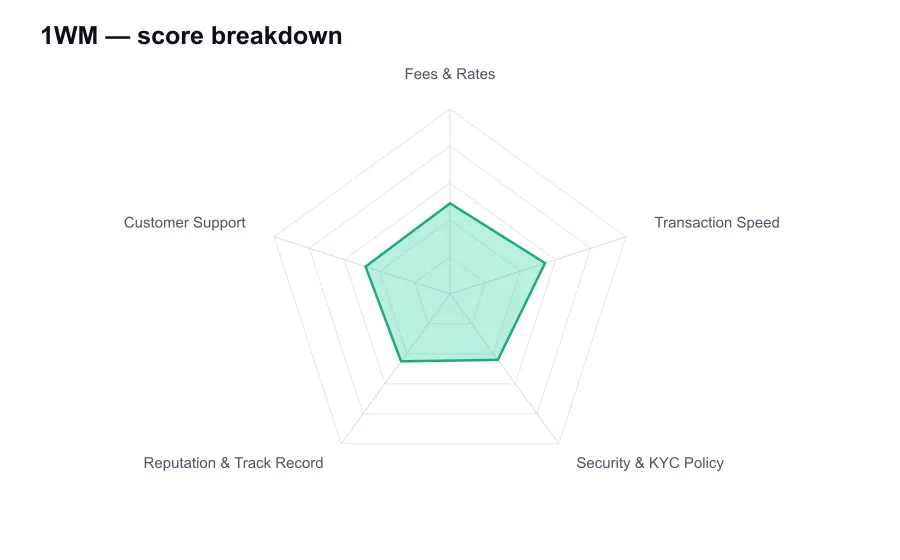
1WM scores 4.8/10 overall in our independent review, measured against every other provider we've compared, strongest on Transaction Speed (5.4/10) and weakest on Security & KYC Policy (4.4/10).
4.8/10 How we score →Editorial independence: our scores and rankings are produced using the fixed criteria above and are not influenced by advertisers. This is an independent ranking site and is not operated by, or affiliated with, any provider we list.
Affiliate disclosure: some links on this page may earn us a commission at no extra cost to you. This does not affect our rankings.
1WM sits in the small online-exchanger end of the crypto market, a segment built around direct conversions rather than exchange accounts and active trading. The format is familiar: choose what you send, choose what you receive, submit payment details, and allow the service to process the order. This can be a useful shortcut for an awkward crypto or payment route. It also demands a level of trust that customers sometimes underestimate because the interface is much simpler than the underlying movement of money.
There is no reason to judge a provider like 1WM by the standards of a decentralized protocol or a global regulated exchange, because it is not trying to be either. The fair test is more practical. Does the quote remain competitive after all embedded costs? Does the service explain its rate rules and reserve limits? Does an active order receive useful human attention if a payment is delayed or flagged? Those answers matter more than visual design, broad claims, or a long list of supported currencies.
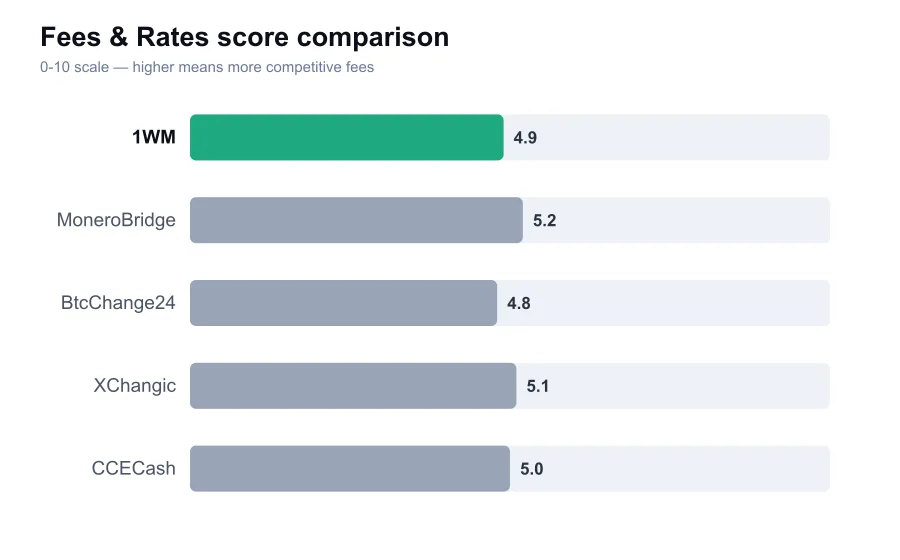
Pricing is likely the first trade-off. A direct exchanger's commission is commonly included in the quoted exchange rate rather than shown as a clean percentage. That makes the cost easy to overlook. A user sees a single destination amount, but that number may reflect the market spread, liquidity cost, payment-provider fees, and the exchanger's own risk margin. The only reliable comparison is the amount that will actually arrive after the customer pays, measured against several reputable alternatives at the same moment.
1WM may be competitively priced on a route where it has available reserve and active demand. It may be much less attractive where a card, bank transfer, or thinner asset is involved. That is normal for this business model, but it rules out any blanket claim that it is a cheap exchange. Traders executing regularly should prefer platforms that disclose maker, taker, deposit, and withdrawal fees separately. Direct exchangers are built for convenience, and convenience is frequently priced into the spread.
Check the terms for the difference between fixed and floating rates. A fixed order can still have a narrow payment deadline, a required exact deposit amount, and a condition that the incoming transaction confirm within a stated time. A floating order may settle at a later market rate after funds arrive. During a quiet day, the difference can be modest. During fast markets, it can materially alter the payout. Do not send an order until you know which risk you are accepting.
Speed is not something 1WM controls end to end. Crypto deposits need confirmations. Bank rails have their own schedules. Payment processors can hold or reject transfers. If a route is automated and reserve is ready, sending out the crypto leg can be quite fast. If the payment hits a manual review queue, the clock changes completely. This is why published exchange times should be understood as normal-case estimates, not a contract for a deadline-sensitive transfer.
Customers can improve their own odds of a clean transaction. Send precisely the requested amount, include any required payment reference, use an account in their own name where the rules require it, and do not send a token through the wrong network. Keep the transaction hash and receipt. These steps sound obvious, but a large share of exchange disputes begins with an underpayment, third-party payer, missing memo, or network mismatch. Support cannot always repair those errors quickly.
The security picture is modest. A small exchanger temporarily receives customer funds, meaning the customer must trust both the technology and the people operating the service. That differs sharply from a 1inch-style self-custody swap, where the wallet signs an onchain transaction, and from a large custodial exchange with published security practices. The appropriate response is not panic. It is risk sizing. Use an amount proportionate to the public information available about the provider and the route.
KYC policy should be viewed with the same realism. A service may permit an order without creating a full account, but it can still apply anti-fraud and anti-money-laundering screening. An unusual transaction, name mismatch, suspicious wallet exposure, or chargeback-sensitive payment method can trigger a request for ID or source-of-funds evidence. That possibility belongs in the decision before payment. It is far better to choose a provider whose verification standards you accept than to argue after a transfer is already pending.
Public reputation is difficult to establish for lesser-known exchangers because evidence is often dispersed across monitoring sites, forums, and social channels. Look beyond a numerical rating. Recent reviews describing the exact direction and a completed payout are useful. Repeated reports of a particular problem, whether it is delayed support, rate revisions, or document requests after payment, should carry real weight. A service can have many satisfactory small orders and still be a poor choice for a large or complicated one.
I would be especially wary of treating a favorable reserve figure as proof of safety. Reserve data can suggest that a route is available, but it does not demonstrate a company's solvency, legal status, cybersecurity controls, or ability to resolve a dispute. Those are separate questions. Established exchanges have their own risks, including account freezes and data collection, but they usually offer a clearer corporate footprint and more mature security infrastructure than a small order-based operator.
Support is therefore central to 1WM's usefulness. The best sign is a clear, specific pre-sale reply about processing times, sender-name rules, limits, and what happens if a transfer arrives late. The worst sign is a generic promise that everything is automatic, followed by silence once a customer asks about an exception. There is no substitute for responsive support in this niche, because manual intervention is exactly what customers need when the usual flow fails.
1WM can suit a user who knows the payment rail, has independently checked a current quote, and only wants to complete a modest exchange. It is not suitable for a first major crypto purchase, a business transfer requiring invoices and formal records, or an investor moving long-term holdings. The narrowness of that recommendation is intentional. Smaller exchangers can be useful tools, but they should remain tools, not financial homes.
My take is that 1WM belongs on a comparison list, not at the top of a default recommendation list. Its order-based approach can be practical, but public transparency and institutional reassurance appear limited beside established alternatives. If the final payout is clearly better, recent route-specific feedback is solid, and a small test succeeds, it may do the job. If any of those conditions is missing, choose a more established provider. A few saved percentage points are not enough compensation for unclear execution risk.
| Criterion | Score (0-10) | Notes |
|---|---|---|
| Fees & Rates | 4.9 | Quoted payout can conceal a meaningful spread |
| Transaction Speed | 5.4 | Fast only where payment and review stages cooperate |
| Security & KYC Policy | 4.4 | Temporary custody with limited public control detail |
| Reputation & Track Record | 4.5 | Use recent detailed feedback as the main signal |
| Customer Support | 4.8 | Support quality is crucial but hard to verify in advance |
| Pros | Cons |
|---|
Direct exchangers commonly build their margin into the rate. Compare the final payout with other providers rather than looking only for a fee percentage.
Yes. Blockchain confirmations, bank processing, reserve availability, and compliance checks can all delay an order beyond a normal estimate.
It is safer to test a small order first. Large transfers are better handled through providers with stronger public transparency and formal support channels.
| Alternative | Score |
|---|---|
| MoneroBridge Review | 4.8/10 |
| BtcChange24 Review | 4.7/10 |
| XChangic Review | 4.7/10 |
| CCECash Review | 4.9/10 |
| Allswap Review | 5.0/10 |
| WmMoney Review | 5.0/10 |