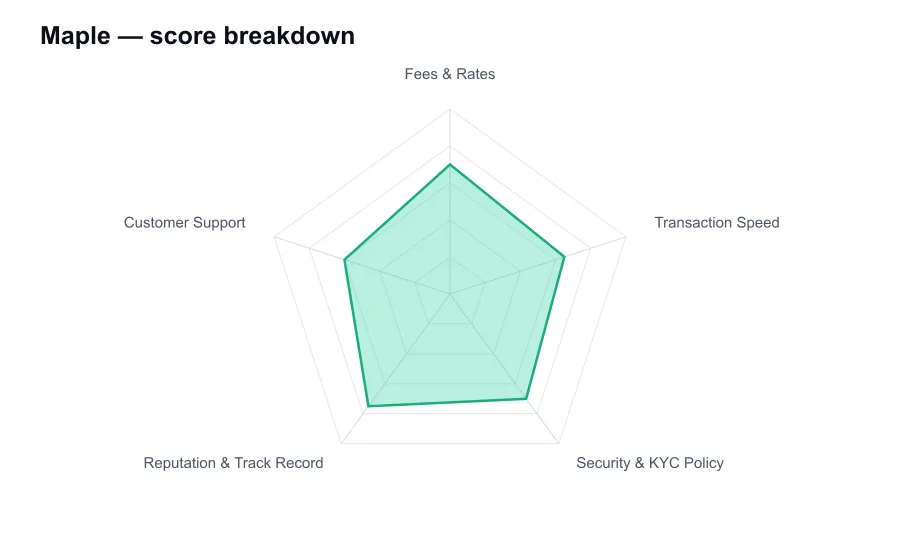
Maple scores 6.9/10 overall in our independent review, measured against every other provider we've compared, strongest on Reputation & Track Record (7.5/10) and weakest on Customer Support (6.0/10).
6.9/10 How we score →Editorial independence: our scores and rankings are produced using the fixed criteria above and are not influenced by advertisers. This is an independent ranking site and is not operated by, or affiliated with, any provider we list.
Affiliate disclosure: some links on this page may earn us a commission at no extra cost to you. This does not affect our rankings.
Maple is not a retail crypto exchange in the Coinbase sense. It is a decentralized credit marketplace and institutional lending protocol built around onchain lending pools, delegated credit assessment, and yield opportunities for capital providers. That makes it more interesting than another token swap interface, but it also makes it more complicated. People arriving to buy a coin or make a quick card purchase are looking in the wrong place.
The protocol's core proposition is credit, not spot trading. Borrowers seek undercollateralized or structured onchain loans, while lenders supply assets to pools in pursuit of yield. Maple has operated through major changes in crypto credit, including the painful failures of several centralized lenders in 2022. That history is important because it shows both why onchain transparency has value and why lending yield should never be confused with a risk free savings rate.
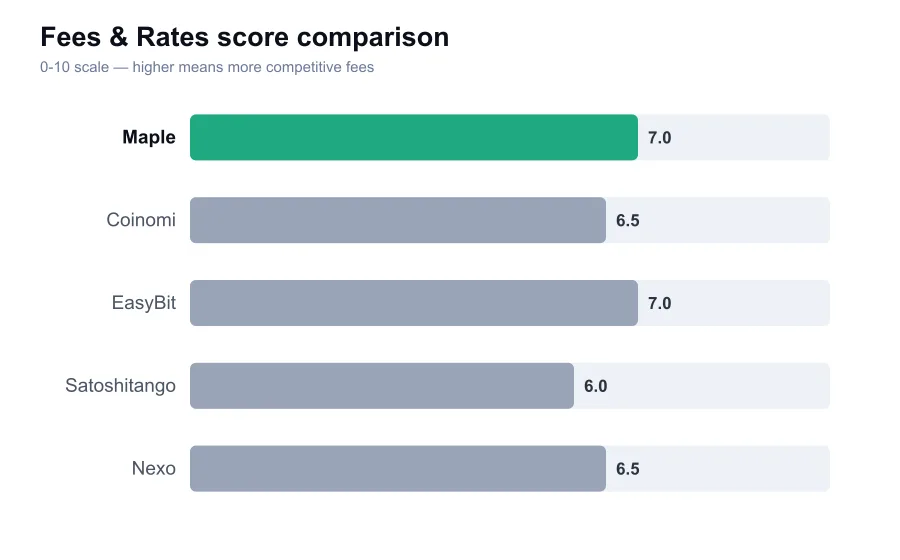
Maple's fee picture is more nuanced than a conventional exchange's maker and taker grid. Users need to look at the specific pool, vault, or product rather than hunt for one universal percentage. Management fees, performance fees, pool-level economics, withdrawal terms, and blockchain gas costs can all affect the result. The displayed annualized yield is not the amount that arrives in a wallet after every layer of cost and risk is accounted for.
That isn't a criticism of variable pricing by itself. Credit products have different durations, collateral structures, and underwriting costs, so a single flat fee would be artificial. The issue is that users must read the relevant product documentation and transaction preview. Sophisticated allocators will recognize that as normal fund due diligence. Casual DeFi users may find it less forgiving than a simple swap quote, particularly when yields change as liquidity and borrower demand change.
Transaction speed is largely dictated by the chain and the product's liquidity terms. A deposit into an onchain pool can confirm within minutes under normal network conditions, but getting capital back is not always equivalent to selling a liquid coin. Some products have withdrawal windows, queue mechanics, maturities, or limits based on available liquidity. If you might need cash tomorrow, a credit pool is the wrong tool no matter how polished the interface looks.
Maple's architecture does offer a meaningful advantage over opaque centralized lenders. Pool activity, token movements, and smart contract interactions can be inspected onchain. That makes it easier to see where capital is allocated than it was with several high yield lenders that relied on quarterly assurances and private balance sheets. Visibility, though, isn't the same as safety. A lender still relies on borrower quality, pool rules, oracle and smart contract behavior, legal arrangements, and the competence of the people setting credit policy.
Security should be assessed at two levels. The first is technical, including contract audits, upgrade controls, multisig governance, integrations, and the user's own wallet security. The second is credit security, meaning whether borrowers repay and whether loss-absorption mechanisms work as designed. Many DeFi reviews focus only on code risk. For Maple, credit risk can be the much bigger issue, especially in a market where collateral values and liquidity can deteriorate quickly.
Maple's past deserves direct treatment. The 2022 crypto credit crisis exposed real defaults and loss events across lending markets, including loans associated with Maple pools. That was not a theoretical stress test. It showed that delegated underwriting and undercollateralized lending can fail, particularly when counterparties are connected to an industry-wide liquidity shock. Maple's evolution and later product development matter, but no responsible reviewer should erase that lesson because current conditions look calmer.
The protocol has since pursued a more institutional posture, with products and structures designed for qualified or institutional capital in some contexts. That can improve borrower screening and market discipline, yet it also means access and disclosures vary by offering and jurisdiction. KYC is not a simple yes or no answer across Maple's ecosystem. Wallet-level DeFi interaction may differ from access to institutional products, where eligibility, legal onboarding, and sanctions controls can be significant.
For retail users, this distinction is crucial. Connecting a wallet is technically easy. Understanding whether a product is appropriate, legally available, liquid enough, and properly diversified is the difficult part. A permissionless interface can create false confidence because it doesn't stop a user from taking a concentrated credit position. The protocol is better viewed as a specialized allocation tool than a beginner friendly exchange account.
Maple's reputation is considerably stronger than that of an anonymous swap site. It has a recognizable team, a substantial history in DeFi credit, broad industry coverage, and an operating record through both expansion and distress. Still, its reputation is mixed in the only way that matters for lenders. It has demonstrated endurance and transparency, but it has also demonstrated that yield earned from crypto credit is payment for taking real loss risk.
Support is reasonable for a DeFi protocol, with documentation and community channels forming the main route to help, but it does not resemble private banking or a retail broker's call center. Wallet mistakes, wrong-network transfers, and irreversible signed transactions cannot usually be undone by a ticket. Larger or institutional users should expect a more structured relationship through the relevant product channel, while ordinary users need to be capable of self-service.
Maple compares favorably with the failed centralized yield platforms that blurred the line between customer deposits and risky lending. Its onchain nature gives users better tools to inspect activity and terms. It does not compare favorably with a bank account, a money market fund, or a fully liquid spot exchange for simplicity and certainty. Those are different products, and pretending otherwise is how people make bad allocation decisions.
The right way to use Maple is with an explicit risk budget. Read the pool mandate, identify who bears first losses, understand redemption mechanics, verify the chain and contract address, and avoid treating headline APR as guaranteed income. A diversified stablecoin or digital asset allocation may include a carefully selected credit position. It should not rely on one pool as a substitute for emergency cash.
My assessment is positive on Maple as serious DeFi infrastructure and cautious on it as an investment destination. The project has substance, a far clearer identity than most minor crypto platforms, and lessons learned in public rather than hidden behind marketing. Its weakness isn't that it lacks ambition. It's that crypto credit remains inherently difficult, cyclical, and capable of producing sharp losses. Experienced users can find a legitimate tool here. Everyone else should start by understanding the risks, not the yield.
| Criterion | Score (0-10) | Notes |
|---|---|---|
| Fees & Rates | 7.0 | Product-specific fees are disclosed, but not simple. |
| Transaction Speed | 6.5 | Onchain deposits are quick, redemptions can be conditional. |
| Security & KYC Policy | 7.0 | Transparent onchain design, but real smart contract and credit risk. |
| Reputation & Track Record | 7.5 | Established DeFi credit name tested through market stress. |
| Customer Support | 6.0 | Documentation-led support suits experienced self-custody users. |
| Pros | Cons |
|---|
Not primarily. Maple is a decentralized credit and lending protocol. Users provide or access capital through pools and products rather than trade a conventional spot order book.
No. Yield depends on the relevant product and carries borrower, liquidity, smart contract, and market risks. A displayed APR is not a guarantee of principal or return.
Requirements vary by product, jurisdiction, and access route. Some institutional offerings can involve eligibility and onboarding checks, while wallet interactions may differ.
Do not assume so. Withdrawal timing depends on the particular pool or product, available liquidity, and its stated redemption or queue mechanics.
| Alternative | Score |
|---|---|
| EasyBit Review | 6.9/10 |
| Satoshitango Review | 6.9/10 |
| Nexo Review | 6.9/10 |
| Coinomi Review | 6.9/10 |
| Changelly Review | 7.0/10 |
| Alfacash Review | 6.8/10 |