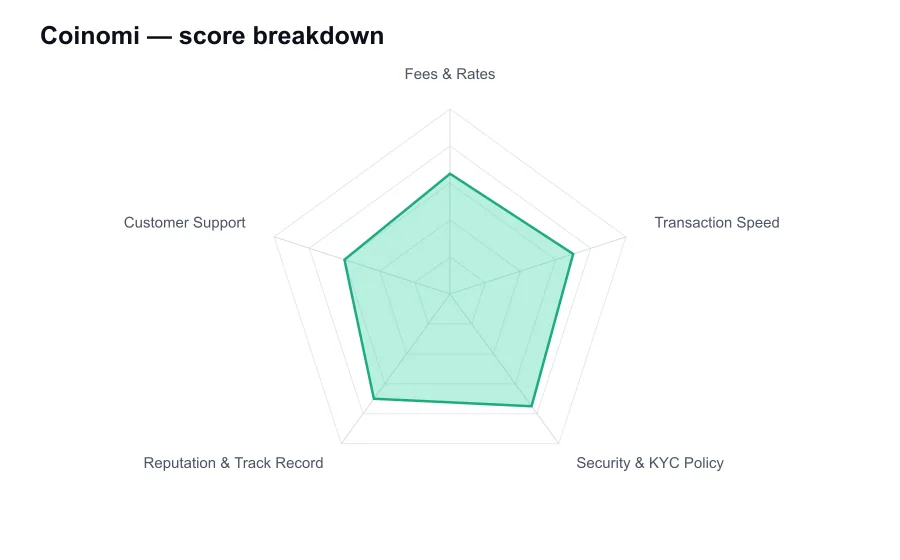
Coinomi scores 6.9/10 overall in our independent review, measured against every other provider we've compared, strongest on Security & KYC Policy (7.5/10) and weakest on Customer Support (6.0/10).
6.9/10 How we score →Editorial independence: our scores and rankings are produced using the fixed criteria above and are not influenced by advertisers. This is an independent ranking site and is not operated by, or affiliated with, any provider we list.
Affiliate disclosure: some links on this page may earn us a commission at no extra cost to you. This does not affect our rankings.
Coinomi is primarily a noncustodial cryptocurrency wallet, not a conventional exchange. That distinction should shape every expectation. Coinomi gives users control of their recovery phrase and private keys, supports a broad range of networks and assets, and includes access to third party swap and purchase services. It does not operate like Coinbase or Kraken, where a central company holds a customer balance and matches trades in its own order book.
The wallet has been around since 2014 and became well known for supporting a long list of coins long before multi chain wallets became standard. It is available across mobile and desktop environments, and its appeal is obvious to people with a mixed portfolio. Rather than maintaining separate applications for Bitcoin, Ethereum tokens, and several smaller chains, a user can manage many assets from one interface.
That convenience comes with a basic responsibility that cannot be delegated. Coinomi is noncustodial, so losing the recovery phrase can mean permanently losing access to the wallet. Coinomi support cannot reset it, reverse a confirmed blockchain payment, or restore a device that was set up without a properly backed up seed. New users sometimes treat noncustodial wallets like online banking. They are not. The customer, not the provider, holds the final recovery mechanism.
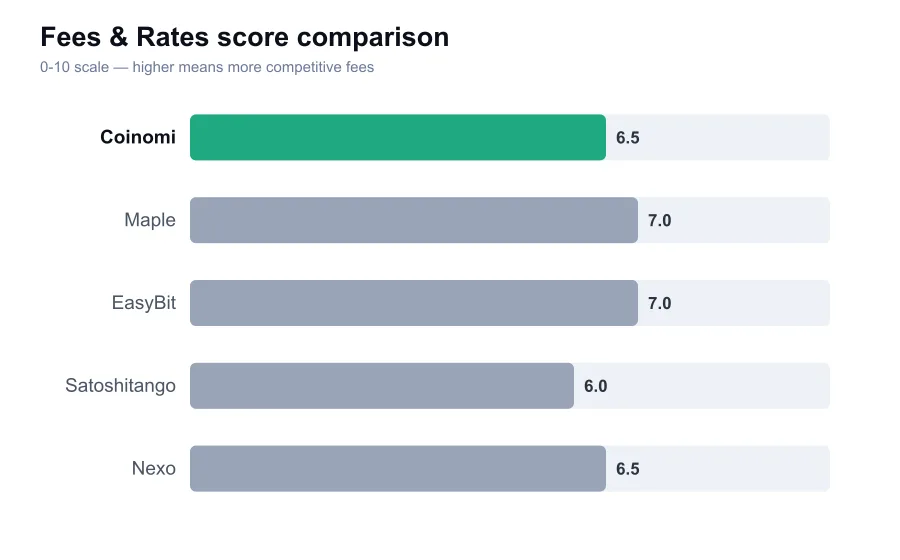
Fees need careful explanation because saying Coinomi has no fee is only half true. Creating and holding wallets does not generally carry a Coinomi custody fee. Sending assets requires a network fee, which goes to miners or validators, not to Coinomi. The amount depends on the chain and current congestion. Bitcoin and Ethereum can become expensive at busy times, while networks with lower transaction costs can be much cheaper.
The more complicated cost appears in the wallet's built in exchange function. Coinomi connects users to third party swap providers, and the final quote can include a provider fee and a spread. Coinomi may receive compensation from partners, depending on the route. The important figure is not a marketing claim about low fees. It is how much crypto actually arrives compared with a live market price and what a liquid exchange would have delivered.
For a small emergency conversion, the integrated swap is convenient. You can exchange assets without moving through multiple applications, opening a centralised exchange account, and waiting for a bank transfer. For a large or repeated conversion, that convenience can be expensive. Compare the all in quote with a specialist swap service and a major exchange. A few percentage points of poor execution can matter far more than the on chain fee displayed before the transaction.
Speed depends on what users are doing. Opening the wallet and generating addresses is immediate. Standard blockchain transfers take as long as the network takes, plus any fee related queue time. A Bitcoin payment might gain its first confirmation in roughly ten minutes under normal conditions, though that is never guaranteed. An Ethereum or other network transfer can be quicker, but congestion, gas settings, and token contract behaviour all change the result.
Built in swaps introduce a second layer of waiting. The customer sends one asset to a partner, the partner waits for confirmations, executes the conversion, then sends the output. A quick swap may finish within minutes, while an illiquid pair, a busy chain, or a compliance review can take far longer. Coinomi cannot promise the same speed as a direct wallet transfer because it does not control every party in that process.
Coinomi's security model is strong in the way that matters most to self custody advocates: keys stay on the user's device rather than in a central exchange hot wallet. It supports a recovery phrase and local encryption, and users can protect a device with a strong password and biometric controls where their operating system permits. That substantially reduces exposure to a centralised exchange failure or a mass withdrawal freeze.
It does not eliminate risk. A malicious browser extension, copied seed phrase, compromised phone backup, fake Coinomi download, or phishing page can defeat excellent wallet architecture. Never enter a recovery phrase into a website, cloud form, or chat. Download the software only from Coinomi's official channels, verify addresses on the device before sending, and keep the seed offline. A hardware wallet can offer a stronger signing environment for people holding substantial value.
Coinomi has faced security scrutiny in the past, including a 2019 vulnerability report concerning a desktop wallet seed phrase being transmitted to a spell check service under certain conditions. Coinomi said it addressed the issue quickly. The episode is a useful reminder that noncustodial software deserves scrutiny, updates, and independent research, not blind loyalty. A wallet's age is valuable, but it is not a substitute for secure user habits or ongoing development.
There is no routine KYC requirement merely to create and use a Coinomi wallet. That is one of its genuine attractions. The wallet itself does not need your passport to generate addresses or receive crypto. KYC can still appear when a user chooses a third party fiat purchase provider or swap partner, because those services operate under their own legal and compliance rules. Coinomi cannot make those external obligations disappear.
The support experience is appropriate for software, not concierge financial service. Coinomi provides guides, a knowledge base, and support contact routes, but it cannot reverse blockchain finality and should not be expected to diagnose every partner transaction instantly. Users with a swap problem need to preserve transaction IDs, addresses, and the partner reference. Complaints about slow swaps often stem from confusion about whether Coinomi or the external exchange provider controls the transaction.
Reputation is respectable but not spotless. Coinomi has survived many crypto cycles and remains one of the better known multi asset wallet brands. It has never had the institutional standing of hardware wallet makers such as Ledger or Trezor, and its enormous asset support can make the interface feel busy. Still, the core proposition remains sound for users who understand self custody and don't mistake a wallet aggregator for a cheap exchange.
I like Coinomi best as a practical multi chain wallet for modest to medium self managed balances, particularly for users who want broad asset support without opening an exchange account for every network. I would not use its built in swap tool blindly for large trades, and I would not store life changing wealth on a general purpose phone wallet. Use it for the wallet function, compare partner quotes, protect the recovery phrase like the master key it is, and it does its job well.
| Criterion | Score (0-10) | Notes |
|---|---|---|
| Fees & Rates | 6.5 | Wallet use is free, swap quotes can be costly |
| Transaction Speed | 7.0 | Direct transfers follow network confirmation times |
| Security & KYC Policy | 7.5 | Noncustodial keys, but user security is essential |
| Reputation & Track Record | 7.0 | Established multi chain wallet since 2014 |
| Customer Support | 6.0 | Useful guides, limited control over partner swaps |
| Pros | Cons |
|---|
Coinomi does not generally charge a wallet fee to receive crypto. Sending requires the relevant blockchain network fee, which varies with the network and congestion.
Creating and using the noncustodial wallet does not normally require KYC. Third party buy and swap partners may require verification under their own rules.
Only if you have the recovery phrase. Restore it on a trusted device. Without that phrase, Coinomi cannot recover access to a noncustodial wallet.
No. They depend on the source network confirmations, the external swap provider, liquidity, and the destination network. Times can range from minutes to much longer.
| Alternative | Score |
|---|---|
| Maple Review | 6.9/10 |
| EasyBit Review | 6.9/10 |
| Satoshitango Review | 6.9/10 |
| Nexo Review | 6.9/10 |
| Changelly Review | 7.0/10 |
| Alfacash Review | 6.8/10 |